Ep.19: The Fifty-Ring Circus
Remember, you can always listen here or follow us on Apple Podcasts or Spotify. Either way, thanks for supporting us.
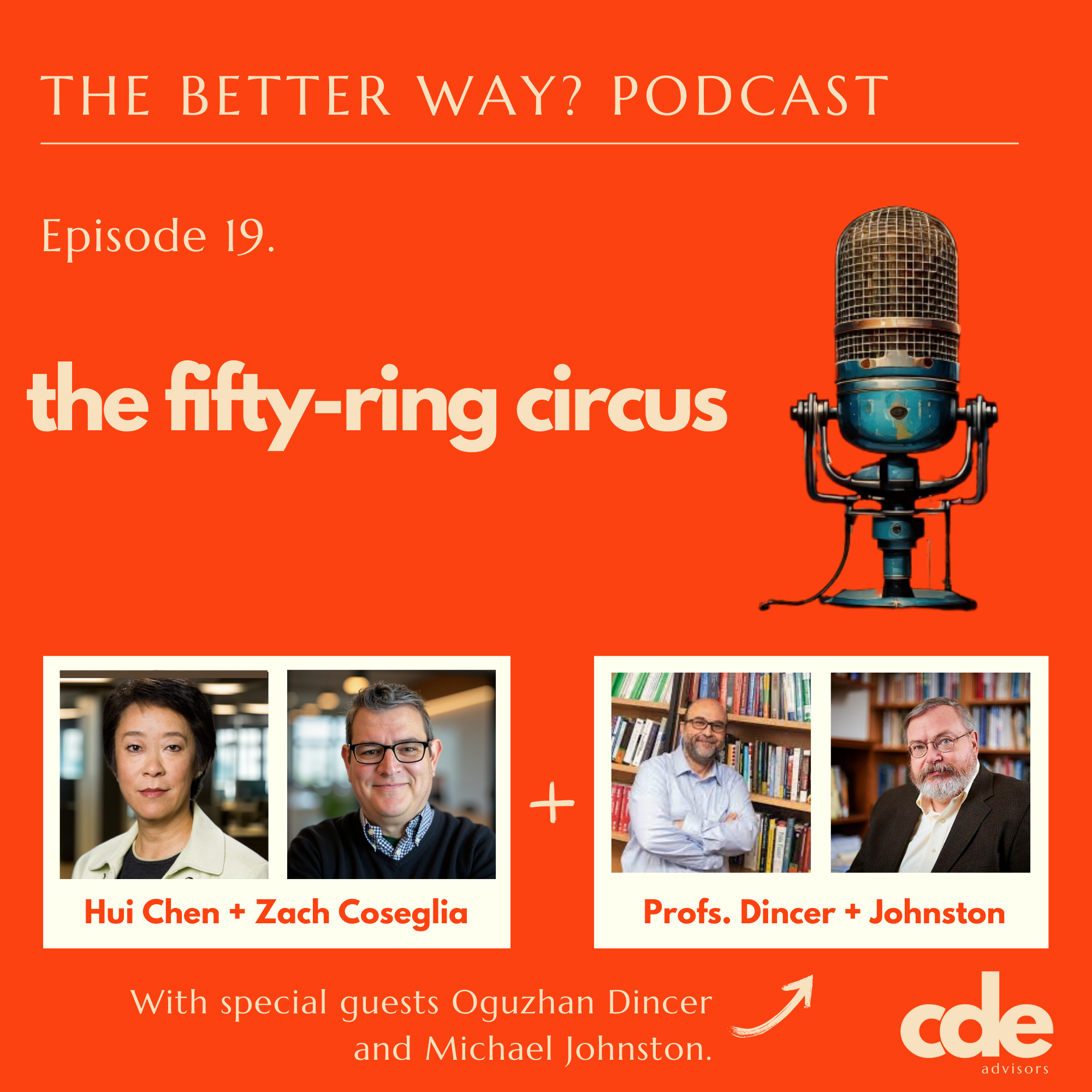
About this episode. In this episode of The Better Way?, Zach and Hui unpack the complexities of corruption with Professors Oguzhan Dincer and Michael Johnston, authors of Corruption in America: A Fifty-Ring Circus. They explore why corruption is not a simple crime—but instead, a deeply entrenched phenomenon with long-term consequences for democracy, development, and institutional trust.
You’ll hear why defining corruption is harder than you think, how campaign finance and lobbying create a race to the bottom, and what our guests’ five-year survey of political reporters uncovered about corruption right here at home. Plus, practical advice for those who want to fight back—not just by checking compliance boxes, but by demanding accountability and informed participation. By the end, you’ll see corruption not as a distant problem, but as a challenge we all have a stake in solving.
Who? Zach Coseglia + Hui Chen, CDE Advisors; Prof. Oguzhan Dincer, Illinois State University; and Prof. Michael Johnston, Colgate University
Full Transcript:
ZACH: Welcome back to The Better Way? Podcast brought to you by CDE Advisors. Culture. Data. Ethics. This is a curiosity podcast for those who ask, “There has to be a better way, right? There just has to be.” I'm Zach Coseglia, and I am joined as always by the incorporable, Hui Chen. Welcome, Hui.
HUI: Thank you so much, Zach. Hello, everyone. We have two very distinguished guests with us today. We have Professor Oz Dincer, who is a Professor of Economics and the Director of the Institute of Corruption Studies at the Illinois State University, and Professor Michael Johnston, Emeritus Charles A. Dana, Professor of Political Science at Colgate University. We are here today to talk about the recent book they coauthored, Corruption in America: A Fifty-Ring Circus.
ZACH: Welcome to The Better Way?
PROF. JOHNSTON: Thank you very much.
PROF. DINCER: Hello!
ZACH: Very happy to have you. I'll ask you the same question that I ask all of our guests, which is, we just heard a very brief intro about who you are, but I'd like each of you to introduce yourselves personally. Who are you? So, Professor Dincer. Why don't we start with you? Who is Oguzhan Dincer?
PROF. DINCER: Thank you. I'm Turkish. I'm Turkish American, sorry. I came to US in 1998. I did my PhD here at the University of Oregon. Before that, I worked for the Turkish government. I worked for the banking industry in Turkey. Then I decided to be an academic basically. And then I came to US, did my PhD, and the second year of my PhD program, I took this labor economics class. It's not related to corruption, but then when I was reading this paper on efficiency of wage hypothesis, I said “okay, you know, if you pay these guys more money, maybe they won't steal.” Then I start getting into this corruption literature and since I guess the year 2000, I've been reading and writing about corruption.
ZACH: Amazing. And we're going to dive deep, so stay tuned. Professor Johnston, who are you? Tell us a little bit more about yourself.
PROF. JOHNSTON: Well, I am an aging academician, grew up in a working class family in Iowa in a small village, and I got fascinated with corruption in the dying days of the Nixon administration, which gives me now about half a century of trying to get it right. I don't know that I have, but I've benefited immensely from working with Professor Dincer since, I guess it was 2012, and a lot of good things have flowed from that. My engagement with the international anti-corruption movement has been sort of up and down. An enthusiastic supporter and at the same time increasingly dismayed about how it seems to be going round and round the same circles and not getting very much done.
ZACH: One of the things we talk about quite a bit in this space is sort of how we got on the path that we're on. I'd love for each of you to just say a little bit more about what it was that drew you to corruption as a topic of study and inquiry. So, Professor Johnson, why don't we start with you? The latter days of the Nixon administration seem like a perfect time to get interested in this topic.
PROF. JOHNSTON: You had the Prince of Darkness who was presiding over things and raising questions about literally, what are the bounds of power to whom our officials are accountable? At the time, I had been working on my doctoral dissertation, which was on ethnic politics in New Haven, and there was a political machines piece to that patronage politics. And so, I began to wonder how those meanings of corruption did and did not overlap. And about that same time, I read Jim Scott's book, Comparative Political Corruption, and that sort of set me off either up or down that path, depending upon how you choose to think about it ever since.
ZACH: And what about you, Professor Dincer? What drew you to it from the perspective of an economist, right?
PROF. DINCER: Yeah. I mean to me it's . . . I mean, I don't see corruption as a like this simple crime because it has these nasty long-term consequences. You know, when you look at all these developing nations, some of these countries have been developing over the last 50 years they've never developed yet. So you know, you start asking this question to yourselves. So why are they not developed yet? That's what fascinates me, this long-term consequences and this stickiness of the issue. And I mean as a Turkish American, you know when I . . . If you look at Turkey's pattern over the last, say, 100 years, it's been getting more corrupt, more corrupt every day, and it is still a developing country. Although we have the industrial infrastructure, we have the human capital, we have the physical capital, we still have not developed yet. And that is, I think, one of the main reasons. And that's what fascinates me. And why is it sticky? Why can't we get rid of this thing, right? Because, you know, when you become corrupt, you stay corrupt, for ages, really. That's the main thing, I think for me.
HUI: Okay, so I find that fascinating because one of the things we always like to do when we start our discussion on these podcasts is to define terms right from the outset. But as your book has illustrated, corruption is a sticky phenomenon and a complex concept to define. Talk to us about the complexities of trying to define corruption. Why is this so hard?
PROF. JOHNSTON: I would maybe, if I may start with the Transparency International definition as the abuse of entrusted power for private gain. And there are several—that sounds persuasive—but there are several things wrong with it. One is that it focuses upon behavior specific actions as though there were a bright line boundary around what is and is not corrupt behavior, first of all. Those boundaries shift a great deal. It posits a sort of clear-cut distinction between public and private domains when in fact, if we've seen nothing else in the past half century, it's been that those boundaries have been shifted and have been in some cases obliterated…and the abuse of entrusted power. Well, in many of the countries that Professor Dincer mentioned and in many others, perhaps, you know, closer to where I sit today, power has been stolen. It's been bought. It's been seized at gunpoint. It has been inherited. In other words, it's been anything but entrusted. And defining the phenomenon in terms of entrusted power is to impose a liberal democratic frame upon a problem that just doesn't fit for billions of people around the world.
So those are some of the problems that I have. I see corruption not as a category of behavior, but as a bundle of issues about the limits of wealth, power, how they may be used, exchanged, pursued. This is your typical academician taking what looks simple to most people and fuzzing the issue rather dramatically, but for better or worse, that's how I see it.
ZACH: You're among friends when it comes to taking concepts that others may seem or perceive as being fairly simple and really breaking them up. What about you, Professor Dincer? How would you define corruption or what challenges do you see with trying to come up with a definition?
PROF. DINCER: I mean, just one definition is really . . . I mean you can broadly define the issue, but you have types of corruption, forms of corruption, in different contexts it changes. That's why in the book we try to define corruption. We come up with two different definitions, one illegal corruption, and one legal corruption. But there's also different types of corruption, like grand corruption versus petty corruption. We can't really bundle that in one definition of, you know, use of public office for private gain. This is just the most common definition. This is kind of the easy way out. But I think like what Michael said, to fight with corruption, we have to have clear definitions of which type of corruption are we fighting. We have to come up with that first, right? And we cannot . . . okay, let's fight corruption. You can't do that, right? So, what is the issue that you're fighting with? Which corruption are you fighting with, I guess?
ZACH: There are two phrases that you introduced just then, Professor Dincer, which was legal corruption versus illegal corruption. So why don't we start there and sort of talking about different types of corruption? Help us understand what you mean by that, because I think that's a sort of way of looking at it that might be new to a lot of our listeners.
PROF. JOHNSTON: One of the best things about our partnership is we've had to think this through and rethink it multiple times over the years. But just take a couple of American examples, if I may. If you ask people what corruption goes on in the US, you get are a couple of answers, campaign finance and lobbying. Now both of those are not only legal, they are protected constitutionally by the 1st Amendment. There are many other kinds of behavior that either are legal or don't clearly break any laws, but nonetheless serve, as a very good political scientist named Mark Warren put it, to exclude people from their role as citizens—exclude people from decisions that affect their lives. And so we look at a variety of activities that add to inequality, add to distrust, undermine accountability, and undermine the common framework of values and assumptions that a democracy needs. Those are exceedingly fragile, and it's possible to damage those in ways that are legal, illegal and in very much in a gray area.
PROF. DINCER: The problem in the United States, I think, I mean, if you ask people, I think majority of the people in the United States, they hate lobbyists. They hate to hear this word lobbying, right? We need to clarify this. We do need lobbyists. We do need lobbying as an activity because lobbyists actually educate the legislators. We can't expect a legislator to know about everything they vote on. But the problem in the US is access to this particular politician. So, when it comes to accessing the politician to educate them or to inform them about the issues, the system in the United States is lopsided. So, whoever has the money, they have access to the politician, they have access to the legislator. That actually creates this corrupt environment. So, because, you know I'm an economist, so I'm pretty cynical when it when I look at politics in general. You know, when I see a politician, I think his first purpose is to be re-elected. That's how I see them. So, because his first purpose is to be reelected, he's going to vote accordingly. Where else is campaign money coming from? The lobbyists or the special interest groups who support them. So you can't expect that politician to vote freely on any issue. That's what's behind this term, legal corruption. And that was not really studied in depth before Michael and I started doing this, as far as I know.
HUI: In your book, you cited a couple of interesting studies. There is the, I hope I'm pronouncing this right, Masiere and de Souza study, and you also did a study on perceptions of the people in the US about corruption. Can you tell us a little bit about both of those studies?
PROF. DINCER: Yes, de Souza study, Masiere and de Souza. They looked at Euro barometer surveys I think, and in those surveys they asked about how legal corruption exists or not. So they have these survey questions on, you know, do you believe democratic institutions work in your country? Do you believe your voices are heard? And all these several questions paraphrased differently. And then the statistical study, came up with an index of legal corruption in EU countries just for one year.
Our index is quite different. They didn't have a . . . like Masiere and de Souza, they did not survey the people themselves. They did not ask direct questions on legal corruption versus something else. They came up with the legal corruption index based on a bunch of different questions. We on the other hand, we gave a clear-cut definition of legal corruption and illegal corruption. We surveyed political reporters and investigative reporters in each state directly and we asked about their perceptions. So, that's a very big difference between our two studies. And we conducted our survey for five years until the COVID hit. So, between 2014 and 2018 and then we paused after COVID and then we haven't started yet, but we're thinking about it. So, we have five years of data across 49 states—we couldn't find a reporter to respond in North Dakota. So, except North Dakota, we have response from every state.
HUI : Interesting.
PROF. DINCER: I think only two reporters in North Dakota covering politics and one of them was an Associate Press reporter and Associate Press as an institution said we don't do that. We don't respond to surveys and the other reporters simply did not respond. But we came up with a survey-based measure of both illegal and legal corruption and we also did it for three branches of government, legislative, judicial and executive.
ZACH: I'm curious about the decision to survey journalists. Help us understand sort of the motivation, the why behind that.
PROF. DINCER: Most of the surveys, they just survey people. They ask about, you know, do you think your country is corrupt? Do you think your city is corrupt? So and so forth. But people's perceptions are based on what they hear from the news. So our idea was, why don't we go directly the source? Why don't we go to the reporters who actually are the watchdogs? Watching these guys 24/7, and all year. So we . . . there's a study done before us. They surveyed, I think late 90s. They surveyed only the Associated Press reporters. They asked about lobbying activities with a couple of questions on mostly illegal corruption. We got the idea from them, and then we surveyed roughly 1,000 reporters each year. Our response rate was about 35% to 40%.
ZACH: What was the primary endpoint or what was the question that you were ultimately trying to answer through your study? And then we'll talk about what you actually found. But what was the question you were asking?
PROF. JOHNSTON: There are a couple of important sort of broader considerations. One is that we really can't measure corruption directly. It's secretive. The definition is fuzzy, at best. It's a matter of opinion. “I'm a fine upstanding lobbyist who's trying to educate my constituents. That guy over there is a corrupt influence trader.” You know, it's very hard to do. But one thing the book does, and here's where Professor Dincer's methodology really came in handy, is it uses three different kinds of proxy measures of corruption to triangulate in. And there is a lot of consistency among them and at the same time some important divergences. I mean, we were able, among other things, to compare the relationship of legal to illegal corruption among the branches across the states, across five years. And you know, nobody has ever done that. And I give full credit to Professor Dincer and his institute for getting that done. So you know, what we're doing is not trying to come up with yet another number. One number for a whole country, especially a big one, is a very problematical kind of thing. So what we're getting are several different indications. And so the questions that were asked, I think one of the strong points, we used very specific definitions of legal and illegal corruption. You know, not do you think North Dakota is corrupt, but rather what kinds of deals are made legally, what kinds of deals are made illegally? That I think drew out some important kinds of kinds of contrasts. So the notion is not, here's a number, but rather here's a dilemma across the states in different ways in relationship to different policy areas that we all need to attend to.
HUI: So we definitely want to come back to talk more about measuring corruption because that’s another thing we love to do here is measuring. Before we leave the topic of the two studies that you mentioned, tell us briefly about what the finding of those two studies—both the de Souza study and your study, the EU and the US.
PROF. DINCER : De Souza study: they came up with the legal corruption measure and then they did an empirical study on people's trust in democracy and so on and so forth. They say higher the legal corruption, lower the trust in democracy. And that was it. We did something more in depth when we came up with our measures, then we did a deep dive in causes and consequences of corruption across 50 U.S. states over the five years. So our measure passes the smell test. When you rank the states, you're going to see Louisiana, you're going to see New Jersey, you're going to see Illinois, you're going to see New York as the most corrupt state and you know you don't see Vermont somewhere up there, right? So that passes the smell test and that when you do the empirical analysis looking at causes and consequences with our measure the data generally support the theory.
ZACH: Let's actually go past ranking and talk about some of the more nuanced observations and findings from some of your research. And let's start with what you call the determinants of corruption in America and walk through some of them. Let's start with political variables. What does your research tell us about political variables when it comes to corruption?
PROF. DINCER: I kind of want to focus on the voter participation, which is quite important to me. Because I think if you're going to really try to solve this issue. It has to come from the bottom. It has to be bottom up, so we have to demand cleanliness. One reason is you cannot fight with corruption by policing only. You know, convicting a corrupt government official is very difficult and it's very, very expensive. The typical example that I give all the time is Rod Blagojevich. Former Illinois governor. He tried to sell Obama's Senate seat and FBI was wiretapping his phone. He got caught. He got caught on tape trying to sell President Obama's Senate seat, and the first trial ended with mistrial because one jury member did not think he was guilty. So he has to go to a second trial and it lasted a few years. The cost estimates range from $5 million to $30 million. Yeah, so we don't know which one it is, but the minimum 5, maximum 30 million bucks. So it's expensive, it is difficult. So we have to vote them out if we think they're corrupt. So, voter participation is crucial here. But I think our most interesting result is voter’s participation is not enough. It's not sufficient. Voters have to be informed. And we found corruption goes down if media covers it well and if voters go to the voting booth. Otherwise corruption goes up. So, if there is not enough media coverage, voter participation actually may increase corruption because you can actually buy the votes, especially at the local level. Voter participation is very low, some big cities, it's like 10%. I think it was in last mayoral election, it was in Dallas, it was about 10%, 15%. In Chicago, it was about 30%. So you can buy the votes if you want to be a mayor of a big city in the United States or in the state legislatures. It's the same thing. So the main political variable that I focused on was that, and the second was the term limits. Maybe Michael want to say something about that or I can continue. I mean, I feel like I'm talking too much.
ZACH: Yeah, I'd love to hear more about term limits, cause I always and I often on this space, actually talk about make comparisons to the TV show The West Wing, which is one of my favorite shows. And there's a famous line on The West Wing where President Bartlett says “it turns out we do have term limits in this country. They're called elections.” Tell us what you found in your research.
PROF. JOHNSTON: I always told my students, two things. One, term limits are a kind of a solution in search of a problem. I mean, if you want to get rid of somebody, you know you can vote her or him out. It's not easy to do, but it can be done. And as Professor Dincer mentioned, the compelling incentive is to get re-elected. And so, if you put a significant threat to that or question mark over that, then the door may be open to changing some behavior. But term limits are not the fix of the fix for corruption. If you have somebody who's good in office, who's doing a fine job of fighting corruption and they have to leave, what good have we done? Mexico just to the South of where I sit at the moment is a paradise of term limits and I don't think anybody with due respect would claim that Mexico is an anti-corruption exemplar. In fact, in many presidential administrations, there are six years in Mexico. It's the last year of the administration, or maybe the second last year of the administration, corruption just goes wild. That could happen with people leaving office in the US with term limits too. You know, why don't I just take the money and run? Term limits, I think, are an attempt to have our laws do our job for us as citizens. And I mean, I hear I'm an unapologetic idealist. It's up to us to govern ourselves in this idealistic view. And just in putting in place a law that takes away from us the obligation to make an intelligent choice strikes me as futile. There's more to be said than I can get off this soapbox. But term limits, you know, 80% and 90% majority support term limits. I'm not persuaded.
ZACH: Let's talk about the demographic variables moving past the political ones. Talk to us about what your research shows around gender equality or gender diversity among legislatures and how that has an impact on perceptions of corruption.
PROF. DINCER: That's kind of interesting because there are a lot . . . there's some experimental studies showing that women are more trustworthy. They are more honest. So there are a couple of studies, interesting papers looking at how you know the percentage of female legislators, how it affects corruption at the country level. So, we decided the same thing at the state level, and we found that if there's a female governor, the corruption is likely to be lower. If there are more female legislators, again, the corruption is likely to be lower. I mean, there's no . . . I don't see a big theoretic . . . big theory behind it, really. This is more . . . I see more of an empirical question—and our results confirm the cross-country studies and some experimental studies really. So, we have more female legislators. We have more female politicians. We have less corruption.
PROF. JOHNSTON: In one sense, some of those demographic variables that you're talking about are political. I mean, one thing we looked at is an old and long-standing typology of the state's political cultures. And this goes back to work done by a fellow named Daniel Elazar in the 1950s, 60s and 70s. And it makes a kind of intuitive stance, still. Politics in Illinois has a different flavor from what it has in Minnesota, where I went to college. In Minnesota, there was a school board candidate in Minneapolis who took Kool-Aid and Hostess HoHos out to a senior citizen center one morning for a meet and greet and found himself in court and convicted for buying votes. Because in Minnesota you're not supposed to exchange anything of value for a vote. That sort of principle is on the books everywhere, but in Minnesota it really counted. So these kinds of political culture differences are important and the gender equality aspect, I mean, I would want to look much more at this, but my sense is that that's part of a larger commitment toward openness toward a, you know, public spirited view of the political arena as well as one having to do with gender fairness. Now Professor Dincer probably has better data on that than I do, but it shows how the political and the demographic and the cultural, frankly overlap and interlock.
ZACH: Well, let's round out the determinants of corruption by talking just a little bit more about economic variables and tell us, similarly, some of what you've seen around income equality from your research, what correlations you see there that might be interesting for us to explore more based on what you have seen.
PROF. DINCER: There's a chicken and egg relationship when it comes to corruption and income inequality. So, income inequality causes corruption, but corruption also causes income inequality. So, if there's a huge income gap within the society, then it will certainly impact how the politicians will behave. So high income inequality causes more corruption. On the other hand, if there is corruption, you see more income inequality, mainly because low-income individuals in any society, they are the ones who rely upon the publicly provided services. In corrupt societies, both the quality and the quantity of publicly provided services go down, so they are going to be the ones who are most affected. So, when you talk about upward mobility, so if you're born to a poor family, what are the opportunities you get to go up? If you don't have access to healthcare, you don't have access to education, you don't have access to social services it's almost impossible for you to actually succeed in life. So you are stuck in the income group that you're born into. So corruption has this nasty negative impact on income distribution and on poverty, and we see it on the racial level as well. So when we looked at impact of corruption on the number of deaths during COVID, blacks versus whites. We saw in more corrupt states there are more black dying, or even police killings of black Americans. We see the same impact again. More corrupt states, there are more police killings of black Americans.
When you start talking about inequality, it's not only income. I want to also talk about decentralization. We're living in this country where it's very decentralized, both politically and economically. So, local governments have a lot of power, both power to tax and power to spend. So, when you talk about decentralization, it's like a double-edged sword. It can be bad or it can be good. Because if you give a lot of power to local politicians, they are very familiar with the areas that they can actually manipulate, they can actually corrupt. On the other hand, if you have a corrupt government, if you're living in a decentralized society, you can identify your government is corrupt by simply looking at the next city. So, you can simply move. So that gives an incentive for local politicians to behave. But what we found in the US, we use several different decentralization measures and we're reporting only one in the book, but it's supported by other measures as well: decentralization actually lowers corruption in the United States.
HUI: So I have this untested theory that local government is inherently corrupt because . . . and I will frame it by saying that I was raised in New Jersey and now live in Hawaii. So you're . . . you have some appreciation. So certainly people in Hawaii, it's not that easy for people to just get up and leave. But despite that, many of them have left because of the lack of economic good job opportunities in the state. But the reason why I think they're inherently corrupt is, I think in any whether it's in a less populous state or in a big city, the number and types of people who are drawn to local politics is very limited. And from that limited circle you create this, I scratch your back and you'll scratch mine type of mentality. I'm curious as to what your thoughts on my theory might be.
PROF. JOHNSTON: Sounds good to me. Seriously, you know, for years and years and years of survey data asking about corruption at the federal, state and local level. And people have said, “oh, Washington is hopelessly corrupt, state capital not so good. My local government has very little corruption.” That’s nonsense for a variety of reasons. I mean, one is that at the local level, the ladder from the street corner up to a position of at least moderate influence is pretty short. And at local level, too, you have the kind of friends and neighbors face to face. You know, let's all scratch each other’s backs, as you put it, kind of thing going on. Now, this is not to say that that Washington is this shining example of integrity, especially lately. I don't perhaps want to get too partisan about it, but we've seen a lot of contrary evidence. But the localities in particular, like decentralization in general, decentralization might break up official power over what goes on at the grassroots. But it might also open 1000 doors in any given community to one kind of influence or another, one kind of connection or another. So I'm on your side when you compare levels of government.
PROF. DINCER: I think the biggest problem when it comes to local governments is, the local press is dying. Local media is dying.
HUI: Right, yes.
PROF. DINCER: So, there is nobody reporting happening in what's happening in city halls. So even at the state level, we see this . . . like when we conducted this survey, our survey, I noticed that most of the . . . I identify most of the reporters by following their Twitter accounts. So I was, you know, updating my list and I saw this reporter. She was this great political reporter doing this in Miami for years. She became a real estate agent.
HUI: Wow.
PROF. JOHNSTON: Yeah.
PROF. DINCER: Because, yeah, Miami Herald, they just fired a bunch of reporters from their newsroom. What can you do? So this is one of the biggest newspapers in Florida, in Miami. Now think about at the more local level. Like in Chicago, we have Chicago Tribune and Chicago Sun Times . . . they were almost going to go shut down, but luckily, they survived. But I think there's only one reporter covering the City Hall in Chicago now. There are maybe a handful of reporters covering the state sessions in Springfield. It's dying. If people don't know what's happening in their county governments, in their city governments, in their state governments, politicians, they will act like kids in a candy store. They're going to do everything. And that's one of the main problems in the local governments today, because we really don't know. I mean, I ask people, you know, what is the last time you voted for the school board elections? A lot of people say, “no, I never vote on those elections.” I mean, we don't even vote for the mayoral elections in Chicago, for God's sake. Like I said, it was about 35%. Rob Blagoevich: everybody knew he was corrupt. He ran for the second term. The voter participation rate was about 45%. Half of the people didn't care. And at the local level it's even worse.
PROF. JOHNSTON: And there's even empirical evidence for this in terms of quality of local government financial management in cities where a newspaper has died. There's evidence that the quality of financial management and see this in terms of tax rate of deficit spending, I mean of monitoring of spending in a variety of specific indicators, they deteriorate. And deteriorate markedly once a newspaper dies. I mean, there's this notion citizens don't know, and those thieves in that candy store have less reason to think anybody's watching.
HUI: So you argue in the book that the way forward is to begin with understanding the fundamental problems corruption reflects and embody. The imbalance of power that allowed the few to exploit and abuse the many. You also mentioned other ideas like compiling and publishing indicators and benchmarks of essential services, public accountability data. We would like to ask you if you have specific advice for a lot of those are in our listening audience who work in the corporate world, both in the US and abroad, who want to fight corruption. What are some of the things that we should be doing?
PROF. JOHNSTON: My advice, I guess I would sum it up by saying raise your sights, look beyond your balance sheet, look beyond the next quarter, look at the broader public, both consequences and sources of support for your corporate entity and realize that what might be an explicit and easy solution for something in the short term might build in considerable harm in the long term. So, think in terms of those longer-term kinds of considerations and don't reduce fighting corruption simply to questions of compliance. There's a lot of this going on, especially internationally for business, you know, and it's a fine thing, but it turns anti-corruption efforts into sort of a box checking exercise. We did this, we did that, and we did the other thing. We're in compliance. You know, see you later. Take a look at those broader values that they all claim to serve in their mission statements. Ask what they might mean, and ask whether you're advancing them today and on down the road.
ZACH: This is the part in the transcript where it says in italics “Zach and Hui nod vigorously in agreement” with what you just said.
HUI: Agree. Well, let me pose. I promise my last question, which is what if those bribes that you pay are legal? So let's forget talking about the other countries. We're now back to your book focusing on the United States. Yes, you can pay that lobbyist to get your company's point of view to that senator who has the vote, what do you do?
PROF. DINCER: I think you have the same problem. It's a race to the bottom. There's always going to be another company hiring a more expensive lobbyist. So, you have to solve this issue. You will be losing money.
HUI: Yeah.
PROF. JOHNSTON: Yeah, you're gaining in the short run, but in the long run, you may be really penalizing yourself. There'll be another company who'll pay a bigger contribution, or they'll put a couple of, you know, junior lawyers in your office and write the bill for you. I mean, there are just all sorts of ways that race to the bottom can get very intense.
ZACH: Yeah. It's a theme that we've talked actually quite a lot about and that is, who do you want to be? Who do you want people to perceive you as? What do you want your actions to say about what your company really is, which apply just as much on the legal side as it does on the on the illegal side. All right, we have just a few minutes left, so it's time for The Better Way? questionnaire. This is another opportunity for us to just dig in and get to know you even better beyond just your professional world and your publications. This is rapid fire, so Hui's going to start with the odds and I'll ask the evens and we'll get to know you better. Hui.
HUI: So, choose from one of two. If you could wake up tomorrow having gained any one quality or ability, what would it be? Or you can answer, is there a quality about yourself that you're currently working to improve? If so, what?
PROF. JOHNSTON: I would like to lose weight and have my knees hurt less. In terms of a quality, I would like to retain my concentration, my ability to read, my ability to write. I'm at an age where sometimes you can't take those for granted, so I would hope to keep them going.
PROF. DINCER: I need to be more organized. I'm awful. I'm so disorganized. I mean, Michael knows it during the book. So yeah.
ZACH: It's hard to write a book with someone to not learn that.
PROF. JOHNSTON: Hey, we got it done.
PROF. DINCER: And I'm working on it, but I pretty unsuccessful so far.
ZACH: Terrific. All right. Well, all of us probably could work on that a little bit. Question #2, and we'll start with you, Professor Dincer, again, choose from one of the following two. Who's your favorite mentor or who do you wish you could be mentored by?
PROF. DINCER: That's my dad, actually. I wish I listened to him more closely and follow his advice more closely, but yeah.
PROF. JOHNSTON: Mm-hmm.
ZACH: That's a great answer. How about you, Professor Johnston?
PROF. JOHNSTON: With respect to mentors, I think I've outlived almost all of them. I shouldn't put it that way, but it would be wonderful to be and I can't. It will be wonderful to be able to go back in time and have some conversations with some of those people and you know, with my parents and say, hey, you know, I know a little bit about how this stuff turns out. What do you think?
HUI: Right. Next question. We'll start with Professor Johnston. What is the best job, paid or unpaid, that you've ever had?
PROF. JOHNSTON: Academic work, teaching and writing both. And I resist any notion that there's a teeter totter relationship between teaching and research. At Colgate University, we had a lot of parents who resented faculty research. But you know, and if I can't do research, what am I supposed to teach? You know the question I ask.
HUI: Great. And Professor Dincer?
PROF. DINCER: We had an awful jazz band when I was in college, but we played in different pubs every weekend in Ankara. We made good money, free booze. It was awesome.
ZACH: That sounds like a really good job. Yeah, that's great. All right. The next question is, what is your favorite thing to do, Professor Dincer?
PROF. DINCER: I'm a huge soccer fan and we also have a soccer podcast. My team in Turkey in Fenerbahçe. After every Fenerbahçe game, we analyze the game. It's like we spend hours on, you know, the tactics and everything. So that's my favorite thing to do, really.
ZACH: Amazing. How fun. I love that. Professor Johnston. What's your favorite thing to do?
PROF. JOHNSTON: My case, my favorite thing is to read, drink cheap wine, watch baseball, and there is a connection between baseball and corruption. I'm a pathological optimist about corruption, and I'm a fan of the Pittsburgh Pirates. So you can see where that takes you.
ZACH: Wow.
HUI: What is your favorite place, Professor Johnston?
PROF. JOHNSTON: I'm lucky enough to be able to say that it's wherever my wife and I are at any given time.
HUI: Oh, that's wonderful. And Professor Dincer?
PROF. DINCER: I taught in New Zealand for three years. That was my first job, and there was this little village called Hahe close to Auckland in North Island. That's my favorite. That's me and my wife, our favorite place there.
HUI: Oh.
ZACH: I'll have to add it to the list. Sounds great. All right. Question number six is what makes you proud? Professor Johnston, why don't we start with you?
PROF. JOHNSTON: Helping others in my field, helping younger people get a foot on the lower rung of the ladder, helping them to avoid some of the obvious mistakes I've made along the way, and then seeing them go on and accomplish things that I would not have been able to think of myself.
PROF. DINCER: I became a father when I was 43 years old. So it's really my daughter, whatever she does makes me proud. I mean, even if she does awful things, it still makes me proud.
HUI: Oh, that's wonderful. So, from the profound to the mundane, what e-mail sign off do you use most often, Professor Dincer?
PROF. DINCER: It's from my New Zealand days. It's always cheers.
ZACH: Okay.
HUI: Okay. Professor Johnston?
PROF. JOHNSTON: It’s cheers.
PROF. DINCER: Yeah.
ZACH: Oh, two cheers. Cheers all around.
HUI: Yes, you cheer each other.
PROF. JOHNSTON: Yeah, it has nothing to do with the cheap wine, but it's just more of a mutual encouragement.
ZACH: Sure. All right, #8. What trend in your field is most overrated? Professor Dincer.
PROF. DINCER: Financial economics. I hate it.
ZACH: Okay, Professor Johnson?
PROF. JOHNSTON: Artificial intelligence.
ZACH: Oh, wow. You just opened up a whole can of worms. We'll have to talk about that another time.
PROF. JOHNSTON: I know. But I mean, I even asked this morning a factual question about I don't remember what and got an answer that was just completely off the wall. I mean, you know, it happens.
ZACH: Oh, it does. It does indeed. All right, Hui, last question.
HUI: Absolutely. Last question, what word would you use to describe your day so far, Professor Johnston?
PROF. JOHNSTON: Peaceful.
HUI: Nice. And Professor Dincer?
PROF. DINCER: Peachy.
HUI: Oh, we've never heard that one before.
PROF. DINCER: Yes.
PROF. JOHNSTON: Hmm.
ZACH: We have not. Cheers to that. Cheers to Peachy. Thank you both so much for joining us. This has been a wonderful discussion. We'd love to have you back and dive even deeper into some of these topics.
HUI: Thank you both so much.
ZACH: And thank you all for tuning in to The Better Way? Podcast. For more information about this or anything else that’s happening with CDE Advisors, visit our website at www.CDEAdvisors.com, where you can also check out the Better Way blog. And please like and subscribe to this series on Apply or Spotify. And, finally, if you have thoughts about what we talked about today, the work we do here at CDE, or just have ideas for Better Ways we should explore, please don’t hesitate to reach out—we’d love to hear from you. Thanks again for listening.