Ep.22: The Art and Discipline of Investigations
Remember, you can always listen here or follow us on Apple Podcasts or Spotify. Either way, thanks for supporting us.
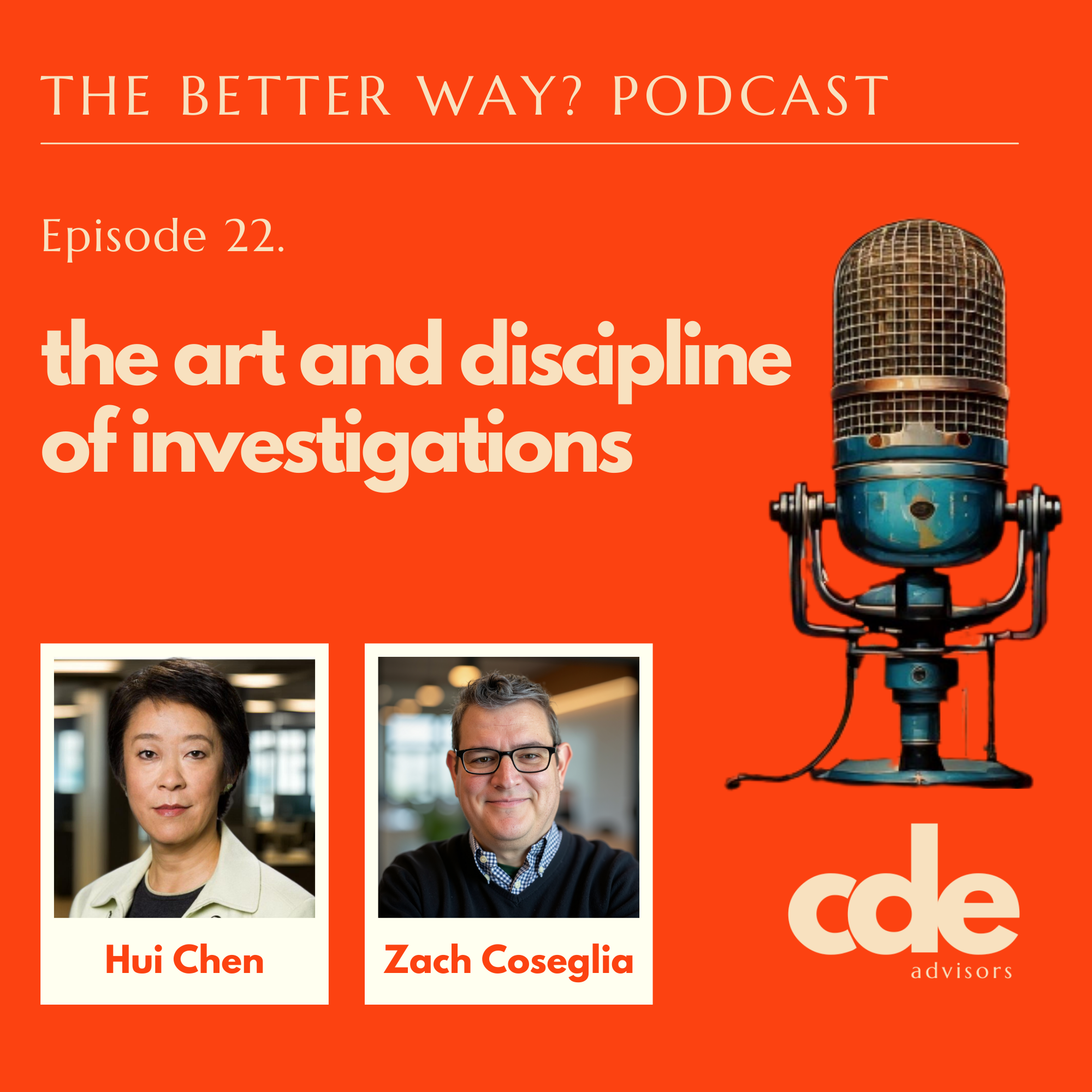
About this episode. Investigations can be rigid, legalistic exercises—but as Zach and Hui remind us, they’re fundamentally human. In this episode, they unpack the viral “Coldplay Kiss Cam” incident as a case study in why rushing to judgment is so dangerous, especially in ethics and compliance. From the purpose of investigations to the importance of withholding conclusions until the facts are in, they explore how curiosity, open‑mindedness, and fairness shape better outcomes for people and organizations alike.
They also break down the practical craft of investigations: who should conduct them, how to triage and scope matters, how to interview effectively, and why planning, documentation, and root cause analysis matter. Whether you're building an investigations program or sharpening your own investigative skills, this episode offers grounded, experience‑driven insights and investigate “better ways."
Who? Zach Coseglia + Hui Chen, CDE Advisors
Full Transcript:
ZACH: Welcome back to The Better Way? Podcast brought to you by CDE Advisors. Culture. Data. Ethics. This is a curiosity podcast, for those who ask, “There has to be a better way, right? There just has to be.” I'm Zach Coseglia and I am joined as always by the one and only, Hui Chen. Hi, Hui.
HUI: Hi Zach. Hello everyone. Welcome back to The Better Way? Podcast.
ZACH: Indeed, we got a fun topic today, one that is special to both of us. What are we going to talk about?
HUI: We're going to talk about investigations, which is something that both you and I started our careers with, and it's something that remains near and dear to our hearts. It's still my very favorite thing to do.
ZACH: Absolutely. And I wanted to start actually with a little bit of storytelling, which is an important part of the investigative process and an important part of our point of view on compliance more generally. So it just seemed appropriate.
HUI: Well, I do think investigation is a form of storytelling.
ZACH: So, here's the story. On July 16th, 2025, at a Coldplay concert near Boston, something unexpected happened. And I'm guessing most of you probably know where this story is going! During a segment of the show where there's a Kiss Cam shown to the audience—this is a camera that goes around the audience and identifies people, sometimes embarrasses them, and oftentimes people kiss to show their affection for each other when they're a couple. That's, I don't know, maybe a US concept? I don't know if that's a global concept, but a little bit of explanation for those who may not be familiar with the concept.
But during the Kiss Cam portion of the show, these two audience members reacted strangely. In fact, when they saw that the camera was on them, they ducked immediately. Now, they had been sort of embracing each other, but when they saw the camera, they ducked out of out of view. We've since learned that the gentleman in the picture—in the Kiss Cam—was a guy named Andy Byron, who was the then CEO of a company called Astronomer, and the woman was named Kristin Cabot. She was their then-Chief People Officer—and both of them were married to other people at the time of the concert. Now, until this night most of us had never heard of Astronomer. But by the next morning, it seemed like everyone, at least in our circles and especially on LinkedIn, were talking about this incident. You know, it was on the news, it was trending on social media, beyond LinkedIn—on mainstream social media. It was the very definition of a viral pop culture meme.
It was also really serious business for the people involved and for their company. Just to give a flavor of what happened—for those who may not remember, may not be familiar. You know, there was widespread speculation about their relationship. There was actually misidentification of another colleague of theirs, or a fellow employee, who had all kinds of accusations hurled at her, even though she wasn't even present. The company immediately announced that they were doing an investigation, which is of course the topic of today's discussion. Both of these folks ultimately resigned or left the company. The swarm descended on these folks and their families, and some of you may even remember that Gwyneth Paltrow weirdly wound up getting brought in to deflect. It was really kind of nuts. Now, in the ethics and compliance circles, I saw this immediately being used as a case study, especially on LinkedIn. It felt, though, like our colleagues were kind of salivating at the salaciousness of this story and the fact that their misconduct, allegedly, was caught on camera. But I was in . . . Hui, you and I have talked about this a lot—I was really disappointed in the community because of the pile on.
Honestly, it feels a little uncomfortable for me to even be talking about it now in this context because of how uncomfortable I felt about the way that so much of our community reacted to it in the moment. And the reason for that discomfort was the judgment of it all. It was in those immediate moments, literally minutes and hours after it happened, when we knew very little about these people or their situation—we didn't know them. And yet I saw hundreds, probably thousands of people in the comments, posting their own takes, as if they were experts on this company . . . as if they were experts on this company's culture, as if they were experts on this company's compliance program.
Now, I'm not saying that what happened wasn't potentially—likely—a violation. But at that moment, we didn't know. You know, these folks were labeled as adulterers, but we didn't know the status of their relationships . . . with each other, in fact, or with their alleged spouses. We've since learned, actually, interestingly, that Kristin, her husband, was at the concert with his own date. You know, they were accused of violating conflicts of interest policies, but we didn't know whether or not their relationship had been disclosed in those moments. It was assumed by so many that, well, they must not have a compliance program or they must not have proper controls, because if they did, this sort of thing wouldn't happen. But we didn't know that.
They were called hypocrites. They were called arrogant. And all of these things may have been true, but we didn't know. And while I expect, generally, the population to sort of lean into the scandal, I just expected more from our colleagues. And I think this is a wonderful place to start in a conversation about investigations, because as investigators, we have this responsibility to be objective in our analysis. That means putting aside assumptions and focusing on the facts and focusing on evidence. We have a responsibility to listen before we start passing judgment. There is a time for judgment, but it's at the end, not the beginning. And then, of course, there's just the, we don't salivate over this stuff. You know, we lead with curiosity and with an open mind. Because we expect people to come to us when things go wrong. And if we react that way when they do, why would anyone want to come to us?
HUI: Well, I think your discomfort is very much the heart of our conversation today, because it's not about the judgment of it all. It's really about the judgment without facts.
ZACH: Yes.
HUI: And not knowing the facts, yet very willing to make a judgment based on the little bit that you saw, is what investigation is supposed to prevent.
ZACH: Let's take a few steps back, I guess, and talk about some really basic stuff, which is often the way that we sort of approach these things. Talk about the why. Why do we do investigations way? What is the purpose? What are the outcomes that we're looking for from an investigation?
HUI: We always like to start with why. So, I guess if you were to ask me, I would say it's precisely what we just said, is to gather facts so that you can make an assessment. There are other consequences that come from an appropriate process that allows you to gather all the relevant facts, so that you can render decision-making. And some of those outcomes is a sense of justice and fairness in your organization. The other outcome that would come out of that why is to be able to identify the vulnerabilities in your organization. What are the vulnerabilities in your systems and processes and culture that may lead to something having gone wrong? So to me, those are the primary purposes. However, I rarely hear those given as answers when we ask why we often, or at least I often more hear to defend the company.
ZACH: Yeah, the legal, the legal argument.
HUI: That's right. The legal argument, which is not wrong. But to me, that's not the primary purpose. I think even if you do think that's the primary purpose, the appropriate defense, the best defense you have is still to gather all the relevant facts. And that you're able to say that based on the facts that we know and diligently gathered and analyzed, we are able to achieve an outcome that is fair, that is consistent. This is relevant even if you are defending it your investigation to someone else because you don't want to have an organization that has inconsistent and unfair results across the organization across time. And also, be able to say that we learn from this. And we have fixed the holes to prevent this from happening again.
ZACH: Yeah. I mean, it's funny that sort of at times disproportionate focus on the legal argument or the legal why . . . here in the investigative context is no different than it is in the broader compliance context.
HUI: Exactly.
ZACH: We often hear that we obviously have sort of pushed against that and really tried to be a loud voice, I think, in in our profession around the human element of it and the need for an outcome / evidence-based approach, etc. But once again, even if as you say, the legal part of it is really what's driving you, there is no way better to satisfy those folks than to say, look, we are voracious fact-finders. We prioritize a sense of internal justice and fairness and equity, and we're using it to constantly improve. And all of those things can be said about a compliance program more broadly as well.
HUI: So true.
ZACH: Yeah. All right. So that's the why. So let's talk about The Who, because this is something that we are constantly asked. It's something that you and I, I know as former in-house investigators have dealt with a lot. Who conducts investigations, who should be conducting investigations, and who should be part of the process of an investigation, even if they're not the ones conducting it. But maybe let's start with the question of who should be conducting—because I don't think that there is necessarily a single right answer for this, but certainly there are many, many approaches. So Hui, what are your thoughts around The Who of that?
HUI: There are. I mean, I think we have to start by acknowledging that there are many different kinds of investigations, requiring different types of competencies. So, people in compliance often think of the ethics and code kind of violations, conflict of interest, insider trading, misuse of assets—or they think of regulatory legal kind of investigations like sanctions, bribery, and antitrust stuff. HR professionals think about harassment, discrimination-type of claims. We also all think about financial accounting-type of investigations involving revenue recognition, embezzlement—and once again bribery also falls into that.
But there are also increasingly other types of investigations: data privacy, cyber, data breaches, GDPR violations, environmental health and safety investigations. So these different types of investigations require different types of competencies. So, it's really thinking through, about your organization: which functions have the competencies that are needed for the different types of investigations? Who should be partnering with whom? Who should take the lead in what kinds of cases? I think those are the questions that you need to think about as you think about who should be doing investigations.
ZACH: I fully agree. In fact, I was just having a conversation with a client this morning about this very issue. But the other competency that's really important and that sometimes gets overlooked is not the subject matter competency of environmental issues or sanctions-related subject matter expertise. Or, you know, harassment, discrimination and employment type expertise. The other competency that's necessary is an ability to conduct a good investigation. Being an investigator is not just something that anyone can do if they have the core underlying subject matter expertise. And I just think that's really important because that's I feel what is often overlooked. It's, we let people, at times, do investigations who have really built the skill sets necessary to do the investigative part well.
HUI: That's so true. And it brings me to a question that I've often been asked, is, the wisdom of hiring former law enforcement to be in-house investigators. And I am one of them. So, you know, I came out of DOJ as a prosecutor. Went in-house to do investigative work. It was not internal investigation. It's a different kind of investigation, but intellectual property type of investigation. But nevertheless, that assumption that someone comes from law enforcement, they must know how to do investigation, is one that I think needs to be thought through very carefully. And I think I want to mention a couple of considerations that are important.
One is what kind of investigations has this person been conducting in their prior role versus the kind of investigation that you want them to do now. If the role that you have in mind is mostly regulatory and ethics type of investigation, so conflict of interest, accounting, potential bribery, antitrust, insider trading, mostly white-collar investigations. You would not do well with someone whose prior investigation is mostly homicides and robberies. Or narcotics. Those are very different investigative skills. I'm not saying they're not transferable, but they're not directly relevant.
The other thing that's really important is, especially with those who have spent a long time, most of their career in law enforcement, there is going to be some adjustment of mindset necessary. And that mindset adjustment is, you're no longer the policeperson interrogating a perpetrator or a suspect with the full power of the state behind you. You don't have the power to subpoena. You don't have the power to arrest. You don't treat your colleagues in the same company as perps, as you would see on, you know, I hear that word on TV, right? So that mindset adjustment is really very important. I have seen so many former law enforcement who fail at their in-house jobs because of the inability to make that mental transition. So, if you are considering hire former law enforcement, think about some of those questions and suss them out in your interview process.
ZACH: Yeah. I mean, look, I think that those things that you've just referenced are equally as applicable to folks who don't have law enforcement background. I didn't have a law enforcement background when I got into the investigations world. And I think that no matter what your background, when you are the investigator, there's often the perception that you're treating people like the perp. There's often the perception that you're acting like an enforcer rather than a fact-finder. And I think that there often are people who don't have law enforcement backgrounds who act like they are the police within an organization in ways that ultimately do not inure to the benefit of the investigative program. So when we talk about the competencies needed to be an investigator, you know there, is beyond the subject matter expertise, the “bedside manner” that you need to be able to interact with people and to be able to conduct an effective interview, to be able to collect information, to be able to assess and analyze that information and to spot potential issues. There is the need to be, you know, open-minded and curious. There's the ability to be able to take information and tell a story with it. I mean, there are all of these things that come with being an investigator, many of which I've not mentioned that need to be learned . . . and so, I just think it's really important to make sure that when we have folks conducting investigations that we make sure that they've really built those competencies beyond the subject matter expertise underlying the investigation.
HUI: Indeed. Those skills need to be learned, and they need to be practiced with great discipline.
ZACH: Absolutely. So, let's talk a little bit about functions, ‘cause this is the question that we often get when we're talking about The Who of investigations, is: should legal be doing them? Should HR be doing them? Should compliance be doing them? And I think that the answer to this question, Hui, I imagine is very much tied to where you started around the diversity of investigations and subject matter expertise, but. What functions should have involvement in the investigative process?
HUI: Like you said, I mean, I believe it should be entirely driven by expertise, both in investigative skills and in the subject matter. There's also always privilege considerations, so that oftentimes drives whether legal will be involved because that that really is the driving question for that function's involvement. And I think that's something companies should think about having a consistent approach to as well, lay out the criteria of the kind of cases and the place of the development of the case where privilege might be triggered. So, a case may not start out as needing privilege protection, but it evolves to a point where you say at this point we think we really need to assert privilege protection here. So, that's one certainly very important driving consideration for whether legal is involved, not just involved, but really at least as an advisor, if not the supervisor of the entire investigation.
ZACH: Sure.
HUI: But I also think it's very important that some function in the company, whether it's compliance or legal or risk, has an overview of all investigations so that there is someone who is having that bird's-eyes view about all the investigations, all the different types of investigations that's going on that can then inform senior management and board of what that overall big picture looks like.
ZACH: Yeah. And just to put a finer point on that, I think a lot of folks will listen to that and they'll hear you say that and they'll say, well, we do that. But what I often see is, well, folks do that, but the compliance team has sort of an overarching bird's eye view of all, you know, code violations. And HR has an overarching bird's eye view of all people related investigations. And, you know, the security team has overarching bird's eye view of the things that fall within their area of expertise. But what you're talking about is there needs to be someone who's looking across all of those things.
HUI: Yeah. That's exactly right.
ZACH: Because there's a bigger and broader story to be told about misconduct, about internal behaviors, about the culture, about accountability—things that matter to compliance and things that speak to, you know, the effectiveness and the success of your program. You got to have that overarching bird's eye view.
HUI: Absolutely. Yeah.
ZACH: Now on the topic of, Who. Who should be informed about investigations along the way—when and how?
HUI: We have seen a variety of practices there, right? We have seen companies that, for example, automatically notify a person's manager when investigation is open about a particular person. That is a practice I'm not comfortable with.
ZACH: I agree, yeah.
HUI: We're not comfortable for the reason that you don't know if this manager could be involved, and certainly at the onset of the investigation. So, I think the question is who needs to be involved to what level, so I do think you owe the business leadership—so that the company's executive leadership team—should have that bird's eye view that we talked about, but they don't need to know every detail, right? So, they can know some of the basic metrics, the overall story, we're seeing a lot of this kind of cases in this function or this geography in this business unit . . . they can see the overall picture. They should be involved in the overall picture.
ZACH: So that would be like at a quarterly compliance committee meeting that is led by and often has representation from various business leaders. It could also be just regular updates to business leaders about what's happening from an investigative process, trends, observations, but not, hey, we just got this very specific allegation.
HUI: Exactly. I think there's also a need for the companies to define a set of criteria that when they're met, certain levels of notifications are triggered. So, this set of criteria can include financial threshold or the types of allegations involved or the people involved. So for example, you would see some companies where the board says if you have an allegation of any kind against the C-suite, anybody in the C-suite, the board wants to hear about it. I think that's fair.
ZACH: And probably immediately. That's not usually the type of thing that one would wait till the next quarterly board update to give an update on. All right. So what about at the end of an investigation? And this is something that is often subject to debate when you're making decisions about people. Let's talk about people first. When you're making disciplinary decisions, what is your view on who should be involved in those discussions?
HUI: I think there are some key stakeholders that are critical for those decisions. You want the business that's involved in the investigation, so that business unit. But I would say you want to go at least two levels above whoever is the most senior person involved. Then you have HR, of course, and you also want to involve the people who might be responsible for any type of non-people remediation. We discover vulnerability, for example in our third-party process, then people responsible for that process should be involved. So it should be a collective decision from these minimal stakeholders.
ZACH: Yeah, yeah. I agree with you generally on the sort of two levels up when it's a bigger deal, particularly if it's the type of thing where, even in the absence of evidence of a manager accountability issue or even direct manager involvement or knowledge, it just makes sense to kind of start a bit higher in terms of making those decisions. I think a lot of the investigations though that are cluttering most folks dockets, they're not that serious in terms of the issue involved and the risk presented.
HUI: Agree.
ZACH: And ultimately, the decision made about who's involved, who's notified should be a risk-based one. And so, there are plenty of low risk, low level, you know, mistakes, even negligence where I think it's probably just fine to work directly with the supervisor—and also probably a lot more efficient to do so. All right, that's a lot on the Who. We could probably talk about The Who more, but we won't. Let's move on to the what, the when and the how. This is the investigative process itself. This is conducting the investigation and let's just start with the basics, I mean where do investigations come from?
HUI: Investigations come from a variety of sources. A lot of people think of hotline immediately. Hotline is certainly not the only source of investigations. There are also direct reports to managers, direct reports, legal compliance. I have seen quite a lot of anonymous emails to senior management and boards, audit referrals from their audit work, sometimes even press articles. So, they come in from a variety of sources, and I think the challenge for every company is how do you manage all these different channels? Should you have one channel? Do you have multiple channels? How do you track across all of these different sources? I have seen companies for example have having different hotlines for different types of misconducts.
ZACH: Yeah.
HUI: That is a practice that I'm personally not in favor of because I think if you want people to speak up, you have to make it easier for them and you don't want them to have to distinguish, wait a minute, is it . . . is it this issue that I call hotline A or is it that issue I call hotline B? So, I'm not in favor of multiple hotlines for multiple issues. But you do have to deal with the fact that there are lots of allegations or reasons for investigations come in from sources other than any type of hotline. So important to have a system to track all of them.
ZACH: Yeah, I want to take it a step further. What I always say is: let's talk about the people. Your employees don't care whether this is a column A investigation or a column B investigation. They don't care if this is going to be done by HR or if this is going to be done by legal or compliance. What you want, I think, from an experience perspective for your people, is that there is a clear place to raise issues; that people will respond and that they will be heard; and that an investigation will be conducted—and they will feel good about the process. One of the things that I'm a big fan of is, having a standard for what requires investigation by an independent function, whatever function that may be, whether it's HR, whether it's legal, whether it's security, whether it's compliance—so that there is an expectation set that if anyone has information about that or about things that fall into that broad bucket, they find their way to the independent investigator. I'm all for dispute resolution happening within teams when it is appropriate for dispute resolution to be resolved within teams. And I'm also all for managers being a source for people to report issues. But in order for it to really work, managers then need to understand that when those things come to them, they have an obligation to bring it to the independent investigator within the organization when it reaches that standard. And I think too often that's where gaps sometimes exist within these reporting channels. It's we say we care about managers being listeners and having accountability in the process. But we actually don't want them to investigate certain things that cross the threshold that we've defined.
HUI: Agree. And that's a perfect segue to talk about triage, which is when all these different sources bring you potentials for investigations. How do you assess them? Who assesses them? And the models that I have seen out there are falling to mainly two categories. Either there is a triage committee model that multiple functions that often conduct investigations like compliance and HR and cyber and security. They form a committee . . . they look at everything that comes in and they decide who takes what. That's one model. The other model is one particular function having the right of first refusal. So one function takes everything that comes in and decides which ones it wants to farm out and to whom. Do you have any particular preference between these two?
ZACH: Yeah. I'm going to give what I hope it doesn't sound like a really obnoxious answer, but I think that the answer to that actually very much sits with the dynamics of a particular organization. I like swiftness. I like efficiency. I like giving people authority and accountability and then expecting them to deliver. The alternative, though, is the committee approach, which I guess I don't like as much, but there are certain organizations that simply can't—for better or for worse, and I think oftentimes for worse . . . just demand that multiple people be involved in making a decision. And if that's the kind of organization you are, then I guess that's the model that's going to work best for you. But I guess I just talked my way into saying I actually kind of appreciate the single point of accountability approach.
HUI: Yeah, I think, in theory, I like the committee approach because I like the idea of all the stakeholders being there hashing it out. And I actually think most cases are pretty clear cut. I don't think most cases will invite a huge discussion about who should take the case. But I agree with you in fact, from practice, it is definitely faster, or at least in my experience, definitely faster when you have a single decision maker.
ZACH: Yeah, well, certainly faster. But also like to your point about, you know, oftentimes they're very clear-cut because they are oftentimes very clear-cut, that does to me kind of weigh in favor of a more single point of accountability. And maybe there's a hybrid approach where anything that is less clear-cut, maybe that's when you bring in multiple people to sort of have the discussion. But yes, I have seen the single point be faster, but I've also never seen it lead to a less quality result.
HUI: Agree.
ZACH: But that's largely a reflection of the people who have been given that authority. All right, Hui. So we've now gone through the triage process. You're an investigator. You've now been assigned an investigation. What do you do?
HUI: Make a plan.
ZACH: A plan. What a novel idea.
HUI: An investigation is plan. Yes, yes. What should be . . .
ZACH: And what goes in what? What goes in an investigations plan?
HUI: I was going to ask you that. You go for it.
ZACH: You were going to ask me? I'm happy to answer. You know, Hui, I think first of all, the most important thing when you get a matter referred to you is to make sure that you have responded to the person who has reported the issue to you. Both because you want to make sure that that person knows that there was someone else on the other end of the hotline or the e-mail that they submitted, but also because you're a fact finder and now you're on the hunt for facts. And it's very rare that a reporter gives you information that makes perfect sense to you. You will likely have questions, both because you want a little bit more information to inform your plan. Speaking from experience, it's often that I don't understand what they're trying to tell me, and reaching back out to the reporter is a good way to get clarification at the beginning to make sure that your plan is aligned to the issues that someone has identified. So to me that's first and foremost, respond to the reporter and collect some additional information. From there it's about assessing what little information you have to determine what more information you need, and that typically leads to a series of document requests or the seeking out of data to inform the facts and to help you further prepare.
HUI: And all of those are guided by a set of questions that you would have to answer at the end of this investigation. Now, I think that set of question becomes my guiding light in the investigations plan. So, these are the initial facts that are presented to me, or at least allegations. They they're not even facts in some in many cases, right? So say, well, is it true? If it's true, then what? What are the consequences? What other additional questions I need to answer? So from the outset, you would have a set of questions that you want answered. That set of questions will likely evolve as your investigation continues, but I would never want to lose sight of those, so that really would be the first opening section of my investigations plan. Questions to be answered; and then it's documents and data that would shed light on those questions. People who might have information to help me answer those questions. That would be sort of the structure of my investigation plan.
ZACH: Yeah, makes perfect sense. So let's talk about the interviews. But the question that you'd ask before you get to interviews, which is who I want to interview and then what order do I want to interview them in. And I can remember when I was a very baby lawyer, 20 years ago, and I was tasked with putting together an investigations plan, I sat there and I was like, all right, what order should we do this in? And I went to the, you know, the supervisor, and I said here's the order that I think we should do them in. We should start with the most senior person and work backwards. Well, I was wrong.
HUI: Yes, it is very interesting that two common sort of approaches that I see very often is precisely, one, is what you described, which is let's start with the people in the core of the investigation. So in the Coldplay story that you told, right. So the reaction there would be let's just go to that couple and talk to them first. The other common approach that I see is let's just go straight to interview and not do any document and data collection. And both of those approaches I would side with your supervisor and say: they're wrong. Because if you go straight to interview, you have no way of verifying the story they're telling you because you have no background information. You haven't done your homework, basically. So, you have to do your homework, even when you're talking to the reporter, initially. Your first information gathering with your reporter, I would always do . . . I mean, if it's possible, if they're in my organization, I would be doing some homework about who is this person? How long has this person been with the company? Is this person reported? Does this person have any sort of issues that we know of? Because having done that homework helps me to be a much better listener when I'm listening to what they're saying—and I'm in a better position to assess the things that they're saying to me. The other issue about going to the most senior or the most center of the allegation players is the same rationale, because they're at the center of it. They're going to tell you a version of story that if you go to them first, you will have no way of verifying this before you talk to them. So, they're telling you something in the moment they're saying these things to you, you don't know if what they're saying to you is corroborated by other people or by other evidence. So, you want to always work from the periphery to the center so that you are then armed with all the facts and evidence that you can gather from elsewhere when you get to the most critical people.
ZACH: All right. Let's talk about interviews, often the most important aspect of many investigations—and probably the one, I think, that's done poorly the most; and really the one that demands the competencies that we talked about at the outset, maybe more than any other. How do you prepare for an interview?
HUI: I always prepare with an interview outline, which I think is how most professional investigators do, and I think the key, however, is not to be so focused and stuck to that outline. So the outline, the purpose is it gives you essentially a checklist of all the questions that you want to make sure that you ask and you don't forget. You know at the end of the interview a person has walked out and next day you say, oh, I should have asked him that, right. So, that's one purpose of that outline. It also gives you sort of a ready access to the documentary and data information that you have collected that's relevant to the interview. But that's all it is. You don't want to be so stuck to it. What you really want to do is to let that outline be your checklist, be your sort of guide, but your primary role in the interview is that of a listener. You want to listen, you want to probe, and you want to let the interview go to places that you might not have expected because of what you heard.
ZACH: Yeah. Just to underscore what you said, cause you say interview outline, I think a lot of folks, they imagine, you know, a ten-page document where every question is written out. I know that is not what Hui, means. I know that that is . . . a one-pager, something short, something pithy, something direct to help guide, as you said. And yeah, it's so important to be able to be present, which leads to another important topic, which is who should be in the interview room with you? Do you typically have a note taker I think some folks might be thinking about, but I think we have very strong views about, using AI transcription for investigative purposes. What's your approach? What do you recommend?
HUI: So, typically I would say have the fewest number of people in the interview possible; and to me that is usually 2. So, the interviewer and another person plus the interviewee.
ZACH: Three.
HUI: So sorry. I meant the interviewer side. So, no more than two, preferably no more than two on the interviewer side and then you have the interviewee—and that should always just be one. You should never be doing joint interviews.
ZACH: For sure.
HUI: So, the purpose for the second person; and you know, traditionally, has been note-taking—and I also always have a second person because I want a witness, and that's something that was drilled into me in my days as a prosecutor. You never, ever interview anybody alone because you don't want to have to become a witness in your own case. So, tell us what are your thoughts on using AI as a note taker?
ZACH: I fear that there might be like a generation listening who will hear my answer and think that it's like that I'm a Luddite or that I'm not forward-thinking. I think it's a bad idea to have AI transcription of your interviews. I think any form of transcription is a bad idea for your interviews. I think it creates an unnecessary risk of misinterpretation, an unnecessary risk of mistake—especially if you're not taking the time to go back and clean it up and verify it. And for that reason, I also think it's not great when the person who is, quote, taking notes is taking transcribed style notes. I think it's better to write down what needs to be written down because it's important to the investigation—because it's a fact that you are going to integrate somehow into the storytelling that you do on the back end . . . and not just writing down verbatim everything that the person says. So I'm not a huge fan of that style of human note-taking and I'm not a huge fan of that style of AI transcription. So, I mean that would be how I would handle it.
HUI: And traditionally one of the reasons for a human note taker is to protect the work product. And so, you know, if it's a recording, it's not a work product and if it's human notes, it is considered work product. And in order really to meet the spirit of that classification, I agree with you there. There should be some human input into how those notes are taken . . . because they're taken with a filter of human intelligence and it's not the transcription style of taking notes. I also think even if you are in a jurisdiction or in a practice where you're somehow required to use some kind of recording or some kind of automatic transcription, having a second person take notes is still a good idea. Because I still very much believe in having a second person as a witness, and that witness is a lot better sitting there taking notes rather than just staring at the person being interviewed. So, you want a second, you want a witness, but you don't want to be so obvious that witness is a witness. So, you have this person do something, which is to take notes, and it serves two purposes. One is you have a witness that's not intruding on the investigation by just staring at the person. And two, you have now a human sort of note taker who's able to make judgments about how to take those notes.
ZACH: All right, so you did your plan. You executed your plan. You reviewed materials. You conducted interviews. Now it's time to develop your report.
HUI: Before we get to the report, I want to say one more thing about the interview, which is linked to the report . . . because we're going to talk about in the report, we want there to be root cause analysis. And in order to be able to do that, you have to ask questions that enable you to do root cause analysis. You have to ask the five layers of why. The person tells you, yes, I just ignored policy. I know the policy existed, but I just ignored it. You need to start probing. Why? Why did you choose to ignore it? Well, because it's more expedient that way. Well, why do you need to be expedient, right? So you need to do that root cause analysis that we talked about in another earlier episode. Interview is your opportunity to do that. Compliance often talk about our inability to assess how did people really take our training? Did they actually learn anything from it? Was it helpful to them? And we compliance professionals struggle with it. Well, we can't, you know, do surveys about how people think about. All these questions interview is your captive audience. They come to this interview you can ask them every relevant question that is germane to the investigation that includes all the factors that led them to the position where they are. So even if it's a witness, that's not the central to your to your the matter you're investigating. You can talk about those policies and procedures that are involved and you say, well, you know, do you think . . . or are you familiar with such and such policy and procedures? Have you ever heard of it? Do you remember taking training on it? No, I don't. Okay, that's some kind of feedback, because if you have records documenting this person has taken training on it, and this person is sitting here telling you they have no recollection of taking that training, that's a feedback point on your training program. So don't forget to do that in your interview so that now when you're writing the report, you can include your root cause analysis.
ZACH: Absolutely. I mean, it comes back to really where we started, which is just about everything we do from an investigative perspective should be guided by curiosity.
HUI: Yes.
ZACH: And let's be curious about more than just the direct allegation in front of us but use it as an opportunity to really inform our understanding about the performance of the program and all of its various parts. I love that. All right, so now we're going to write the report. I mean, first and foremost, the report is going to document the work that we've done.
HUI: Yep.
ZACH: So, it's a record of us executing on all of the things that we put in our plan, the materials that we reviewed, the people who we spoke to, the data that we collected. It's also about then taking all of that stuff and presenting the facts and that's an important point. Facts. This is not about legal conclusions. It's about telling a story of what you learned and pulling it together in a way that is, you know, cohesive and clear across all of the various data points that you collected from documents to interviews and everything in between. I think that report should also include, obviously, we just talked about root cause analysis. It should include root cause analysis. Why do we think this happened? And that should be based not on conjecture, but based on the information that we actually gathered, as you just said, through interviews and through the rest of the investigative process.
HUI: So, a pet peeve of mine is people presenting legal conclusions instead of facts in their investigative reports. So I've been known to go ballistic when I see something in an investigation report that says so and so committed an FCPA violation. That is a legal conclusion.
ZACH: Yeah, it is.
HUI: That should not be an investigation report. You can present all the facts you found, what payments were made, by whom, to whom, how, how much, all that. Those are facts. But if somebody commit a violation of a federal statute does not belong in an investigation report.
ZACH: Yeah, indeed. Now, if they did, it's going to include remediation recommendations, which is the next thing that should certainly be included in a report. But let's talk about that because I don't think that I would recommend the person doing the investigation having a section that says I think this person should be fired and I think this person should get a warning letter. That's not what I would include in a report.
HUI: Agree. I never do that. I never advise that.
ZACH: Yeah. Instead, what I would do is to say, well, usually at the time you're writing your report, those decisions haven't been made. And so, I would say, you know, discussions are pending relating to disciplinary measures relating to those involved. What I do feel comfortable with is recommendations that are more about systems and processes rather than people. So, an observation relating to a control that maybe didn't perform as expected or a gap relating to a particular area of training, etc. That I feel a little bit more comfortable with.
HUI: Yes. And when it comes to the people involved, what I typically say is that they involved in high, medium or low risk conduct. So, I'm not even saying they're high-risk employees, right. So, you may have found an employee who hasn't indeed engaged in misconduct. And I would characterize that in my report as you know having . . . we have found that the employees have done these and for this reason we believe this person has engaged in high-risk conduct. Now, in my mind that often translates that employee should probably be terminated.
ZACH: Yeah.
HUI: So in my mind there is a parallel, like high-risk termination, medium risk warning letter and low risk, maybe oral coaching. But I'm not spelling that out. I'm really just making my risk assessment of the conduct that's been found here to the decision makers. Of which I'm one and let the decision makers consider the risks and what then is appropriate to remediate that risk.
ZACH: That then also gives you a really good data point that can be used for looking across investigations to see whether or not people who were engaged in similar misconduct were dealt with in an equitable way. So if you have a record showing various people engaging in high risk, what you call high risk conduct, well are there people who engaged in high-risk misconduct who wound up getting a slap on the wrist? And then in another matter, someone wound up getting terminated? And can we reconcile that? Is there a reason for that? Or do we think that maybe that's a reflection of potential inequity that's included in our process? Because for many large organizations, these decisions aren't being made by a single group of people. They're being made by dozens, if not dozens and dozens of people across the organization. And it's very important to maintain the integrity of your investigations to ensure that equity is a driving force behind disciplinary decisions.
HUI: Yes, and even if you don't care about equity, you should care about consistency. Which is if you ever have to defend your investigations, if legal liability is real, your primary concern and equity is not so much your concern, your ability to demonstrate that you have investigations that are consistent in their approaches and outcome is an important element in defending your investigation.
ZACH: Yeah, indeed. I personally don't see a difference amongst those concepts, but sadly others might. All right. We're just about at time. Let's share some of our high-level takeaways across this discussion on investigations, which we can surely devote many episodes to. Hui, what's your first take away?
HUI: I think the first take away is the clarity and transparency about how issues are handled in your organization. That's what you want is people who are interested. Having that clarity about how issues are handled, that they're transparent to people in organization.
ZACH: Yeah. And I would almost kind of take that and bifurcate it to say there's one set of information that you want to be transparent about with your employee population across the board, which are things like where do things need to be reported and who do they go to when they have issues? And at the very high level, what happens once they've reported something? The other part of it, in terms of transparency, is making sure that those who are doing investigations have a clear understanding of the process to ensure that it's being executed in a way that is efficient, that it's being executed in a way that is kind of human-centered for the employees involved, and in ways that promote, as you said, consistency and equity and fairness and quality.
HUI: I like that. It's clarity and transparency at the right level for the right audience, yes.
ZACH: Exactly. I think that because I said this at the outset, one of the big takeaways that I have is, the importance of building investigative skills. That this is an art. This is something that that not everyone just naturally has; and that we should make sure that the people who are conducting investigations, they don't need to be lifelong law enforcement personnel. They don't need to be you know, have gone to school and gotten a degree in investigations. I do think that these are things that can be learned, but in order for them to be learned, they need to be taught. So, ensuring that you're investing in the development of investigative skills is just really critical.
HUI: It really is. I mean, I always remember that one of the best investigators I have ever worked with was a scientist. So, he just stepped into the role because there was a theft of lab material involved and I couldn't get on site quick enough. It really needed to be handled right away. He stepped in and his scientific training was perfect for investigation. It's very methodical, it's very evidence and fact based and he's very organized and it was like the perfect background for doing investigation. Those kinds of skill sets and mindsets take training and discipline to practice consistently, and I echo your point completely.
ZACH: So, the other key take away that I'll share is having cultural sensitivity to doing investigations, which is probably something that we've talked about before and truly something that we could dedicate an entire episode to. And there's really two parts of that. One is if you're in a global organization and you're doing investigations all over the world, the way that you do an investigation or an interview, for example, is probably going to be different in China than it is in the US. And I say this from deep, deep experience. Having done hundreds of interviews in the United States and in China, it requires a different touch—and we could again spend a whole episode and probably should talking about that. But beyond just the cultural sensitivity, I think the reason that I love investigations so much is because it is such a human exercise. There are people and sometimes their livelihoods very much at stake based on where the investigation goes. And I think that it's important to not just lead with curiosity, which we've said a lot here, but also really important to lead with empathy—and that comes back to where we started with the Coldplay example. It means being curious. It means understanding the other person's perspective. It means not rushing to judgment. It means having an open mind. And anyway, I think it's critical.
HUI: Oh, I cannot agree, more. We should definitely do another episode on this question.
ZACH: Yeah, let's do it.
HUI: But I think I have been involved in in interviews and investigations in many languages and I have seen how cross-cultural and lack of linguistic understanding creating problems in interviews. I mean multiple times I'll say like you don't even have to know how to speak the language. You can watch people's expression. And you know that they don't understand what you just said. Even through an interpreter.
ZACH: Indeed. I mean, well, that's the thing. I mean, we were talking about who else should be in the room and that actually immediately made me think of, you know, cross-jurisdictional investigations where you might have an interviewer who doesn't speak the same language as the interviewee. I got to tell you, having done it a lot, it often feels to me like the person you're interviewing is the interpreter, not the interviewee. And that means you're not getting the right story.
HUI: Yeah, I can probably do a whole episode on just in interpreter stories and interviews.
ZACH: I'm sure. And thank God that you speak so many languages because you probably understood that it was being misinterpreted in the moment.
HUI: I probably get that more from my observation than from my linguistic skills.
ZACH: All right. Any other takeaways from you?
HUI: I think the other takeaways we have mentioned repeatedly the importance of consistency evidenced by documented methodology and data and also just continuous improvement through root cause analysis. We have emphasized those two points throughout. So, we'll close with them.
ZACH: Hui, another great discussion. I love talking about investigations with you. I used to love, well, I still do, but we haven't done it recently, doing investigations with you. Thanks for the chat.
HUI: Thank you. Thanks, everyone.
ZACH: And thank you all for tuning in to The Better Way? Podcast. For more information about this or anything else that’s happening with CDE Advisors, visit our website at www.CDEAdvisors.com, where you can also check out the Better Way blog. And please like and subscribe to this series on Apply or Spotify. And, finally, if you have thoughts about what we talked about today, the work we do here at CDE, or just have ideas for Better Ways we should explore, please don’t hesitate to reach out—we’d love to hear from you. Thanks again for listening.