Ep.23: The Psychology of Compliance Training
Remember, you can always listen here or follow us on Apple Podcasts or Spotify. Either way, thanks for supporting us.
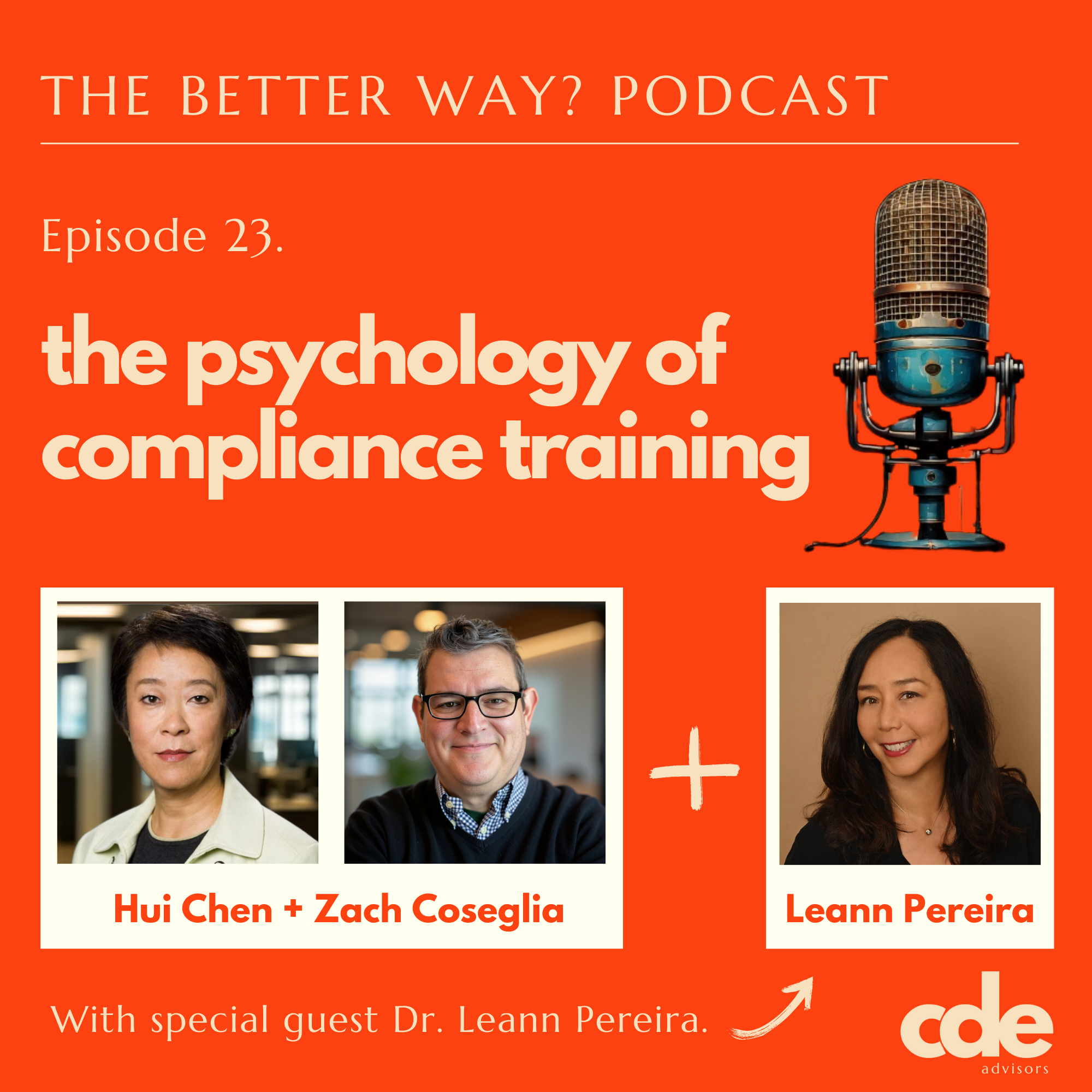
About this episode. In this episode of The Better Way?, Zach and Hui sit down with Dr. Leann Pereira to explore the psychology behind compliance training—why meaningful learning isn’t about entertainment, quizzes, or catchy trends, but about context, behavior, and relevance. Leann breaks down how bias shows up in everyday managerial decisions, why learning transfer requires realism over edutainment, and how organizations often underestimate the complexity of human behavior at work.
They also dive into the power of data to reveal cultural blind spots, challenge leaders’ assumptions, and surface the micro‑cultures that shape the employee experience. Leann explains how analytics from mandatory training become a diagnostic tool for identifying hotspots, predicting risk, and tailoring development—not relying on silver‑bullet solutions or buzzword‑heavy fads. It’s a clear-eyed, evidence‑based look at how real behavior change happens and what it takes to build healthier workplaces. Plus, the return of The Better Way? questionnaire!
Who? Zach Coseglia + Hui Chen, CDE Advisors; Dr. Leann Pereira, Emtrain
Full Transcript:
ZACH: Welcome back to The Better Way? Podcast brought to you by CDE advisors. Culture. Data. Ethics. This is a curiosity podcast for those who ask, “There has to be a better way, right? There just has to be.” I'm Zach Coseglia and I am joined, as always, by Hui Chen. Welcome, Hui.
HUI: Hi, Zach. Hello everyone. Welcome back to the Better Way podcast. And we have a guest today. We have with us today, Dr. Leann Pereira, who is the Vice President, Organizational Psychology, Learning and People Sciences and Analytics at Emtrain. It's a very long title. We're going to dig into that a little bit later. But welcome, Leann.
LEANN: Thank you, Hui. Thank you, Zach. It's very fun to be here with you today.
ZACH: We're really happy to have you. So, we're going to start, as we always do, by getting to know you better. We heard your title. We got a little flavor for your professional background, but we want to know who you are. So, tell our listeners, who is Leann?
LEANN: Oh boy, let's see. So, let's start with the easy stuff that you already said, an organizational psychologist. And what does that mean? In technical terms, I guess I spend my time thinking about the interaction between people, processes, technology and data, these days. And so, how do all these things come together and create workplace experiences that, you know, meet everybody's goals? So that's sort of the formal definition of what I do. So, informally, my job is to be sensitive. So, there's a lot of sensitivity to ideas, to nuances, to the everyday moments that make up people's work lives, and I help to provide context and clarity and support when needed, because there's a lot of new things happening all the time and so yeah, that's what I do.
ZACH: I love that. I'm excited to dig deeper into a lot of that. But before we get there and talk specifically about your work, let's talk a little bit more about your professional journey. What inspired you to become an organizational psychologist?
LEANN: So, I first started in HR in recruiting; and I spent a lot of time conducting interviews of people and just learning about, you know, who they were, and what they wanted. This is, I'm dating myself. This is way before LinkedIn. This is way before anybody did on the web, we'd call people up and ask.
ZACH: Oh, my gosh, can you imagine picking up the phone and talking to people?
HUI: Yeah.
LEANN: Really, landlines, no less.
ZACH: Wow. Yeah.
LEANN: Like we're calling them up. So, I call them up and I'd listen to them and I take down really their entire histories and narratives. And then I try to understand what motivated them. And I realized that, hey, this was really fun and I was really good at it. One of my bosses said to me that I could get somebody's like blood sample if I wanted to. Like, people were very willing to share. Fast forward, the industry started to change--where everything went online and recruiting kind of switched to marketing, you know, a personal brand. And less about, you know, people's experiences and who they were. And I had gone in-house to head up a recruiting function. And at the same time, I noticed that, you know, there wasn't a lot of science or there wasn't really a systematic approach to how people were being selected for jobs and the HR was just a mess; and we were kind of like back office. And maybe this was just the start-ups that I was working for . . . it could have been. But I realized that there was a lot more to this and a lot more guidance that I wanted that I didn't quite have in terms of background. And so, I started a journey to get more education. I got a Master of Organizational Development. And I continued to get a doctorate because it was just so fascinating.
ZACH: It's really an interesting origin story because I feel like it very much connects with our story. You know, so much of what we've done has been about . . . and so much of what this podcast is about is challenging, you know, traditional ways of doing things, wondering why there's sometimes a lack of curiosity in the worlds in which we live in. Why decisions are being made seemingly on a feeling as opposed to supported by data and evidence. And that sounds like precisely what drove you to pursue this path.
LEANN: It was precisely that. And I realized, also, coming up, me personally, I've always been in, I want to say diverse communities. So, me personally, I'm Korean, Portuguese. I was raised during the Vietnam War. My son is half Indian and I've always had a lot of different influences, a lot of different perspectives; and it's been a very rich experience in ways I didn't appreciate until I got into positions where, you know, I found that teams were fairly homogeneous. And there just wasn't the level of, I want to say thoughtfulness around important decisions, people decisions and business decisions that I would have expected. I'm not exactly sure where I'm going with that other than to say it was overly . . . I think I was . . . the power dynamics were surprising to me. You know, once I began to rise in the ranks, the way decisions were being made, maybe the lack of judiciousness and all these things bothered me.
HUI: Related to that, I mean, I found it interesting whenever people talk about interview as a way to sort of sift through their candidates . . . because I've always wondered and questioned just how useful are these interviews? Because oftentimes, people are conducting these interviews as if they're looking for a, you know, drinking buddy—which is not at all the same thing as someone who is supposed to perform a very specific role. So, that is a whole set of other curiosities that we could dig into today. That's probably a whole separate podcast. But I want to come back to your to your work at Emtrain because I just read off your very long title and in order to dive into that, perhaps you can tell us first of all a little bit about Emtrain. What is it? What does it do?
LEANN: Fundamentally, Emtrain is a training and development company at its heart, and the focus of the training is compliance training. But we also provide some very interesting analytics around people's behavior and corporate culture stemming from that training. The reason we love . . . and it seems so odd and I can go into this if you have the willingness to listen, but here it goes. So, compliance is really about people's behaviors. It's not a check the box thing, right?
HUI: Amen to that.
ZACH: Totally.
LEANN: So, whether you're running compliance training or whether you're running a leadership training or if you're just a line manager trying to get the best productivity from your team, you're always talk . . . you're always thinking about what's going on in people's hearts and minds. And enhance and do the skills, do the attitudes, you know, do they know what to do? There's a lot going on within an organization and not everybody always understands the rules or the social norms. There's different cultures. There's laws. There's different levels of power dynamics. And it's not as simple as, you know, treat your neighbor as you would like to be treated yourself. There's complexity in understanding cross-cultural nuances and so on and so forth.
Compliance training is a small intervention or tool that people use, that companies use to get people aware that there are differences in behavioral requirements or behavioral norms. Fundamentally, you know, it's meant to protect people and the company, but at its heart, it's striving for something, you know, that it’s extremely complicated and complex.
ZACH: So, let's define a term. You've said compliance training and I think that that may mean different things to different people depending on sort of where they sit. Talk to us about the kinds of trainings that you focus on. Is it anti-bribery and corruption? Is it anti-discrimination? Is it DEI? Is it all of the above? Talk to us a little bit more about what falls under the compliance umbrella.
LEANN: All of the above. So, preventing workplace harassment, where you were talking about how to create a respectful workplace, right? That goes from one hand, anti-bullying. Don't bully to don't discriminate to even beyond that, be inclusive and respectful, right? Anti-bribery and corruption. Knowing where the rules are, where are the boundaries of appropriate behavior, you know? Again, this is a slippery slope because you may want to give gifts to folks. You know, you may have that relationship, and you understand that that this would help close certain deals or so on and so forth. But the mindfulness that behaviors can sway and have repercussions downstream that people don't . . . that people aren't aware of. Fundamentally, I think, compliance training is around, you know, the everyday rules of the road that most of us are . . . I want to say all of us are pretty much good people, but we forget given certain situations, right, or certain pressures.
HUI: So, Leann, I want to ask you, there are a lot of service providers and product providers in this space of compliance training as you defined it. What is Emtrain doing differently? What distinguishes Emtrain from other providers in this space?
LEANN: Yeah. So, fundamentally we take the approach that we're looking at human behaviors that we would like to develop more pro socially. We're social folks. We want to make sure that we're bringing out the best in each other and within ourselves. So, we use behavioral science and learning science in our development, our course development. So, it's not just about rules, but really understanding the actual day-to-day behaviors and habits that contribute to a healthy outcome in the workplace or an unhealthy outcome in the workplace. So let me give you an example. Anti-bribery and corruption: a leader may have a lot . . . people could have a lot of pressures. In fact, there's plenty of examples where executives have a lot of pressure from the board, from the CEO, perhaps, to do things a certain way, right? To get certain results. And over time, that type of pressure just erodes you psychologically, socially, emotionally—and unless you have something else going on, like other reinforcements through . . . training is one way, but training also creates the awareness among colleagues and so on and so forth, so that we can all collectively support the right behaviors. What we try to do is instill that sense of social learning through our training and social reinforcement. So, we're looking at specific behaviors that people learn in groups and can reinforce to create healthier workplaces. It's not just about the rules.
ZACH: So, talk to us about what that looks like in practice. I mean, Hui and I have probably seen hundreds of different versions of compliance trainings, especially relating to anti-bribery and corruption. And it just often feels like we're being kind of marched through the policy. Maybe there's some animation involved and we see people engaging in different scenarios. Maybe it's actual video of people interacting and there are quizzes that are intended to test our knowledge of what the “right thing to do” in a particular situation is. But what are you doing differently? Because we've seen hundreds of versions of this.
LEANN: Right. We actually get into the science of it. So, for one for one series, we worked with Joan Williams, who's a well-known researcher in workplace harassment and bias. And with her, we identified 5 different types of biases that could result in employee relations claims around unfair promotions and advancements. And particularly, these are the ones that women experience in the workplace. And so, it went beyond the, oh, just be fair, you know, make sure that you're fair and everybody away from like, you know, the pedantic preachiness to getting into the specific perceptions—such as, I'll give you an example, prove it again bias. Women often find that they have done something and proven their level of expertise, but it's sort of . . . they have to keep doing that and they're not given the benefit of the doubt.
So, we train managers to be aware of whether or not they're forcing somebody to continually prove themselves beyond what their other colleagues are in order to get, you know, a similar rating or a good enough rating. Or a tightrope bias. That's another one. Like, are you giving a woman a hard time because she's assertive or, you know, not perfectly nice? That type of thing. Yet, you know, Joe down the street could be demanding and he's seen as a great leader because of that. So, we try to break down these struggles into observable behaviors that have been documented in the research to help people become more aware.
ZACH: Yeah. One of the things that really interests me is, first of all, I love that. I love the idea of content being developed based on a rich understanding of available research and turning that research into scenarios and content that really are intended to get to day-to-day, very practical business behaviors. But one of those very common day-to-day business behaviors is just trying to get through the compliance training as quickly as possible. So, what are you doing as a psychologist to advise and to improve and to sort of push back on our instinct to just click through it until I'm done 'cause I got to check that box?
LEANN: Right. So, first of all, we try to make these interactions in these videos as intimate and relevant to your work experience. Nonetheless, after a minute, nobody cares and they want to move on, right? So, we see that in the data. The other thing we do is we do ask you reflection questions about your personal experience. It's an assessment on the leadership effectiveness, basically, and the team dynamics. So, we'll go through and ask you about various workplace experiences, and then you tell us about how you experience things—and I think the ability to have that voice is something that is interesting to the learners. And while they do that, you know, for example . . . let me pick something that's . . . we don't . . . actually, “I perceive bias in my performance evaluations” would be something like a question that we would ask, after they have learned about what bias and performance evaluations is, right. And then they would respond and then we would present them back with data on not just where they responded, but their response relative to the organizational averages and then to our global database average. So, they get little insights along the way.
HUI: It's interesting. It's really fascinating because you're asking these reflection questions in the way that connects to the training and personalizes it, and you are kind of taking an engagement, or what people often call an engagement survey, but on that topic in that moment, am I understanding that correctly?
LEANN: It is and we really, you know, we have a 16-factor culture model. So, we really try to link these questions in the assessments to very specific behaviors that we can teach and train towards like the ability to mitigate bias, the ability to think at a systems level, you know, the ability to act with integrity, that type of thing.
ZACH: Do you see folks . . . like the individual gets that sort of snapshot of where they sit, but I imagine that the organization can take a step back and they can look at the sort of organization wide data. I mean, do you see folks using the data that's coming out of your product as either replacing or supplementing their overall assessment of their culture beyond just the effort to train and educate and shape behaviors?
LEANN: Yeah. So, they use it in two ways. The first use case was for employee relations or ethics officers to actually look and see where they may have hotspots within their organization and then proactively address them. So, if we see that, you know, there's questions around leaders giving gifts to others, right? Like we can spot that, and we could escalate that for any particular group or leaders of groups. If an employee doesn't feel that security practices are as locked down as they should, we can provide that information to the leaders so that they can proactively go in and check out what's happening before an incident occurs. Because the assumption is the employees will know what is going on if you ask them and let's not wait until something happens before we have to go and take an action.
ZACH: One of the things that Hui and I often talk about, and it was actually a term that was introduced to us by the cultural psychologist we used to work with, and that's FOFO, the fear of finding out. What if at all . . . do you get that from your clients? This like . . . you're collecting all of this wonderfully rich data that people like us look at and are like, this is exactly what we want and what we need to be able to make better decisions and build stronger programs. But you're also creating and collecting a lot of data that could really scare people. So how do you deal with that?
LEANN: Right. So, there are a couple of ways. So, the FOFO is real. Some clients will just opt to not have questions—and because they can't deal with it. Other clients will take a very proactive approach and look regularly at the data and address the issue. That is a matter of, you know, resources, overhead, and I want to say, the willingness to trade off risk versus development, right? That's the decision that usually the chief legal officer is making within the organization.
ZACH: Although in fairness, like this is what we always say is, it's really not a tradeoff between, you know, risk and development because the risk is that this thing exists and you don't know about it. That's the worst version of the risk. The fact that we're asking these questions and collecting these data is not creating the risk. The risk is there. The real risk is in your failure to identify it.
LEANN: Right, right. And we were amazed when we first developed the analytics that you know the companies that were in the lower end of our benchmark sometimes wound up in the news. So, we saw some of those issues, yeah.
ZACH: Well, there you go.
LEANN: Yeah.
HUI: Your training is really not just the training; it's a diagnostic tool.
LEANN: It is, you know, it's training, diagnostic and development because the way we frame it is really based upon skills. So, if we say, like listen, if everybody was extremely skilled, you're going to have, you know, management that is able to align folks, keep everybody communicating. You're never going to have issues, and you know, as much as people may or may not like to see it . . . or see it this way: our perspective is it really is a matter of competence because that's why managers are there. It is their job to keep things running and smooth and everybody working along. So, you know, it's not an accident if there are chronic issues. My view is really a matter of leadership competence.
HUI: And in terms of how you use these analytics, one of the questions that we face most often when it comes to training is: how do you measure the effectiveness of training. So, when you talk about, for example, helping managers become more aware of their potential biases and promotions, how do you know that you have accomplished that goal? How do you use your data in those ways?
LEANN: Yeah. So, part of my job is to actually test the effectiveness of the training. So, we've done pre/post-test analysis with clients where we, you know, do statistical analysis and we compare it to scores. So, we did a study where we looked at performance review data and then we said, okay, let's compare a group who has received this. We'll give training and compare them to the group who hasn't received training: let's see what the outcomes were. Because we were looking at the advancement of women in executive roles . . . and we did find a noticeable difference after about an hour of training that included the e-learning plus a facilitated workshop. The women's whose managers went through training had higher performance evaluation scores than those who didn't. So didn't take that much.
ZACH: I just want to like let that linger in the air for everyone to think about because what's so powerful about that to me is so much of effectiveness analysis focuses on the acquisition of knowledge. You know, here's a series of questions, did you get them right? And there's value in that at times. I don't want to completely discount that; but what you're just talking about is much bigger than that. It was actually . . . that's actually about the behavior related to the underlying training topic. This was actually looking at the performance evaluations and determining whether or not there was a meaningful, statistically significant impact . . .
LEANN: Right.
ZACH: . . . on the result. Fascinating.
LEANN: Well, and the other thing is that, at work we did this within a couple of weeks of them having to do their evaluations. So, it's useful to do it when it's relevant and then reinforce it over time. Yeah, it's another thing that you know when there's going to be a big sales conference, we suggest pushing out micro learnings on certain behaviors that we want to reinforce before everyone goes out drinking in Hawaii.
ZACH: Absolutely. Well, and this is a great segue because I actually want to talk to you about some of the sort of, you know, trends that we hear about or that we see in the training world and get your thoughts on some of them. One of them that we hear a lot about and it sounds like you're bought into is this idea of the power of training closer to the moment . . . just in time, whatever folks want to call it.
LEANN: Oh, yeah.
ZACH: Here's another sort of trend that I want to get your thoughts on. And I've seen your product. We've talked a little bit about it today. I know that you all use video, right? You use like actual human beings engaging with each other, not animation. Talk to us about whether or not that's a very intentional decision and what the reasoning behind that decision is.
LEANN: What we want to do is make it as relatable to people in their work environment for the idea of transfer, right? And transfer is the ability to learn something and then apply it, right? So, the application of learning is called learning transfer. What I understand, animations are really good at concepts—like we can learn a concept or remember the idea, but I'm not sure that I've seen any convincing research that it's very good at transfer.
ZACH: Interesting. And what about what we . . . and this is sort of an extension of that . . . and we see this increasing focus on let's make this entertaining, you know?
LEANN: Yes, edutainment.
ZACH: Yes, let's release, you know, 10 episodes so that people can binge them in the same way that they consume their Netflix. Let's create Hollywood style scripts to try to really tell these . . . What are your thoughts on that and how does that sort of thinking differ from what you're doing and is there a research-based reason for what you do.
LEANN: So, people are very . . . especially around compliance training, nobody wants to take their people off the floor to train. Their job isn't to learn, it's to do their job. Meaningful learning is meaningful because it's relevant. It doesn't have to be entertaining. And I think that's the big criticism around learning events where you go in and you sit in a room with other people and you have a good time and then you go away. And you're not sure if you've retained. And the outcome metrics are really “engagement.” Engagement can mean, it's mostly social engagement at that point, right? It's not necessarily meaningful learning. I don't think learning has to be entertaining at all. In fact, at this point in our lives, right after having a fair amount of professional experience, we know that sometimes the most painful experiences are the most instructive and all of that stuff. But I will say this, if you're learning something that is germane and instructive to you, and you're struggling with a problem and you're actually learning a technique or a skill that will help you with it, your stress goes down, your engagement goes up. Even though you're taking time away from your actual job, you're actually making your situation better. So, learning, when it's appropriate for the specific problem set, has other well-being properties besides entertainment.
HUI: In order to do that, though, you need to have a fairly good understanding of what is stressing people out; and what are the issues that they're confronted with that they find themselves struggling with. How do you do that? How do you build your content from the ground up, so to speak, without having to . . . I assume you don't customize for every client. So how do you do that in a way that actually speaks to the different employees and different organizations across the world . . . so that they can feel like, oh, I identify with this, this is addressing something that I'm struggling with.
LEANN: Right. So, a lot of it again is because we collect the data in the compliance training, which means, first of all that it's mandatory and almost your entire employee base is going to take it where it is a compliance requirement. So, we get a pretty good pulse on what's going on. We just use that data to understand the trends around . . . a lot of it is around, like, conflict management, communication, stress, emotional stress. You know, so we teach skills like emotional validation, which helps build empathy, that type of thing.
ZACH: You said something before about the complexity of all of this. One of the complexities for a lot of companies is there are so many micro cultures that make up their organization; and part of that is driven by just like very basic things like geographic diversity / operating in multiple countries. How do you address the non-monolithic nature of a large organization and still make the messages resonate with the people?
LEANN: I'm a really big proponent of personalized learning; and the best that we can do is understand from data segments which groups are having what type of problems—and then we could assign training that way, right? So again, some groups may have problems with responsible authority and power dynamics, where other groups are having more interpersonal problems around, you know, managing task workflow and task allocation, right? So, all of those things come up in the data and we can segment it by management group or region. The more challenging issues are when we see it across demographics that could span multiple different management groups. You have more systemic issues where we have, you know, maybe there's gender imbalances and those types of things. So those are hard, harder to address.
ZACH: So, if someone's just saying, okay, we want to get started, where does that baseline data come from?
LEANN: We usually get it from their annual compliance training.
ZACH: So, at a baseline, you may deploy a series of modules that are collecting data and then you use the data that's collected through those modules to target specific groups for either a specific type of training or maybe a more customized version of a training that might go out to the broader organization.
LEANN: Right. Like, they would deploy a code of conduct training, which is probably about 1/2 an hour to 45 minutes depending upon . . . or the preventing workplace harassment could be up to two hours’ worth of training. So, there's a lot of data that are collected at that point.
ZACH: I see.
LEANN: Yeah.
HUI: Talk to us a little bit about predictive analytics.
LEANN: So, basically, what we're doing is we're looking at data sets and we're understanding trends; and we can do analysis at a variety of different levels. We can do just a simple trend analysis where we understand that, you know, these hotspots are more likely to result in these types of problems, right? Power dynamics, hotspots where managers aren't necessarily empathetic, and you have issues around them making inappropriate request to employees during work hours . . . and that type of stuff. We'll see that data and we can say, you know, those trends indicate that there is a strong likelihood of getting an employee relations complaint from this particular group. We look at, you know, the percentage of positive responses versus the percentage of negative responses. We can, you know construct something called an odds ratio, which is, you know, the likelihood of a group responding favorably or unfavorably to certain things.
ZACH: All right. We're going to get to The Better Way? questionnaire in just a second. But I have one general question for you before we get there. This is a curiosity podcast, so I'd love to know what you're curious about right now. Like what is Leann curious about today?
LEANN: I'm very curious about using AI in learning. A lot of what we do is one way, meaning that we're pushing all of this material. I'd love to have something more dialogue based within compliance training . . . you know, something where we show a scenario . . . and then have a dialogue with somebody around their actual experiences and asking them about how this might have shown up in work. So, it's almost like they're having a conversation as training versus just looking through videos. I'd like to try something like that.
HUI: That sounds fascinating. But now I lied when I said I had no further questions. Now you inspired me, Zach, to ask another question. Based on the work that you've done in this space, what do you think business organization leaders should be curious about?
LEANN: Honestly, Hui, I think we're really at the beginning of people understanding psychology within organizations. I think we're very, very driven by financial metrics alone; and I don't think people really understand how behaviors and interpersonal interactions drive performance and outcomes. Because at the end of the day, a company or an organization is a collection of people. Those are really the differentiators. A lot of our tools are the same. The infrastructure is the same. We're all using one or one of two phones, right? I think there's a lot more that we're going to learn in this area, and I think leaders should be more curious about that.
HUI: I love that.
ZACH: Yeah, I love that too. And it rings very true to me, and I'm sure it rings true to Hui too. Not only that I think that there's more that we could do or more that leaders should be paying attention to, but also that, much like financial performance, there is data that can be used to help inform and to shape understanding of cultural performance and cultural challenges. I think that too many folks think of it as a sort of like soft thing; and as a result, the evidence that they use in assessing their performance is how they feel about their culture. And oftentimes they feel things that maybe aren't supported by the data, especially the more senior those individuals are and the more the more distant they may be from the core of the organization.
HUI: What has been surprising to me is finding that even from leaders of companies that are very data and science driven, that in everything they do in their products, in their finances, they demand hard data, hard evidence, but when it comes to culture, they default back to their feelings.
LEANN: Yeah, you know, I've seen some progressive organizations. Workday had a tool, or they showed us something, where their managers had a dashboard of employee sentiment across a handful of different metrics and you know they checked them on a regular basis . . . weekly, I believe. So, some culture forward companies are taking this very seriously and creating dashboards for their leaders.
ZACH: I love that. Well, you would think if a company was going to do it, it might be Workday.
LEANN: Yeah, I think it was their product, in fact, yeah.
ZACH: Exactly. All right. So, we've promised you The Better Way? questionnaire. There's nine questions. We're going to rotate back and forth between me and Hui on the odds and the evens. I'll start with question #1. You have the choice of two questions to answer. You can either tell us if you could wake up tomorrow having gained one quality or ability, what would it be? Or you can tell us, is there a quality about yourself that you're currently working to improve? And if so, what?
LEANN: I would . . . let me take the easy way out and say that if I could wake up tomorrow speaking 10 languages, I would love that.
ZACH: Love it. You're not the first person who said that. It's a really good one. Me too.
HUI: I love that too. All right, the second question is also a choose one of two. You can either tell us who is your favorite mentor, or you can tell us who do you wish you could be mentored by.
LEANN: You know, I really love this question. So, I thought about it, and I love mentors who are in the trenches with me on projects, but they're everyday people and I love when I can see, they're multifaceted. So, I work with one right here. Janine is great. She's extremely empathetic, and you know, she's got this willingness and ability to listen, but then she's also very daring and visionary on the other side. So, I love that about her. And then there was a manager at Apple that I worked with, or you know, a leader. His name was Gerald Anderson. And he was super compassionate and very accessible, but also very driven and results focused; and you saw both sides come out. So those are my favorite types of mentors.
ZACH: I love that. Such a thoughtful answer. I hope someday someone will speak of me the way you just spoke of both of them. I love that. All right, question #3. What is the best job, paid or unpaid, that you've ever had?
LEANN: Yard duty at an elementary school. When my son was in 3rd grade, I helped corral all the youngsters and that was very fun.
ZACH: Amazing.
HUI: We've never heard that one before. That's awesome.
ZACH: Definitely not, nor would it be my choice, so . . .
HUI: Agreed. Next question is what is your favorite thing to do?
LEANN: I love eating noodle soup while watching TV.
HUI: I love that.
ZACH: That sounds great. That sounds really great. All right, question #5. What's your favorite place? And you can define place however you choose.
LEANN: Oh, I've got two. One is Honolulu and the other is Yosemite.
ZACH: All right.
HUI: Very nice, I approve.
ZACH: Indeed.
HUI: What makes you proud?
LEANN: This one is my son. I try not to come up. I try not to say that, but it's true. I'm proud of my son. He's a lovely human being. I really am very proud of him.
ZACH: We get that a lot. We get that a lot. Not about your son, but about other . . . All right, so the next question is a very controversial one, so much so that we may very well just take it off the list at some point. But it is what e-mail sign-off do you use most frequently?
LEANN: Oh, they automate this. So, it's not even my own choice. It's like warm regards, that type of thing.
ZACH: Interesting. All right. So, we know that the people at Emtrain aren't actually wishing you warm regards. It's all automated. We're all always. That's right. That's it.
LEANN: We're always wishing you. It's still automatic.
HUI: That is very interesting.
ZACH: It is.
HUI: From the mundane to the profound, what trend in your field is most overrated?
LEANN: They all are, any single one of them . . . because anytime they're like, oh, you just have to be empathetic or, you know, radically candid or create psychological safety. I mean, it's never any one thing. It's thousands of choices that people make every day.
ZACH: Can I just . . . So, I'm going to get my soapbox here for a second. I'm so happy to hear you say that, you know, Hui and I are not behavioral scientists, but we work with a lot of behavioral scientists . . . and we have over the years. And yet I see people who aren't behavioral scientists all the time thinking that there is a silver bullet. And the silver bullet just happened to be captured in the one book on behavioral science that they read. And we just see it all the time. It's like, well, you just got to nudge them . . . or you just got to do you, just got to do this or you got to do that. And the beauty of this discipline is that it is so deeply complex. If there were a silver bullet, we wouldn't be where we are. So, I love that.
LEANN: Could I just add, it's complex, it's context bound, it's situational . . . but I will say being competent in any particular area will show up as consistent performance across time and different situations. So that's when you know you're good at something . . . you're good at it regardless of when they throw it at you, how it comes across, whatever.
ZACH: Absolutely. All right, last question. What word would you use to describe your day so far?
LEANN: Contemplative. Lots of writing leadership reports today.
ZACH: Okay, we like that, thinking. We're big fans of thinking over here, so that's great. Well, Leann, thank you so much for joining us. This has been a great discussion. An hour is never enough. We'll have to do it again sometime.
LEANN: Thank you, Zach and Hui. You are both so delightful and engaging. I really enjoyed this.
HUI: Thank you, Leann.
ZACH: And thank you all for tuning in to The Better Way? Podcast. For more information about this or anything else that’s happening with CDE Advisors, visit our website at www.CDEAdvisors.com, where you can also check out the Better Way blog. And please like and subscribe to this series on Apply or Spotify. And, finally, if you have thoughts about what we talked about today, the work we do here at CDE, or just have ideas for Better Ways we should explore, please don’t hesitate to reach out—we’d love to hear from you. Thanks again for listening.