Ep.25: Bystander Intervention: People Taking Care of People
Remember, you can always listen here or follow us on Apple Podcasts or Spotify. Either way, thanks for supporting us.
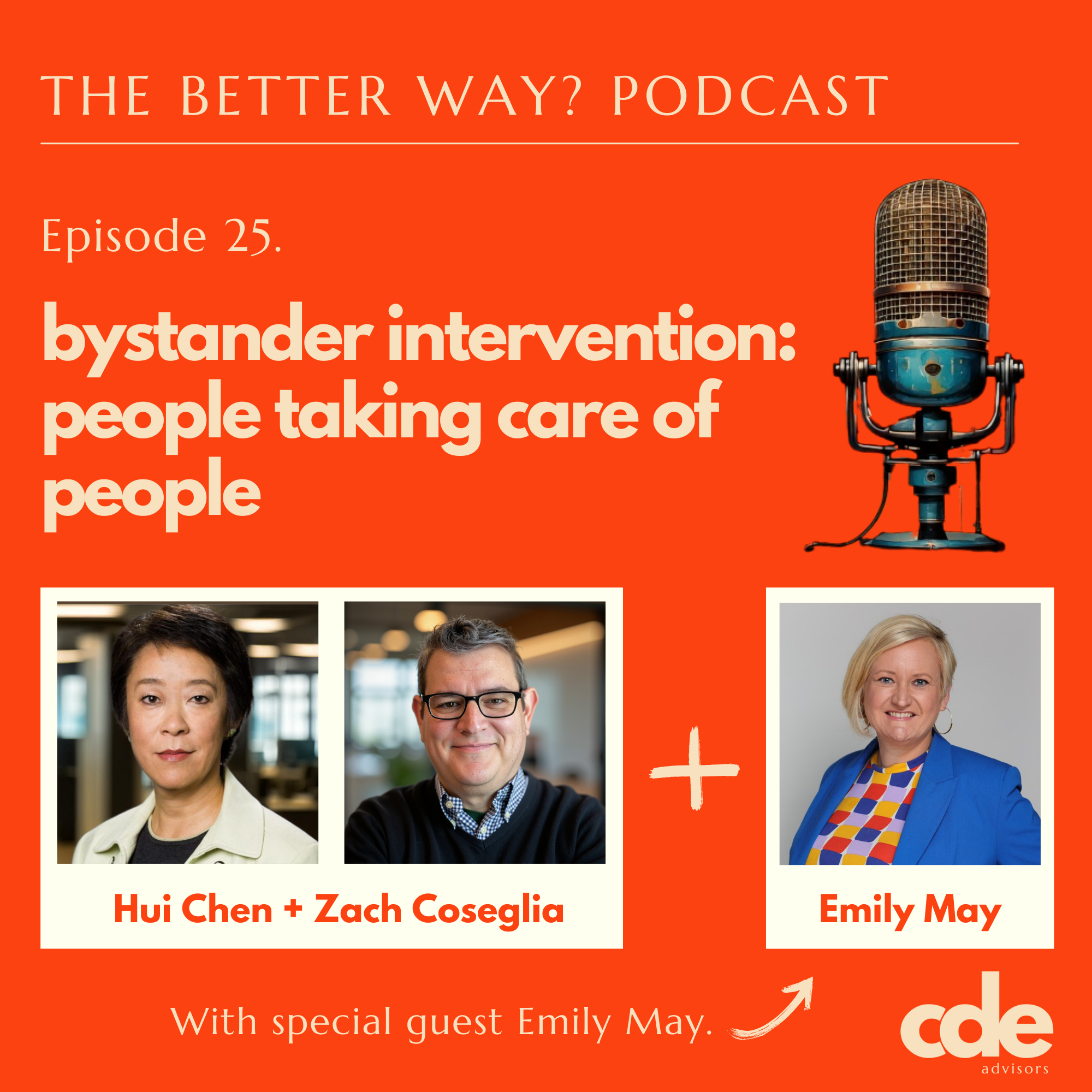
About this episode. In this episode of The Better Way?, Zach and Hui sit down with Emily May, President and Co‑Founder of Right To Be, whose work has transformed global understanding of harassment and bystander intervention. Emily shares the origins of her movement; breaks down the powerful 5Ds framework to bystander intervention; and explains how these simple, accessible tools help everyday people safely intervene in moments of harm and reduce trauma for those targeted (in life and at work!).
But the conversation goes even deeper. Emily offers grounded optimism for a fractured world, arguing that stories shape empathy, empathy builds community, and "community is our immunity.” She reminds us that solving massive societal challenges begins with small, repeatable human actions—and that people are far more eager to take care of each other than we often realize. This is an episode filled with practical guidance, hope, and heart.
Who? Zach Coseglia + Hui Chen, CDE Advisors; Emily May, Right to Be
Full Transcript:
ZACH: Welcome back to The Better Way? Podcast brought to you by CDE advisors. Culture. Data. Ethics. This is a curiosity podcast for those who ask, “There has to be a better way, right? There just has to be.” I'm Zach Coseglia and I am joined as always by the one and only, Hui Chen. Hi, Hui.
HUI: Hi, Zach. Hello everyone out there. We're very excited today to have a very special guest join us. We have with us Emily May. Emily May is the President, Co-founder and Lead Executive Officer of Right to Be, which is a movement we'll tell you about in a bit. Emily has delivered three Ted Talks, co-authored a guide to bystander intervention called I've Got Your Back, and partnered with Cornell University to publish research advancing global understanding of harassment prevention. Her work has been featured in many media outlets, including the New York Times, NPR and People Magazine. We are very, very excited and honored to have you with us today, Emily. Welcome.
EMILY MAY: Thank you so much for having me, Hui and Zachary.
ZACH: We're really excited for this discussion. You know, we kind of start and end the podcast by getting to know our guest a little bit better. We'll have some fun at the end, but I want to start by really just generally asking you, who is Emily May? Just tell us about yourself in your words.
EMILY MAY: I am a commitment to be the light, see the light, and receive the light. And tangibly what that means is addressing hate and harassment in all of its forms. And that is the work that I commit myself to every single . . . every single day. In addition, of course, to committing myself to my two very cute children and my girlfriend and my family and my friends, right? There is this just burning desire in me to figure this out. And I think it's really driven by the fact that I can . . . I see a world without hate and harassment. And I've seen, having done this work now for 20 years, the way in which we've made so, so, so many improvements and the way that we've stepped back a little bit from those improvements. But I'm like, all right, if we can do this in the past 20 years. What can we do in the next 20 years? Let's go.
HUI: It’s so exciting.
ZACH: Amazing. I got to tell you . . . it is. And we don't get a lot of optimism in our world today. So to have someone who does the work that you do have an optimistic outlook is actually really, really inspiring. Let's talk a little bit more about Right To Be. Tell us what Right To Be is, how it started, and how it's grown over the course of many years.
EMILY MAY: So, I started this organization when I was a baby. I was twenty-four years old and I was really focused on my experience of street harassment. And I was like, listen, if people said this stuff to me at work, somebody would do something, right? Like I remember Anita Hill, people would do something. And you know, but when it happened on the street, nobody did anything. And so a group of friends and I had this wild idea inspired by a young woman named Thao Nguyen to document our experiences of street harassment and to start a little blog. And a little blog hit a nerve and it created this really broad conversation about this issue. And we took that; we kept telling our stories. We mobilized people all around the globe, another 40 countries around the globe to tell their stories too. And then, we started to think like, all right, well, with all these stories, like, what are the solutions? And the thing that came up again and again is like . . . what we would read is like, well, then this person asked me if I was okay. Well, then this person offered to walk me to where I needed to go. And we were like, okay, all right, let's teach people how to be that person, right? And so that has launched a whole, you know, wing of our work. And we've expanded from just looking at street harassment to looking at hate and harassment in all of its forms, whether it be racism, ableism, religion, LGBTQ folks—you name it. So, that's been the journey over the past 20 years. It's been a wild one.
HUI: You started by saying that if I were to experience something, I want someone to do something. And then you went from there to teaching people how to be that somebody that steps up. And that really leads us to this topic of bystander intervention, which is topic that I've been fascinated with for a long time. So really starting, you know, even back in my sort of college sociology class with the Kitty Genovese case in New York, right? This is . . . for those who don't know, this is a case where a young lady was assaulted in an apartment complex and many, many lights went on as she was screaming for help, and no one, no one came forward to help her, to call the police, anything like that. So, the idea, the notion that a bystander can do something is very empowering and I would love for you to first, we always like to start with defining the terms. tell us what is bystander intervention?
EMILY MAY: At its core, bystander intervention is just people taking care of people. You know, if I were to drop my hat on the street, you would likely pick it up. Miss, Miss, you dropped your hat. If I was to struggle opening a door, you'd probably open that door, right? But if you saw me getting harassed or somebody shouting a slur at me, you know, more often than not, people freeze. They don't know what to do. And so, when we teach bystander intervention, we're literally just teaching people how to do that core human thing that they want to do—but did they forget how to in that moment. And so . . .
HUI: Or they are afraid.
EMILY MAY: Or they're afraid, right!? And I think that's an important part of the conversation. There's a lot of really valid reasons not to intervene. And I think one of the biggest stereotypes is that if you're going to intervene, you got to strap on your superhero spandex, swoop down and beat everybody up. But when we talk about bystander intervention, we're talking about de-escalating the situation. We don't want you sweeping down in your superhero spandex, you know. And so we have the five Ds of bystander intervention, and four of them are very indirect, and one of them is direct, but even the direct one is about setting that boundary and then turning your attention to the person being harassed.
HUI: Tell us about the five Ds. What are the five Ds?
EMILY MAY: Yeah, so the 5D's. The first one is distract—creating a distraction to de-escalate the situation. So that could be anything from starting a conversation to building safer space with the person being harassed to dropping your coffee cup or a handful of change just to break up the moment to get it to stop.
HUI: Brilliant.
EMILY MAY: The second one is delegate. So, finding somebody else to help. Most of the time, the easiest person to get to help you is going to be the person right next to you. Like you, they're fully human, right? They also want to take care of this person. Unlike you, they might not have listened to this podcast, so you got to help them out. Tell them what they need to help you out doing.
The third one is document. If you're going to document, we advise people, you know, to take that documentation, whether it's that phone footage or whatever it is, and then to give it to the person experiencing that harm, if you're able—to really allow them the power to do what they want to do with it, whether it's putting it on social media or using it to explain to their boss why they're late for work. Give the power back to them. And that's really the goal of all of this bystander intervention.
The 4th one is delay. So that is the check-in. Are you okay? Can I help you? Do you need me to walk you anywhere? Sometimes the harassment is quick. It's like a passing slur or a grab. Right in those moments, sometimes there's nothing you can do but check in on the person afterwards. But what we found is that even a knowing glance can reduce trauma for people experiencing harassment.
And then the last one is direct. So that is not the superhero spandex. That one is taking, you know, setting a boundary with the person doing the harassing like she looks uncomfortable, like he clearly doesn't want to talk to you, right? And then not getting into a back and forth, not using it as an opportunity to explain to these people, you know, why harassment is not okay. They're not in a great learning mindset in that moment, exactly. Talk to him about it later. But then turn your attention to the person being harassed and make sure that they have you know what that they need and that their needs are being prioritized in that moment.
HUI: Yep. So in a little bit we might ask you to go into some concrete scenarios of how these play out. But before we go there, let's talk a little bit about how did this 5D framework get started.
EMILY MAY: We were reading so many stories of hate and harassment, and this was the only good thing that ever happened when it came to hate and harassment. And so, we looked it up, and it was a concept called bystander intervention. And there was a great organization called Green Dot that did bystander intervention. So we called them up and we were like, teach us everything that you know. And they did. And we adapted it into the context of street harassment and then adapted it into there to look at all different forms of hate and harassment.
And you know, and we found that it's something that, you know, people think on the surface like, oh, that's scary. And then as soon as they learn about it, they're like, oh, yeah, I could do that. I could absolutely do that. And so that's what we've been doing. We've been teaching people these five Ds to really help them overcome their fear. And what I want to say about fear, just really quickly, is that that fear that people have is important, right? We want people to acknowledge the fears that they're holding, acknowledge the concerns that they're holding, whether it's a fear that it's going to turn on them, a fear that it's going to escalate, you know, a fear that they're going to do the wrong thing. Whatever it is, like hold it as true and then see out of all five D's, is there one thing that you could do that would not trigger that fear? And oftentimes we find that there absolutely is.
HUI: Fascinating. We're also very interested, always, in what research is there to validate the approach that you're taking. I had mentioned in your intro your research work with Cornell, and I believe there's quite some research in this area beyond that. So tell us a little bit about the research orientation and validation of the approach.
EMILY MAY: Yeah. So we have, you know, starting that thing I told you earlier on or knowing . . . as little as a knowing glance can reduce trauma. That is actually research that came out of our work with Cornell University, reading all of these stories, looking at that data, analyzing that data through a content analysis is where we picked up on that and we were like, wow, that's powerful. The other piece of this though is that, you know, we have been doing bystander intervention trainings now for 15 or so years. And so, we've deeply studied our own work; and found that of the people who are trained, 76% of them will actually report intervening the next time they see harassment happening after taking this training. And that's pretty powerful . . . because you're talking about a one-hour training. We're not sitting down with people for a whole day or week of their lives and then getting them to intervene. We're talking about a one-hour training. And then people are willing to take that information and do something. And I think that speaks, you know, not just to the fact that, yes, it's a great training, but it also speaks to people's core desire to want to do something and just not knowing what to do.
HUI: So, there's impact on the intervener. It's not just really the person being harassed, but this methodology seems to have an impact on the person who's doing the intervening beyond that scenario.
EMILY MAY: Yeah. And just to complicate it a little bit further for you, oftentimes the people intervening are people who have experienced hate or harassment in a different way at a different time, right? And so the experience of being able to help somebody else is healing for them because they're . . .
HUI: Interesting.
EMILY MAY: . . . able to help somebody when maybe nobody helped them.
HUI: That makes a lot of sense.
ZACH: It does.
HUI: So, shall we take it into some scenarios of unwelcome behavior? And since our audience is mostly in the corporate world, let's start there. Can you give us some scenarios of something like micro aggression, exclusion, inappropriate jokes—that's not the kind that you would think immediately you have a superhero spandex scenario, but it's sort of more subtle . . . but it's there. And how would bystanders in the room deal with that?
EMILY MAY: Yeah. So we work with tons of companies on this because I think a lot of people, you know, are like, all right, well, what can I do other than just not harass my colleagues? Like that's a very low bar to pass, you know?
ZACH: It's a low bar.
HUI: Indeed.
EMILY MAY: And I think I think the thing of it too is that a lot of stuff happening in the workplace. it is these slights, like it's these micro aggressions. It's these moments of disrespect. And did I get that disrespect because I'm a woman or because I'm gay or just happened because that person's having a bad day, right? There's a lot of that kind of stuff that's happening in the workplace as well. So, you know, what's interesting about the workplace environment is that there's a fair amount of things that we're already doing in the workplace. So I talked earlier about distract, creating a distraction. So in the workplace, right? Think about a meeting, something happens, right? All of a sudden it's like, okay, well, let's take 5, right? Or, like, breaking up the dynamic. Let's hear one minute from everybody around the table, right? To break that dynamic up or you know, you think about delegate, right?
We've heard stories and folks from NASA's Jet Propulsion Lab, for example, of seeing, you know, somebody who's experiencing some sort of a micro aggression or some form of disrespect and being like, hey Bob, I need you over here to take a look at this, right? And then Bob comes over to their desk and they're like, no, you're good. I just wanted to get you out of that situation. Document obviously—HR is all over documentation and it's a critical point, especially if you do decide to take it to HR further. Delay, right? We see all the time in the middle of meetings, especially now that we're remote, like, hey, I heard that, I saw that. Are you okay? Right? That G-Chat in the middle of meetings and then of course direct, which I think the interesting piece about the workplace dynamic is that with direct managers really have a responsibility to call out hate, harassment, disrespect, micro aggressions, all of it when they're seeing it happen in real time. But there's also ways in which, you know, the rest of us who are non-managers can also show up into that and be . . . and show up in a workplace environment, oftentimes from a place of curiosity. Like, did you mean to say that like that? Or like, I didn't quite understand the point that you were trying to make or, you know, really giving people a chance to take a second shot at seeing it in a better way and to correct themselves, hopefully before they require you know, a further level of intervention.
So you know, I think all of this stuff we've seen will be super, super impactful in a workplace environment because all of it is designed to de-escalate the situation, to address the harm that's at play; and even if you get it wrong, which is a big fear that a lot of people have—like, what if that's not disrespect, what if that's an inside joke that I just don't understand? Even so, you know, you're not creating harm by implementing the five D's. Like, so what? Bob came to your desk. Like, so what, you asked if somebody was okay in the middle of a meeting, you know?
ZACH: What do you say to folks who think, well, in the workplace scenario, there's this added sort of layer of disproportionate power dynamics. Especially if the manager is the one who's making someone uncomfortable, or if the manager is the one who's guilty of the micro-aggressions or the inappropriate jokes. Do you suggest that you focus on the first four D's and sort of stay away from direct, or do you have some other guidance for folks in those scenarios?
EMILY MAY: Yeah, it's definitely a concern, I think, that's very much . . . very much real. And I think, you know, it depends on like your particular dynamic, what feels comfortable. For most people, if it's their manager, direct intervention is not going to be it, right? Especially if they are, you know scared right? Of losing their job or, you know, facing some sort of adverse consequences, losing opportunities, you know, and maybe . . . but maybe there's somebody who has a good relationship with that person who could have a side conversation with them, right? Maybe, you know there's somebody else that you could, you know, potentially pull in or maybe you write it down and you're kind of keeping a log of it to really see the extent to which it is a trend and it is impacting, you know, other people across the organization, right? So it depends, it's an assessment that everybody needs to make. If it's your boss and they happen to be hugely disrespectful, but for some reason or another you have a great relationship with them, right? Maybe you can be direct, right? That's a thing. But yes, I think, I think the fear of some kind of retaliation is very real in the in the workplace. It's just about how do you work around it.
HUI: And I really like the distraction aspect because that really to me it's a much safer and clever way of just breaking the situation like you said. So, why should organizations want to help their employees be skilled in bystander intervention?
EMILY MAY: Yeah, well, I mean, I think your organizational culture is set by every single human inside that organizational culture. And also, as a leader, cause on top of doing this work, I also lead an organization, right? Like, you have to set that culture and positively reinforce that culture. And so, you know, we have set it in terms of setting an example, but also setting it in terms of creating and reinforcing organizational values and, you know, making sure that people are held accountable when they are moving outside of them, and that their performance is assessed based on their ability to align with organizational values.
So all of that is in play. But what I've found is that in organizations, including my own, where you have a culture where people feel safe and comfortable intervening and taking care of each other in a deeper way, people are not like, oh, that's weird or uncomfortable. They're like, yay! You gave me a strategy, and you said it's oaky that I use it and I know how to do it in a way that's appropriate and not get myself fired in the process, like this is great. So, we really see people outside of organizations That will set the culture. We'll try this too. But it's super successful if you already have a culture where you're really working towards respect and fairness across the board and inclusive leadership across the board. And then you get people something that they can tangibly do. You know, it works.
ZACH: That is a little bit of an antidote to the power dynamic issue we were talking about before. It's like if you invest in this sort of training, if you kind of embed this into your values and you give people these tools it becomes easier to have the more direct conversation because you can frame it as, hey, like, remember when we talked about this thing, I just wanted to bring it to your attention. This is me living what the enterprise is telling me it values.
EMILY MAY: Yeah. Exactly, exactly. I'm just doing what you taught me.
ZACH: Yeah. Exactly. Yeah. Love it.
EMILY MAY: You know, it provides a little . . . it provides a little cover. But you know, people, people are eager to show up and take care of each other. I mean, you know, look at our country right now. People are coming out of the woodwork to take care of each other and that's not new to the culture of obviously the United States, but I would say the world. That's just part of what it takes to be human. It's what makes us human is our desire to, you know, want to care for one another.
HUI: One reason for my fascination with bystander intervention is what we talked about is the impact on the intervener. And that leads me to have this theory that this applies not only for harassment and intimidation and unwelcome behavior, but also for other types of misconduct that may not traditionally been, you know, have been associated with these. So for example, sort of these white collar type of misconduct. Bribery of fraud cases. Rarely are these cases done by someone solo, so they're usually someone else is aware of what is going on. And my theory is the bystander intervention approach can also apply there so that when you hear somebody say, you know what, let's just put that on the company charge card when you're not supposed to, somebody says, eh, probably not a good idea. Or somebody says, you know, the way to get the sale done is just to get a little kick back to the purchasing manager, right? And then to have someone sort of skillfully say, oh, that's probably not the best strategy for this and that reason. And have you ever encountered this kind of application or and what are your thoughts on it?
EMILY MAY: Yeah. I mean, you're looking at like bystander intervention to reduce fraud. That is . . . that’s cool. We could we should . . . we should . . . we should build that. We should build that training. No, you could absolutely . . . I mean any kind of harm; you could absolutely use it to address those various types of harm. I think, you know, you're right. I think that the sort of the suggestions that you had of kind of leaning in with curiosity or gently setting a firm boundary, right? Like those are the types of things that you might want to do and I think the challenge that people have, and I think the training that people seek when those types of things happening are happening, is how to do it in a way that doesn't make you seem like a big nerd or a tattletale or you lose face or, you know, whatever it is—but just to be like, I don't know if we need to be doing fraud today, bud. You know, like, not today. Well, let's do it tomorrow.
HUI: Exactly, exactly, exactly. Yeah. I mean, that's at least a theory of mine. I mean, when I have raised it with sort of the corporate compliance community, a lot of times the fear is, oh, no, no, no, you know, we don't want them to be involved. We want them to tell us that this is happening. Well, one, I'm hearing from you, at least in the harassment and intimidation kind of cases, this type of skill set actually increases reporting. And two, wouldn't it be better for someone to be right there and deal with the problem? And maybe tell you about it afterwards as well than to wait until fraud has already been committed and then you try to chase it.
EMILY MAY: Exactly, exactly. And I don't think that companies are fully thinking like, I don't want to deal with the fraud case. I don't want a fraud to happen. You know what I'm saying? Like if somebody has an idea to commit fraud but doesn't act on it, that's fine. We can have all kinds of terrible ideas. You didn't act on it. It's not my problem.
HUI: Exactly, exactly.
ZACH: Exactly, exactly. Well, and that's what's so powerful about this is that so much of the world that we operate in is about detection and then about reactively addressing what has been detected. We talk about wanting to prevent, but at the end of the day, it's outweighed by the amount that's spent on detection and reactive activity. But what's beautiful about this is it really is a preventative tool. At the end of the day, this model is really about preventing escalation. By addressing it very early on.
EMILY MAY: Yeah, exactly.
ZACH: Love that.
HUI: So, what may be some reasons why organizations resist intervention training?
EMILY MAY: So, I didn't see companies being into it at all until about 2018. We started to see it with McKinsey wanted to do it, NASA's Jet Propulsion Lab wanted to do it, Deloitte wanted to do it. And so we started making some headway. And then 2020, 2021, demand for it exploded. So, in the beginning, it wasn't happening because people really weren't identifying harassment as an issue. But as, you know, the Me-Too movement took hold, Black Lives Matter started to take hold . . . people were like, hmm, maybe this is a problem. And then, we had, you know, we had January 6th, we had George Floyd, we had Brianna Taylor, we had, you know, the murders of the Asian women in Atlanta. And then everybody was like, whoa, whoa, whoa, we need to do more than just a little implicit bias training over here. Like we need to get people actual tools. And it turns out that harassment does happen, and it does matter, and it does impact employee experience. And then, you know, the government kind of made like everything remotely DEI related, of which at times bystander intervention gets lumped into (I think wrongly, but it does) . . . as like illegal, right? So, everybody got scared and they moved all of their training and all of their compliance in house so that nobody could possibly say a wrong thing that could get them sued by the federal government. So it's not a great answer. It's a little bit of a tactical answer. It's an answer of, you know, this moment that people are in. It was like they didn't know about it, they loved it. And then all of a sudden it was like a fear of, you know, compliance with federal government mandates.
HUI: Can you share one or two sort of success stories, case studies? Including how you measure your accomplishments and success.
EMILY MAY: Yeah, I think one of the amazing things that we were able to do . . . so when I started this organization, you know, I was told that street harassment wasn't a big issue. It wasn't a big deal. I must be a hypersensitive woman. That I needed to get a thicker skin. That I needed to work on a more important social justice issue. Like you name it, right? And now 20 years later, we're in this world where not only do people know that harassment's not okay, we've also had the world's largest makeup brand, L'Oreal Paris, invest a historic amount of money on addressing street harassment using bystander intervention with Right to Be and scaling it across forty-four countries, across over 20 languages, training over 4 million people. I mean, that to me, that is a wild and profound amount of change, not just this is the change that we've been able to make through the Stand Up Against Street Harassment program. But to go from a world where everybody is like, oh honey, this is your problem, to a world where like major makeup brands are like, oh no, this is everybody's problem and we're going to take a leading role in solving it. That is a beautiful, beautiful thing. And that's, you know, that's a part of what gives me hope. I think, you know, companies have so much power to make so much tremendous change, both for their employees and for the world. It's just about unlocking it.
HUI: So, how do you take this approach cross-culturally? Because you mentioned now you know L'Oreal, Paris and you do operate in many countries, and what is perceived or understood or felt as unwelcome behavior varies from culture to culture—and perhaps methods of intervention may be a little different. So tell us about how you scale it and address the cross-cultural issues as you operate internationally.
EMILY MAY: So every time we are working in a new country or in a new cultural environment, and I would even describe cultural environment as, like, not just a country's cultural environment—but like let's say we're working in the sports industry for example—we are hyper customizing that content and I think that's why it works is because it's hyper customized to that country's needs, to that industry needs or the company's needs, whatever it is. Because then people can really see themselves in it. It doesn't feel like an abstract academic like idea.
HUI: I see.
EMILY MAY: It's like, okay, here's what I can do. And here's how that makes sense to me. And here's how I do it in the stadium, or here's how I do it on the subway, or here's, you know, whatever it is. And so, yeah, we have a cultural adaptation process.
HUI: Interesting. Interesting. That makes a lot of sense. So shall we take it to the bigger world?
ZACH: Yeah. So, let's take even a step back. One of the things that I did in preparation for our discussion today was I tried to watch as much of your talks as I could, and I encourage folks. We'll link to them too (check out: this, this, and this to start). I encourage folks who are listening to continue their education and continue their curiosity on this topic. But one of the things that you talked about that really hit with me was early in the journey of creating this organization, you asked the question, how do we solve a problem as big as . . . ?
And you clearly weren't intimidated by the size of that question because you built something incredible over the course of the past 20 years. Now, when I look at the world. I asked myself, how do we deal with . . . how do we . . . how do we solve a problem as big as the challenges that we see in our world today? And I think a lot of the people who are listening are, like us, ethics and compliance people who are responsible for sort of promoting and championing integrity within their companies, but who bring that same ethos to the world—and who, like me, are a little unsure of what we can do to help solve a problem as big as . . . the world that we find ourselves living in today. So what . . . what guidance do you have, or what insight do you have for us about how to tackle some of the world's really big issues?
EMILY MAY: Me, like everyone else, has been thinking a lot about this recently and I think there's a couple things. I think, number one, is that we have to tell our stories, what no matter what our stories are in this moment that we are living through, and we have to tell them to each other. We need to deepen an understanding about what life in 2026 looks like and how that is different for each other based on where we live and who we are. And that, like that act of finding friends, telling our stories, right, that will build resilience, but it'll also help us to educate us that not everybody's moving through this moment in the exact same way. And build curiosity about, okay, well, why is your moment so different than mine, right? It's a huge point of education.
I think the other thing is that it is incumbent upon leaders in the world that we're trying to create . . . to identify what are the actions that everyday people can take, right? You should not have to be a professional politician or professional social worker or professional activist in order to take action to create the world that we want to live in. We should be breaking it up into these micro moments, right? I think about, you know, the environmental movement, very much popularizing the idea of a reusable water bottle. Simple, right? But now it's something that all of us do. And if you have a plastic water bottle, everybody's like, oh, you don't like the earth, you know? And so, we need, you know, we need a bystander intervention to serve that same function in the world. We need this idea of taking care of each other and making it so simple and so routine and so every day and accessible . . . and to make it normal. And I think that when we come together, we come together in community and tell each other our stories. We come together in perhaps a broader community and take care of people that even we don't know, that is how we get through, right? It's the disruption, the isolation, the fissures between communities that is creating this world that we're in right now, right?
But if we can figure out how to be in community, community is the immunity—and it will move us. It will move us through. You know, I think a lot of folks after, you know, the 2016 election were like, you know, resistance, resistance, resistance. And, in this recent moment, it's, a community, community, community. You know, it's how do we come together in a way that maybe I don't think we've ever come together in this constellation, in this way, in this time in our history. It looks different than maybe, you know, it did in the 1950s when my grandparents would come together of a sewing circle at church. But we got to figure it out because it's not um none of this pain is going to go anywhere and unless we figure out how to be in community with each other.
ZACH: When you . . . one of the things that I wrote down as I was looking and listening to some of your talks was you said: “stories shape empathy and empathy builds community.” And those words were just so powerful, but also something that we don't see enough of within the workplace and are really words to live by.
EMILY MAY: Yeah, and I think you can disagree with somebody's ideas all day long, but when you know somebody's story, they become very hard not to love.
ZACH: Yeah.
HUI: Hmm. That is so powerful.
ZACH: It is. Well, and it's a wonderful kind of segue too, because we want to tell a little bit more of your story through The Better Way Questionnaire. This is, you know, inspired by the Proust questionnaire, by Inside the Actor's Studio, all kinds of folks who have done something like this. They're meant to be sort of rapid-fire. And we'll trade off back and forth. So, I'll start with the odd ones.
And the first question is actually a choice of two questions. The first is, if you could wake up tomorrow having gained any one quality or ability, what would it be? Or you can answer, is there a quality about yourself that you're currently working to improve? And if so, what?
EMILY MAY: If I could wake up with a quality tomorrow, I would be a healer. A healer of like physical pain, but also trauma.
HUI: Wow. Wow. And it's so powerful I don't even want to move to the next question, but we will. We will. So this is also a choice of one of two questions. Who is your favorite mentor or who do you wish you could be mentored by?
EMILY MAY: Oh my God, I have three perfect mentors that have just changed my life. Like, I'm a massive endorser of mentorship. I'm just going to name them out. I got Luanda Yanosick. I got Adria Goodson. I got Madeline Wade. I got these amazing, amazing women in my court, protecting me, watching over me, guiding me. I am blessed.
ZACH: Wow. Great. All right. Question three, what is the best job, paid or unpaid, that you've ever had?
EMILY MAY: Oh, it's this one. And it's been both paid and unpaid, by the way. We are a non-profit organization. I've done it both ways.
ZACH: Amazing.
HUI: That's great. That's great. What is your favorite thing to do?
EMILY MAY: Cuddle.
HUI: Oh.
ZACH: That's a good answer. Also, the first one, first time we've gotten that, but what a good answer. Yeah. All right, question number five. What is your favorite place? And you can define place however you choose.
EMILY MAY: I love New York City. I love it. It's my home, Brooklyn. I love it. I love it. I know it makes no sense to live here, but I can't help it.
HUI: I understand that as a former New Yorker. All right. Next question is what makes you proud?
EMILY MAY: Um, I am real proud of folks in Minnesota right now standing up for the rights of immigrants. I think it is one of the most beautiful things that I have ever seen. And I am so proud that they are shining a light for us and taking care of folks in this moment.
ZACH: Well, now I feel really bad about going to the next question, which we've been talking about taking off the questionnaire for a while because it is not nearly as deep or profound as that. But what e-mail sign-off do you use most frequently?
EMILY MAY: Warmly.
ZACH: Warmly!
HUI: Oh, that fits. That fits.
ZACH: It does. It's lovely.
EMILY MAY: Right. I'm a commitment to be the light, see the light, and receive the light. I got to sign off warmly, you know?
HUI: Yes. Yes, yes, yes, that is perfect. Next question, what trend in your field is most overrated?
EMILY MAY: Oh, that has got to be, um, the e-mail petitions. They're just painful. I know they're a great organizing strategy. I know it. But God, it just painful.
ZACH: Warmly. And finally, what word would you use to describe your day so far?
EMILY MAY: Like, uh, heartfulness.
HUI: Oh.
EMILY MAY: It's kind of two. I kind of cheated.
ZACH: That was really lovely. Terrific. Thank you so much for sharing your story . . . your stories with us, and for a really wonderful discussion. We could truly go on for at least another hour. But we'll not do that out of respect for you, but thank you so much, Emily.
EMILY MAY: It's been such a pleasure. Thank you all so much.
ZACH: And thank you all for tuning in to The Better Way? Podcast. For more information about this or anything else that’s happening with CDE Advisors, visit our website at www.CDEAdvisors.com, where you can also check out the Better Way blog. And please like and subscribe to this series on Apply or Spotify. And, finally, if you have thoughts about what we talked about today, the work we do here at CDE, or just have ideas for Better Ways we should explore, please don’t hesitate to reach out—we’d love to hear from you. Thanks again for listening.