Ep.24: Moments that Made Us
Remember, you can always listen here or follow us on Apple Podcasts or Spotify. Either way, thanks for supporting us.
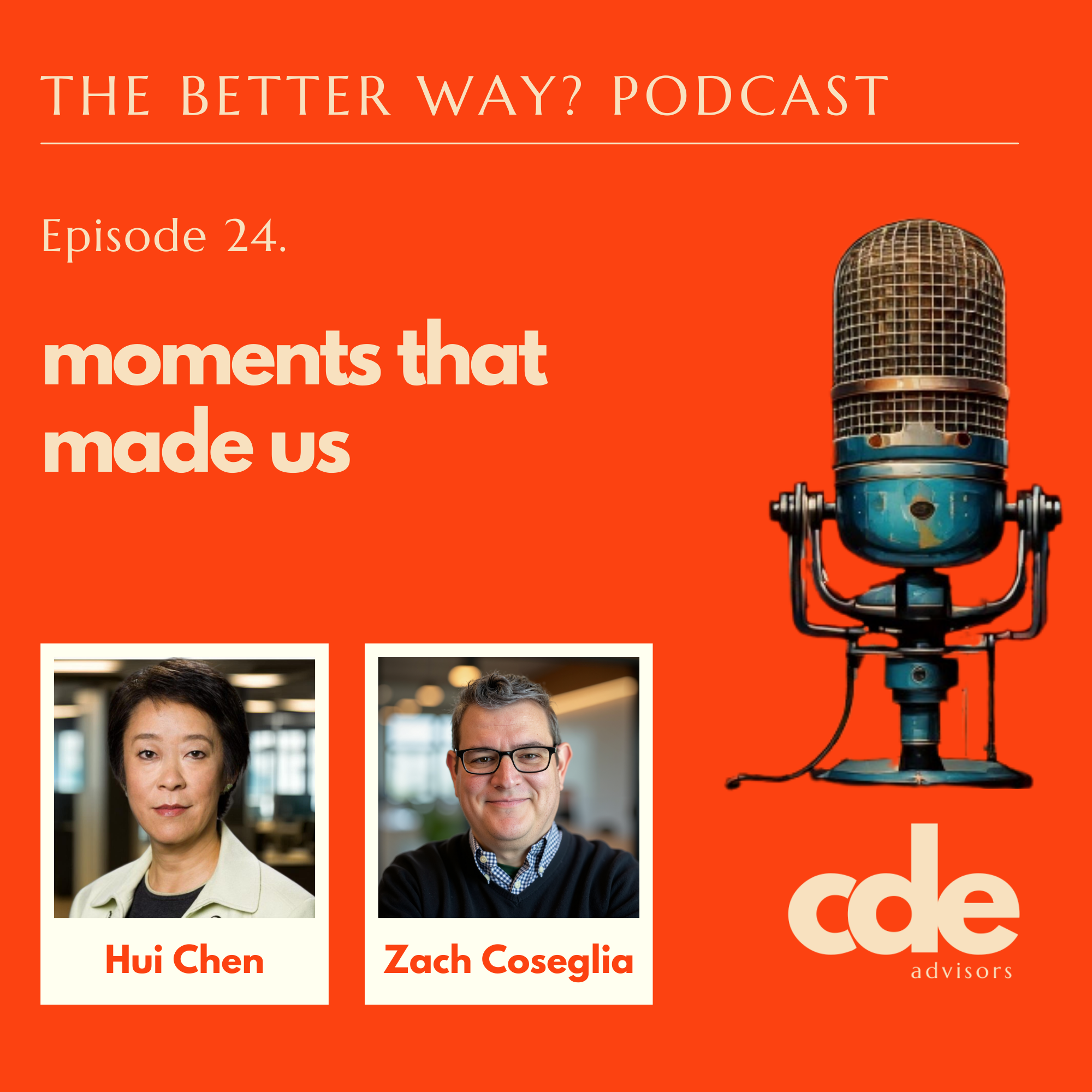
About this episode. In this reflective episode, Zach and Hui open up about the pivotal moments that shaped how they think about ethics, culture, and compliance—from unexpected lessons in empathy and communication to the realities of navigating risk, culture, and power inside global organizations. Their stories reveal how the work of compliance is far more human, nuanced, and emotionally complex than policy manuals ever acknowledge.
They also explore how data, design thinking, and personal courage can transform the way organizations (and individuals) approach integrity and decision‑making. Ultimately, the conversation invites listeners to reflect on the experiences that have shaped their own professional journeys—and to consider whether there might be a better way forward.
Who? Zach Coseglia + Hui Chen, CDE Advisors
Full Transcript:
ZACH: Welcome back to The Better Way? Podcast brought to you by CDE Advisors. Culture. Data. Ethics. This is a curiosity podcast where we ask, “There has to be a better way, right? There just has to be.” I'm Zach Coseglia, and I am joined as always by Hui Chen. Hi, Hui.
HUI: Hi, Zach. Hello, everyone.
ZACH: How's it going?
HUI: Not bad. I hope everyone out there is weathering the weather.
ZACH: Staying warm. Yes, indeed. I actually have my window open, which seems oppressive given how cold it is, but you know, I was a little warm.
HUI: I like that fresh air thing. And by the way, our comment about the cold weather doesn't apply to those of you who are in the Southern Hemisphere. Of course, then in that case, enjoy your summer.
ZACH: That is true. That is very true. Very true. All right. So, it's just us today. We're going to have a little bit of a sort of personal discussion, maybe be a little bit vulnerable and share more about what got us where we are . . . and specifically some of the milestones or moments that have shaped how we approach our work; and more specifically, that have shaped our point of view around ethics, culture and compliance. So, Hui, you're going to hate me, but I'm going to throw it to you first to share the first moment that comes to you, or the first series of moments that really helped shape your point of view on compliance.
HUI: All right, Zach, I will always do what you say. I do love these storytelling . . . we tell people that we love storytelling, and we believe storytelling is powerful and this is this is one way we're actually practicing what we believe. So, when you talk about these moments that have shaped the way we work and our point of view, I have to go back to my very first in-house compliance job. And I had never done compliance before. And so everything was a learning experience to me. So, there's sort of a series of moments that that come to mind as I think back to that.
So, one, the first one was, you know, I was talking to some of the business colleagues to whom I had denied a request to sponsor some government official travel from one part of the world to the United States. And I just said: this is this, you know, I don't see a good business reason for this, blah, blah, blah. And they said to me, you know what, we have to maintain relationship with this customer. We don't want to deliver this bad news. You go tell them. So yeah, so they dragged me in front of this customer and they literally, like, sat away from me in this meeting. So there's the customer behind his desk. I'm sitting in front of his desk, and my two colleagues are like sitting to the side. Like, they intentionally wanted to distance themselves from me. And so, I very politely informed the customer, who is basically a government official in the sense that this is someone who's a leader in a state-owned enterprise, the reasons why we have, you know . . . the reason was that we have policies and procedures that prohibit us from being able to do what he wanted us to do, which was to send his people on a nice tour to the United States. And the customer was understandably quite upset. He yelled at me and now I can't remember if this included the pounding of the desk or not, but he definitely yelled at me; and he says, well, you are a lawyer, I have lawyers too—and basically like . . . my lawyer can battle with you. And at this point, I blame everything on the headquarters. So oh, I completely understand where you are, blah blah blah. But you know it's the headquarters and I don't . . . my hands are tied here. I want to help you, but my hands are tied here. The experience, I have to say, was very instructive for me, and to this day I think about it a lot because, one, it gave me a sense of what the sales colleagues were facing. So, when we as compliance people sitting in our office tell them, well, just go tell the customer this and that, you try it. Right? So, I kind of really appreciated that approach that these colleagues took. I'm sure they didn't take it for the purpose of educating me. They really did want me as a human shield, but that the experience of a human shield really gave me a lot of appreciation about really just empathy and walking in someone's shoes . . . and understand a little bit about just the business realities out there and what do the customers say when you say these kinds of things to them. So, so that's sort of moment one.
And then there's another time now in the same job I'm trying to build this third-party system, right. So, we've all been there. We have third party questionnaires, you know, asking your businesspeople, do you have any third-party representatives, you know, in this transaction? And they said no. And I said, well, agents, no. I came up with all the names of third parties that I could think of. Like, you know, third parties, agents, something else. And no, no, we don't have any of those. But I had done some homework. I mean, there was someone who was not from the company or from the customer involved. So, I said, well then who is this person or this entity? And they said, oh, that's a relationship partner. And this just gets the point like, you know, I don't know if they're intentionally trying to be dense or trying to . . .
ZACH: Be cute about it or play semantics with you, yeah.
HUI: Exactly, exactly. But the truth is we were using different words to mean the same thing. And this is what got me again to a point of view where I'm always sensitive about when we're saying these things, do we all mean the same thing by using, you know, by the words that we're using? And are there words out there?
ZACH: Right. Well, it's like we . . . well, it's like what we do here. We always start by defining terms just to make sure that the words we're using are well understood by everyone who's taking part in the conversation.
HUI: Exactly, exactly. And be mindful that your definition may not even be comprehensible to them. You really have to break it down into really basic level like you're ultimately it was being broken down to is there anyone involved in this con . . . you know transaction that doesn't work for the company or the customer, right? And then you might even get into the semantics of like, what do you mean by involved, right? So it might be, you know, who's getting some profit out of this?
ZACH: Yeah.
HUI: Right? Some money out of this? So, sometimes it really does . . . breaking it down to that level of like, let's just talk about exactly what, you know, what we mean by all these terms. And the danger for people who've been in the field for a long time is that you and all the people you work with know these terms, you know what they mean. And you don't . . . you don't think for a moment that someone else could either not understand what you mean or misinterpret what you mean. So that was sort of moment #2.
ZACH: For sure.
HUI: And the final moment that I remember from that job was. There came a time I was . . . I felt like I needed to draft a policy or actually really more specifically a set of procedures relating to marketing events that where we invite customers to presentations or retreats or whatever, right. So, I sat in my office and I've seen . . . I've seen enough of these events on paper to know that there was a problem. So, I was drafting a policy specifically to address those problems and I sort of outlined, you know, what can and cannot be done and I felt pretty good about it. Then I don't know what gave me the idea that I thought, huh, maybe I should run it by the people who actually do these events.
ZACH: That's right. Maybe.
HUI: Maybe. So I convened a little meeting and I walked in. I expected maybe some pushback, but you know, like I thought it was just going to be sort of pro forma in some way. I think in the first 30 minutes they tore apart every piece of my policy. They came back to me with questions I had never thought of. They came back to me with just realities that they deal with that I had never heard of. Well, you know, what if this happens? And what if that happens? I had no answer for them in the in the set of draft procedures that I had. That definitely taught me always, always run it by someone, whether it's a policy, a procedure or even a set of communications, right? A lot of this comes back to communications, is, you think you're saying this . . .
ZACH: That's not what they're hearing, yeah.
HUI: Exactly. That’s not what they’re hearing. Or what they’re hearing is totally not helpful to them. So yeah, those were very defining moments from my first compliance job. How about you?
ZACH: Right, right. So, I have some reflections. Well, I said I have some reflections. So first of all, I love this set of stories, and I hope others do as well, because even the great Hui Chen was a new compliance professional at some point navigating these tricky waters. I love in the first story how you were there because the business sort of wanted to pass the buck to you. And then when you're there in the room, you're passing the buck back to headquarters, which is a sort of a tale as old as time.
HUI: That's right.
ZACH: I think you've mentioned the word empathy, which I think might be a theme as we go through some additional examples, including my next one; and precision, just the importance of precision. Not just in terms of the definition of the words that we're using, but in terms of everything that we do, compliance when done well is precise—and kind of takes account for all of those nuances. Ans then I guess the last thing that I reflect on with that is, you know, I think a lot of people will, you use the term run the policy by them, but that's not really what you did. It was more than running it by them. It wasn't just informing them about it. It was really showing it to them and ultimately, maybe your intent was to just run it by them. But what actually happened was a deeper collaboration about what this policy or set of procedures could actually look like when informed by the realities that they face as a business. And I honestly, I just don't see that enough and I think it's a really important lesson.
HUI: Yeah, you know, thinking back, I mean, if I really did just want to run it by them, I could have just sent it by e-mail and said, you know, here as it is, right. And the fact that I convened the meeting and I clearly invited very honest feedback. And that to me was clearly me wanting them to let me know this works in their world. Now I don't know what drove me to that at that time, but that experience now would drive me to do it for other projects like that.
ZACH: All right, let me let me share one. And there's a series of learnings and experiences that fall under this broader umbrella. But that broader umbrella is one that I've talked about here before and elsewhere. And that's my time leading an investigation function in Asia–more specifically the impact of fully living and working in China. When I think back about that time in my compliance, ethics, culture journey, I think it's fair to say that I approached the work with a lot less nuance than I do today. And maybe one of the reasons for that is because I was an investigator and I sort of saw the lines between what was right and wrong, good and bad, compliant or not compliant as maybe a little bit more well-defined than they might be in other contexts. But the truth is, when I think about my approach, not just as an investigator, but also being an important part of building out the proactive compliance program in those parts of the world, I think I came in like a wrecking ball. And what I learned over time was that what we really probably needed was a diplomat, maybe a psychologist, but certainly not a wrecking ball, and possibly not even a lawyer. So, here's some of the things that I learned over that and how it's impacted the work that that we do today. The first is learning how important culture is, like really seeing it in action, how much culture matters. And here, I'm talking about macro level culture, not just organizational culture. You know I was . . .
HUI: Not even the societal culture.
ZACH: Yeah, well, I'm . . I am working at the same company as all of these people that I'm interacting with every day. You know, the logo on our business cards is the same. Our e-mail addresses are the same. We work for the same people at the end of the day. That was something that very much united us. But it was not enough to overcome the deep cultural divides that existed between these two societies. You know, my sort of, you know, American / Western / New York / headquarters influenced point of view and the realities of what my colleagues were dealing with in China. And I think in a lot of ways, very early on, my expectations might have been unrealistic. And that's coming from someone who, even before I had this job, I had done a tremendous amount of work in Asia, probably, you know, interviewed hundreds of people, had led dozens and dozens of investigations, but then thought that because we all worked at the same company that we might all be speaking the same language, that we might all understand things in the same way, that we might approach the work that we do in similar ways . . . and that just fundamentally wasn't the case. And so, you know, I, you know, began to realize that things like being direct might not necessarily be the right approach when back channeling might actually get you to the place you wanted to be faster—or at all. I learned that some of the interview techniques that I would typically use maybe demanded a little bit of a softer touch than might work when I'm interviewing colleagues, you know, in the US who have the same job, by the way.
HUI: Right.
ZACH: I understood that business practices were very different and the realities that they were facing were more complex than I think I fully appreciated. And when people didn't understand why something was viewed as improper from sort of that headquarters perspective or didn't agree with a recommendation, my instinct was to be like, well, these folks just don't get it—and maybe they didn't. But I think what I ultimately learned was that I needed to have more empathy in my approach to compliance . . . and check some of my assumptions, check some of my, you know, cultural biases. And I just became so much more aware of that when I was actually living and working there day in and day out . . . and was the outsider. It underscored these very, maybe to some, obvious issues but it underscored them in a very real way for me.
Something else that I learned was, you know, I came in like a wrecking ball in part because that was the instruction for my leadership, you know, was to go there and have a spine.
HUI: From headquarters, yes.
ZACH: Exactly, exactly. It's the very similar situation. But I was at first confused because, you know, we talked all the time about how important compliance was and how doing business ethically was as important as how much business we do. And these values of integrity were so deeply ingrained in everything that we talked about. I felt like we had this buy in at the highest levels and that people were really paying attention. And so, when I experienced pushback locally, I was confused by it. I was like, I don't understand the pushback when we say we believe these things so deeply and we talk about them all the time. And I guess this is the point in my compliance journey when I really . . . came to fully understand that people can care about compliance, but there's still a business to run.
HUI: Yeah.
ZACH: And you know, people, even the most senior leaders, you know, have their own burdens and accountabilities and expectations on their shoulders. And there are times when compliance thinks something needs to happen, and it's not just going to get rubber stamped because we say that we care about compliance. And this doesn't mean that people want to do illegal things, or people want to do bad things, or that people have bad intentions. But when we talk about risk, we’re talking about something that lives in various shades of gray. And that was really a big focus of mine: let’s not just talk about what’s illegal or not—I think we can all agree if something is illegal, we’re not going to do it. But then, there’s this whole world of risk where points of view can differ and a group of well-meaning people may be comfortable with different levels of risk. I mean, this is where I really felt that. And you know, there are also sometimes people who don't get it, and sometimes no one cares that they don't get it because they're viewed as crucial to the business.
HUI: Yes.
ZACH: And these were just some of the hard truths that were cemented during that time in my career.
HUI: Yes. I think we're back to at least what I'm hearing is we're back to empathy again. It really is trying to get a sense of what the point of view of the other people, the business leaders, other stakeholders that you're dealing with. You know they don't live in your universe. They have their own universe. You have your universe. Your two universes might overlap on some specific risk or compliance issues. But unbeknownst to you, they have a lot of other demands that they have to manage.
ZACH: They do. They have a lot of other demands. I think it goes a little bit beyond empathy though. And again, this might be a little bit sort of saying the quiet part out loud, but I think that anyone who says this doesn't happen isn't being clear-eyed about the realities of compliance. And that is, just because you think someone is wrong, or just because compliance wants to do something, that doesn't mean it's going to be done. And even if you are truly right, that doesn't mean that you're going to have support for your point of view.
HUI: Yes. That's right.
ZACH: And sometimes the reason for that is simply because business demands outweigh the compliance concern. And here I'm not talking again about illegal versus legal. I'm talking about things that are up for debate across a group of well-meaning people where you may actually be right and it just doesn't matter.
HUI: So sometimes I worry about this when I see messaging from regulators and law enforcement, when it says. . . when it specifically talks about what our favorite topic: tone from the top, right. So, we constantly we want the management to be focused on this. They can't focus on everything. They can't focus on anti-corruption and antitrust competition law and health and safety and sustainability all at once. And by the way, they still have to run a business. So, every single cause wants to get that attention. And the reality is if everybody gets attention, then nobody gets a lot of attention. Right?
ZACH: Right.
HUI: So, it really you really have to look at the realities of what is the demand for this organization at this time. And they can only choose a few things. The basic meaning of the word focus is that you can't just do it with everything. So, leaders have to choose what they want to and need to focus on and many times it is not going to be your topic and it's not because they don't believe in it.
ZACH: 100% it's at . . . That's 100% right. But this is the very reason why I get so frustrated with the slogan-ification of compliance. Things like, as you said, “tone from the top” or “do the right thing” or “make tough choices even when no one is watching” or “integrity in action.” It makes the discipline feel soft, but it also feels very disconnected from the realities of your businesspeople, of the realities of the people who you're advising and supporting, especially when we're talking in that area of gray where it's not about something being illegal. It's just about how much risk are we willing to take on. And you know, it raises an interesting question, which is, you know, is there a role for someone within an organization to be the voice of what is ethical or not? Is that one person's decision? And I think the answer to that is probably no.
HUI: And part of that complexity is there are so many facets of being ethical.
ZACH: Yeah.
HUI: So ethical conduct has to do with your relationship with all your stakeholders and sometimes, right? Exactly.
ZACH: That's right. The community . . . the community that you operate in, your employees, your co-workers, your society, your board of directors, I mean all of these.
HUI: That's right. So sometimes if you're going to support one, you're going to disappoint the other. So, how do you make that choice? And you can't look at ethics from just one angle. You, you know, well, doing the ethical thing with this group of stakeholders is this, but who is going to be disappointed by that? Likely some other stakeholders will have to be disappointed. So, true ethics would look at all the complexities and there is no easy answer and there may be multiple answers or there be multiple imperfect choices.
ZACH: That's right. But through all of this, I'll end with this thought. Through all of this, I really came to understand the power of data because it is complex and because I didn't always have people who were naturally thinking the same way I was. But data is an equalizer . . . when you can show people data to support your point of view and to show them what happens when you go down this path or when you go down that path—when you can use data to add precision to the narrative that you're telling, it goes a long way as an antidote to apathy and to the denial that you sometimes observe from folks who aren't maybe the biggest champions of compliance to start with.
HUI: That is so true. And that actually leads perfectly to my very brief little story, which is from the time when I was at DOJ as a compliance expert. And we had a monitor who came in and as some of you know, the monitor's work is to conduct these in the company and make recommendations and they tend to do this on a on a yearly cycle if it's a multi-year monitorship. So, the monitor would go in, they may do site visits, they would do some transaction testing and those days not a whole lot of people were doing data-driven type of reviews yet. We were still sort of in that transition from transactional sample testing to doing more data-driven work. So, we had this monitor that came in and he had done some transaction testing and there have been a number of instances of inappropriate use of the corporate credit card and his recommendation was train the company, train employees. So, all employees. And I read that and I was just curious and I said, so how many employees have credit card in this company? So, this is we're talking a company of 10s of thousands of people and basically the number that came back was less than 10% of the company.
ZACH: Yeah.
HUI: To me, it was just such a simple question. You're gonna . . . so there is this kind of abuse. So, you want to fix the people who abuse it. Can we just start with the people who actually are impacted by this practice at all? Like you can't misuse a credit card if you don't have one.
ZACH: Truth.
HUI: Just a simple question indicated that . . . and this is what I always tell people, when we say use data, it could be something as simple as this. Just ask how many are we talking about? And that goes to a lot of . . . my pet peeve now, I increasingly become more irritated than before when people use adjectives instead of data when they describe certain things, right? This kind of transaction is rare. What is rare? Rare to you? And we're kind of back to that definition of terms, right? So rare to you is different than rare to me. Rare in a large organization and rare in a small organization are different things. But if you say, there is this kind of transaction happens 10 times out of 1000 transactions. Then I understand exactly what you're talking about. I don't need that adjective rare, just give me the numbers. And that was one of those moments that I thought, my goodness, we should all be much more disciplined about using data instead of adjectives and using data to inform our decision before we put [the] whole company through training how to use something they don't even have.
ZACH: Absolutely. It also raises this other issue that we hear a lot. It’s sort of the “what’s the harm” approach to compliance? It's well, what's the harm in just training everyone, even if only 100 people have a credit card? Or maybe you're thinking about changing something that you've always done and there's push back for it because your change maybe is a little less burdensome. Let's say, for example, you're experimenting with the idea of having people test out of a training . . . but you'll hear people say, well, what's the harm in just having everyone take the training, you know, even if they already know the information. Or what's the harm in just sort of like doing the doing more instead of less when maybe there's a really good reason to do less. And that “what's the harm mindset” is, one, usually never based in data, because if you really were evaluating the effectiveness of things that you're doing, you would be able to tell a story about why you made the decision and you would have the answer to that question, what's the harm? Sometimes the harm, is taking your people away from the core elements of their job—having tens of thousands of people take a training that has no relevance to their work just because . . . is harm. You're doing harm by doing that, and so that it's not just about data, but it's just this idea of doing more when less is a perfectly acceptable choice. And too many compliance professionals, I think, lack the confidence to just say no, let's do less. Let's make that part of the story, yeah.
HUI: Yes, that's right. That's right. And use the data to back our decision to do less, right? Because I want to spell out the harm that you're talking about, just in case some folks are still not seeing the harm. So, harm number one is you're wasting people's time and people's time . . .
ZACH: Yeah. That's a big one.
HUI: That is the biggest harm, right? You're wasting people's time, and time is resource in any organization. So, when you put 10,000 people through just one hour training, that's 10,000 hours, 10,000 hours. And if 5,000 of them didn't need it, you.
Wasted 5000 hours that could have been used for something else productive in your company. And secondly, I'll speak for myself and for many people, noncompliance people, when they have heard that I do compliance. And they tell me, oh, I hate compliance and they utter this sentence. They make me do these trainings that have nothing to do with my job, like, and I can't even explain to them. I don't even have the room or the ability to tell them, like, why do you make me do this when I have nothing to do with this, right? I get angry, as you can hear from my voice when people waste my time and that translates into a disdain for the compliance function, you haven't even met them.
ZACH: Yeah. That's right. That's right. That's right. You're gonna . . . people are likely to be less likely to come to you when there are issues. They may discount other things that you deliver to them that are relevant because it's gotten lost in a sea of irrelevant stuff. It has an impact on the perception and brand that compliance tries to build within an organization, and it's why a lot of people say, you know, that they hate compliance.
HUI: Yes, it's so . . . so, you know, it's harm to the organization and it's harm to your credibility as a compliance function.
ZACH: Yeah, absolutely. Absolutely. Okay let me share another one. This goes back about 10 years when I came back from China, I had a new global role leading a global monitoring, analytics and digital compliance team . . . and I can't remember why this happened, but around this time a group of us were selected to do this two day off-site in human-centered design and design thinking with a focus on the work that we do in compliance. And it was two days where we were just invited to think big, to think differently. To find some better ways . . . and to think about how to innovate our function. The process itself inspired me because it built so deeply, actually, on what I had learned in China: that compliance is this thing that's being received by people, and we need to design with those people in mind. We need to be empathetic to them. We need to understand them. And we need to design policies, procedures, and a program that's going to hit and resonate with them, not just something that we think a regulator or enforcer would find acceptable. But it also sparked this creative part of me . . . . and I think I've always kind of brought that to my work.
HUI: Yes, you do.
ZACH: But this, but this really . . . this was like accelerating that. It was like hitting the gas pedal. And I really began to challenge just about everything that I knew and thought about compliance. And for me, it really was sort of the like origin story of the search for better ways. So, in preparation for our discussion today, you know, I was thinking back about this experience and again, this was 10 years ago, maybe more. The team that I was on as part of this innovation focused workshop created this artificial intelligence agent, this idea, this concept for an artificial intelligence agent that we called GAIL with, you know, the A and the I and GAIL underlined. It was sort of like an Alexa or Siri for compliance.
HUI: Mhm.
ZACH: And the concept was that it would answer key questions about compliance requirements and therefore sort of phase out policies. It would be a discussion partner and brainstorming partner with you that would probably ultimately replace traditional training—but it would also like handle your expenses. It would identify anomalies. And it would be automated in a way where any insights that were generated wouldn't be on the back end for like monitoring purposes, but they would be delivered on the front end to help people make better decisions in real time, whether that was expense . . .
HUI: You were way ahead of your time.
ZACH: This is . . . it was 10 years ago, and you know, and I there was a there was a journey in the years following that were you know little bits of this concept were developed in ways that were in ways that they could be based on the available technology and sort of the realities of you know the cost and budget realities of building something. But when I think back about this concept, this idea that we had over a decade ago, I think that today could be built in a way that wouldn't be resource intensive or cost an unnecessary or ungodly amount of money. And you know, I hope, I guess what I take away from this is that—or what I hope others take away from this—is that I hope that every compliance professional or every person who's working with an organization addressing complex concepts like culture is . . .
HUI: Mhm.
ZACH: Taking these moments to step away from the way we've always done things or the way that we currently do things . . . and asks is there a better way and gives themselves not only the invitation, but the time and space to be able to identify those issues. I know that compliance people, that HR professionals are probably the most budget-strapped teams in any organization, and that sometimes it may feel like even the best idea will die somewhere along in the process. But I think we have to kind of put that to the side to understand and appreciate how much technology has evolved and what we can do today that we couldn't have done a decade ago . . . and really think about how we could transform the work that we do, because I continue to feel like, notwithstanding all of these learnings, compliance hasn't evolved that much in the past 20 years.
HUI: That's very true. And then to the extent it has evolved recently with, you know, it really is being part of that the AI wave, right. So, it can't help but be caught up in some way. But is it involved in the way it needs to be? Really leveraging what technology can do on one hand; and really stepping into the governance demands on the other hand. Most compliance functions I don't think are there.
ZACH: Yeah, yeah. And look, on an even more basic level, part of the inspiration and the significance of that experience for me wasn't just this like really cool idea that we came up with. But the way in which that that workshop was done, you know, the use of design thinking or human-centered design concepts. I mean, you know, this is embedded in the way that we run workshops with our clients. Like, we invite our clients to be hands-on, and we never just lecture in a workshop.
HUI: Never.
ZACH: And we always want more than just the compliance team or the legal team and the HR team in the room, so that we're really designing things together. And so, this one moment a decade ago really sparked my interest in all of those things, and it's still present in the work that we do today.
HUI: Very much so, and I'm so proud of the way we run our workshops. It really is very human centered.
ZACH: Yeah, me too.
HUI: So, is it my turn?
ZACH: It is, yes.
HUI: All right. I'm going to talk about my experience as a whistleblower.
ZACH: Oh, wow.
HUI: It's a very, well, let me just say I was a very reluctant whistleblower. So technically, I would say I didn't really blow the whistle. I think I was just forced into having something sort of come out of my mouth. So, I had a colleague overseas. She was supervised by someone who was based in the headquarters. And so, the boss would from time-to-time travel to her, the country where she works. And on those trips, apparently, he had propositioned that she should come to his hotel and, you know, have relationship with him.
And he wasn't even subtle about this. This, this was all, you know, he left her notes on the, you know, on post it notes, cards, gifts with . . . There's lots of evidence around, basically. There's no question, she was not misinterpreting this. And she told me about this and asked me what to do. I know this person. I also know this person was very close friends with my boss, so I just did not see a scenario where saying something about this would not hurt me. So, I rationalized myself, well, he's only in the country for a few days, and so long as she doesn't go to his hotel as he requests, she'll be okay. And so, I sort of told her this. I said, well, you know, I don't know if you should mention this to anyone because, you know, he's really good friends with our boss and the big boss and where is this going to go? So, but I this tormented me, the fact that I didn't say anything. So it was on my mind, on my mind and you know, and so long as he was not traveling there, I this was not an issue. It just was the . . . an academic issue until the next time he goes to the country. But then I started thinking about he does cover multiple countries. Who knows if this is not happening in some other country where I don't know the person? And I was very uncomfortable, but I still wasn't ready to say anything.
There was a colleague I trusted who happens to be the official ombudsperson. So, I called him and I said I need to talk to you about something. And when I started just a little bit, he goes, wait, are you talking to me in my official role as the ombudsperson? I said, yes. He's like, oh, I didn't realize that I thought you were just like talking to me as a friend. So now I have to give you my spiel about, you know, as an ombudsperson. So, part of that . . . his spiel was that, you know, if you're looking to give company notice about something, this is not the right forum, you know, we're really here just to listen to you, blah, blah, blah. So fine, I wasn't trying to give the company a notice. I didn't want to just talk to someone and talk it through. And after I told him the whole thing and he knows, I mean he works for the same boss. So, I asked him, I said what? What should I do? And he said to me, I think you know what you have to do. You're just not there yet. And I thought, well, this is utterly unhelpful.
So, I continue to be tormented by this. Months go by, now. And we were then sitting in . . . Oh, I was sitting in my boss's office now at this time. So again, there's the big boss, right, with whom I don't interact directly that often. But I was sitting with my boss, who's also friends with this person in question; and my boss starts telling me that we're looking at some reduction in force, you know, sort of globally. And so now we're going to have to go through the people who are like on the list to be laid off in various countries. And lo and behold, the person who's been harassed in this scenario, her name was on the list. And I just, I still remember. I mean, talk about sort of moments you remember. I remember exactly where I was sitting in the office, you know, so you have this desk and you have two chairs in front of it. I was sitting to the . . . in the chair to the right, I remember sort of the field of his office, and I remember feeling like there's a force pushing these words out of me that I couldn't even control. And I just said, no, you can't. I said we can't lay her off and I . . . knowing exactly what I would get the question why and I just blurt it out. I mean it really felt like a bit of an out of body experience and I thought as soon as I blurted that out my boss was kind of stunned. And he's like, do you . . . Do you understand what I have to do now? And he has to go tell the big boss, right?
ZACH: Of course. Of course you did. You knew. Of course you did.
HUI: Yes. So, I'm thinking, sitting there thinking, great, my career is over. Well, certainly my job in this company is over. This is . . . this is . . . I think of all the bad whistleblower movies I had seen. Like, you know, this is just not good. The end of the story is a good one in the sense that this person was ultimately before too long, I believe forced out of the company. He left the company. I do know there was a formal investigation because I was contacted. But his departure, if involuntary, is not clear. So, all we . . . all I know was that there was an investigation and ultimately, he left the company. But I can tell you what I learned from this was, I'm a former federal prosecutor. I am, by most accounts, a pretty fearless person. Okay? I also have done investigation. I know what happens on this end of the line. I was still that scared.
ZACH: Yeah.
HUI: Right? Think about what it’s like for some ordinary person wanting to raise something like this, especially if it involves someone high level—someone that they believe has the connection or the power to make this go away. That was one of those things that I always carry me when I now do advising work with companies that want to encourage speak up. Boy, until you . . . I never would have imagined that I, of all people, would struggle that much with this question, and I did.
ZACH: Absolutely, absolutely. It's such a powerful story because I think, I mean we've had . . . we've been a part of these conversations together and separately for years around people evaluating the strength of their speak up culture—and routinely hear folks very assuredly say, well, we would speak up here. People understand what they're responsible for and I really believe we’ve built a culture where people can do that. You hear these, again, adjective driven statements from leaders all the time and the truth is: it's hard and it's scary. And the data that you're getting, even, from some of the traditional methods of collecting this stuff is probably not entirely accurate.
Especially because people, when answering some of those things, probably feel, as you did, fearless and, you know, righteous and have a deep understanding of what's right. But when actually confronted with a situation like that, probably don't really fully appreciate how difficult it really can be. And I've been there too. And I also think of myself as a fearless person, someone who prides myself in speaking truth to power, oftentimes to my detriment. And yet, these moments are really challenging.
HUI: Yeah, I mean, and I never would have guessed that I would have this problem and until . . .
ZACH: I would never have guessed that you would have this problem either.
HUI: No, nobody who knows me. And I'm going to say that I'm usually a fairly self-aware person. So, I mean, this is really one of those like until you've been in that situation, you really don't know.
ZACH: Yeah. I think that's a really powerful place to end.
HUI: Well, I think we would like to invite all of you out there to think about what are some of the moments that have shaped your perspective, your point of view and how you approach work—and perhaps also life.
ZACH: Absolutely. Think about it. Reach out to us. We'd love to hear your stories.
HUI: Yes. And share, share those stories in not just with us, you know, with others, because sharing sort of builds that community.
ZACH: Absolutely. Well, thank you, Hui, as always, and thanks everybody for listening.
HUI: Thank you, Zach. Thanks everyone.
ZACH: And thank you all for tuning in to The Better Way? Podcast. For more information about this or anything else that’s happening with CDE Advisors, visit our website at www.CDEAdvisors.com, where you can also check out the Better Way blog. And please like and subscribe to this series on Apply or Spotify. And, finally, if you have thoughts about what we talked about today, the work we do here at CDE, or just have ideas for Better Ways we should explore, please don’t hesitate to reach out—we’d love to hear from you. Thanks again for listening.