Ep.30: Meetings Don’t Have to Suck!?
Remember, you can always listen here or follow us on Apple Podcasts or Spotify. Either way, thanks for supporting us.
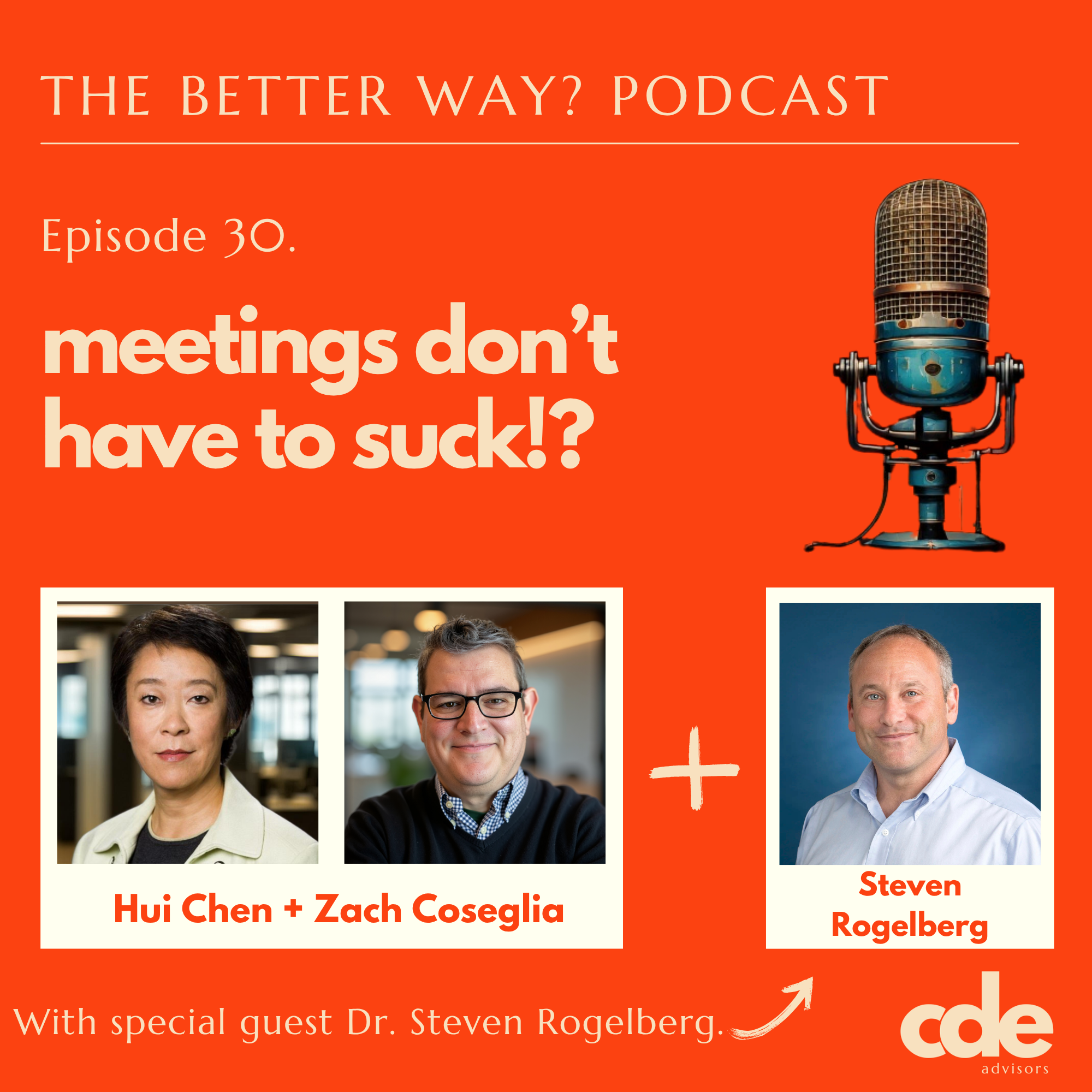
About this episode. We all complain about meetings—in fact, they just might be one of the biggest unmanaged investments in your organization. Is there a better way? In this episode, Zach and Hui sit down with Dr. Steven Rogelberg, one of the world’s leading experts on the science of meetings, to unpack why meetings so often fail—and what leaders get wrong about fixing them. From the surprising truth about agendas to the staggering scale and cost of meetings, this conversation reframes meetings as a critical (and under-managed) business investment.
Dr. Rogelberg shares practical, research-backed tools you can start using immediately: structuring agendas as questions, shrinking meeting times, rethinking who really needs to attend, and shifting from dominating conversations to facilitating them. The result? Meetings that are shorter, more engaging, and worth the time. If you’ve ever felt trapped in a calendar full of ineffective meetings, this episode offers a clear—and refreshingly doable—better way.
Who? Zach Coseglia + Hui Chen, CDE Advisors; Dr. Steven Rogelberg
Full Transcript:
ZACH: Welcome back to The Better Way? Podcast brought to you by CDE advisors. Culture. Data. Ethics. This is a curiosity podcast for those who ask, “There has to be a better way, right? There just has to be.” I'm Zach Coseglia and I am joined as always by the one and only, Hui Chen. Hi, Hui.
HUI: Hi, Zach. Hello, everyone out there. So today, we're going to talk about a topic that we love to complain about but can't seem to escape—meetings. We seem to have so many of them, and they often feel like a waste of time. To help us find better ways on this topic, we have a true expert as our guest today. We have with us Dr. Steven Rogelberg, who is Chancellor's Professor at UNC Charlotte, and one of the world's leading experts on the science of meetings and workplace effectiveness. He's the author of bestselling books, including, The Surprising Science of Meetings and Glad We Met. And his research has been featured everywhere from NPR to the Wall Street Journal to CNN. Professor Rogelberg, thank you so much for joining us.
STEVEN ROGELBERG: It is my pleasure. Thank you for having me.
ZACH: All right, welcome to The Better Way? So, we're going to do what we always do at the top of an episode with a new guest, which is to get to know you better. And we just heard a very formal introduction of who you are, but I'll ask you in a more existential way, who is Steven Rogelberg? Tell us about yourself.
STEVEN ROGELBERG: Well, I am a son, a husband, a friend, a father. I am a guy who very much wants to help make things get better and leveraging science to do so. So I take the responsibility of trying to elevate communities, work, and especially the vulnerable populations really seriously. I'm very much dedicated to trying to figure out what causes humans pain and then try to find science to help allay that pain. And as you kicked off this conversation, meetings are certainly a source of pain.
HUI: No kidding.
ZACH: Indeed. Well, let's dive into it. Hui, where should we start?
HUI: So I'm going to start with some numbers that I learned from Professor Rogelberg's book, The Surprising Science of Meetings. It's kind of staggering. 55 million meetings a day in the United States alone, costing approximately $1.4 trillion. He also has a lot of quotes about how people feel about meetings in the book. And I have to say this one is my favorite. If I die, I hope it's during staff meeting because the transition to death would be so subtle. I just, I could not stop laughing when I read that quote.
STEVEN ROGELBERG: Yeah.
ZACH: It's really perfect.
HUI: So I want to start by asking you, Professor, are meetings the biggest managed investment in organizations today?
STEVEN ROGELBERG: Well, first, let me tell you that 50 million is actually an underestimate now. So our most recent estimates are 300 million meetings a day around the globe. So meeting activity, yes, has only increased.
HUI: Oh my god.
STEVEN ROGELBERG: And if you quantify this, around 15% of an organization's personnel budget is going to meetings. That is a staggering number. So when you think about that, it is easily, for most, the vast majority of organizations, the largest expenditure they're making towards, in a sense, a tool, right? Because, in a sense, you could argue that meetings are a communication collaboration tool. Now, if you look at IT budgets, right, that's also directed towards a tool. It's actually less typically than 15% of the personnel budget. And yet think of the infrastructure organizations build to make sure their IT investment is really working. We don't do that with meetings. So you are absolutely correct. This is the most unchecked investment an organization makes. And as a result, in many ways, it's the greatest opportunity for an organization to make better.
ZACH: Indeed. Well, look, I think we could all, and I'm sure that those who are listening are also thinking of all of the war stories they have about bad meetings. And they probably don't have to think that far back because some of them probably happened today. But this isThe Better Way? So rather than talking about all of the things I think we know about where meetings can go wrong. We wanted to dive right into some of the solutions to try to get to some of your better ways. And I want to start with a quote from your book. You write, “abolishing meetings is a false solution. They are venues where the organization comes to life for employees, teams, and leaders.” So let's start by exploring some of the better ways short of abolishing meetings. And I want to start before we even get into the meeting room. I am a person at a company who is thinking I want to have a meeting. Where should I start to make sure that we get off on the right foot?
STEVEN ROGELBERG: Sure. So first, let me say that I agree with my quote and that a world without meetings is much more problematic than a world with meetings, right? Meetings are essential for communication, coordination, cooperation, consensus decision making, organizational democracy takes place in meetings. So without meetings, we would really have a whole host of new problems. So the goal is not to eliminate meetings, although we can eliminate some meetings, but the goal is to eliminate wasted time in meetings. And that's an achievable goal. So, I'll give you one example, and I'm sure we'll come back to this example multiple times. But this one example can actually change for your listeners so much of the distress associated with meetings. So if you look at most books, not mine, if you look at most training programs, not mine, you will see that they typically will start with, hey, have an agenda. Have an agenda. Well, in my book, the chapter is, “agendas are a hollow crutch.” That's having an agenda in and of itself actually does nothing to improve a meeting. And really, why would it? So much of what's on the agenda is just recycled meeting to meeting. What really matters is: are the items on the agenda actually relevant to people? What matters even more is: how you facilitate conversation around those items. That's the hard stuff. But so many managers think that by just having this piece of paper with a bunch of topics, they've done it. I'm a good leader of meetings, so it creates a false sense of security. But I'm going to share with you an alternative approach that really speaks to your question. And that is, instead of structuring your agenda as a set of topics to be discussed, what I would love for your listeners to do is to start creating their agenda as a set of questions to be answered. By framing your agenda as questions to be answered, now you have to really step back and think, why am I having this meeting? It's to answer these questions. By framing your agenda as questions, you have a much better sense of who needs to be there, right? They're relevant to the questions. By framing your agenda as questions, you know if your meeting has been successful or not. The questions have been answered. By framing your agenda as questions, you create this engaging challenge that draws people in because humans love answering questions. And if you just can't think of any questions, it likely means you don't need a meeting. So, that's just an example of a very simple intervention that will fundamentally change your meeting and the meeting culture. What do you think?
HUI: Just love it.
ZACH: Love it. And I think it goes beyond just meetings. It goes to what we talk about in our world all the time, which is, if we’re going to make people participate in a training, well, what questions do we have that we need people to be able to answer? If we ask people to read a policy, well, what is the information that we're trying to teach them or the things that we want them to know rather than just putting words on the page? So I love this.
STEVEN ROGELBERG: That's right. It's a little switch, right? It's a little switch with profound effects. And ultimately what it will do is it'll make the meetings much more strategic. And it will also help you clarify when you should just send an email. Instead of a meeting. It will also clarify when you can just do something async as opposed to a meeting, right? Because not all questions require gathering together, but ultimately, if you're trying to design this and you say, "Okay, well... I just have information to share. Well, that doesn't really lend itself to a question, right? So, then you can't think of a question. You say, well, I still gotta get that information out. So you'll start thinking differently about how to do it. And maybe your meeting just becomes a discussion of what you had already shared to address questions that people have. So it's, I've done this intervention for a host of organizations and leaders, small to large. And if I had identified one thing that can turn the page, this is a good, very good start.
ZACH: So powerful. And look, we, I have, there's so many directions we could go, but I want to hit just a couple of concepts in your book. One of them is Parkinson's law. What is this?
STEVEN ROGELBERG: I know. Sure. I love this. And this came right from science. And basically what they found is that when you assign amount of time to a task, humans basically use that entire time. And the same applies to meetings. If you schedule a meeting for 60 minutes, it takes 60 minutes. If you schedule a meeting for 30 minutes, it takes 30 minutes. So, if we just default to our Outlook and Google Calendars, generally, our meetings are going to be 60 minutes, and they will go 60 minutes. But we can actually use Parkinson's Law to our advantage. We can schedule meetings for 44 minutes, for 26 minutes, whatever it is, and we will get it done. So really what the science argues for and this is what I talk about in the book, is I just want the leader to make a choice. Right? Look at what you're trying to achieve and say, okay, yeah, I think it will take this much time. And don't be afraid to pick unusual times. Right? Say, no, I think this is probably 40 minutes. Good. Go for 40 minutes. Totally fine. And when you do pick a time, what I encourage leaders to do is to actually dial it back by 5 to 10 minutes. Because that's where we can use Parkinson's Law for our advantage. Right? Because lo and behold, we will almost invariably still get it done. So it's another simple intervention that shrinks meeting times, but there's actually one other beautiful thing that happens when we do that. Namely, if we don't run our meetings for 60 minutes, we wind up giving people back, let's say, 10, 15 minutes. And this allows for recovery after a meeting. What has been found is that when people have back-to-back-to-back-to-back meetings without that recovery,
Their drain is really significant. But if you can add these intervals of recovery, then they're able to show up at their next meeting much more present. And one of the hallmarks of being more present is less multitasking.
ZACH: I'm just thinking of all of the days that I spend or have spent historically in back-to-back meetings and that everything you just said feels so real to my lived experience. And I know probably a lot of people who are listening. One more concept that I want you to talk a little bit about before we move on. And that is the 8, 18, 1800 rule. Because I think we're always sort of...
STEVEN ROGELBERG: Yeah.
ZACH: There's always this debate about who needs to be in that room. So tell us a little bit more about how that applies in the context of who should be invited.
STEVEN ROGELBERG: Sure. So we can think of rules of thumb, right? We could say, well, if you have decision making, you need to keep it under 8, because it's just so hard for humans to facilitate beyond 8. You could think if we have brainstorming, okay, maybe we can go to 18, because brainstorming is, you're not really asking people to engage or seek consensus, you're getting ideas. And if it's just information dissemination, heck, you go up to 1800. Fine. Those are rules of thumb. But in general, rules of thumb are the enemy. Because rules of thumb lead to us not being intentional. And that's what we need to be. We need to be intentional. We need to look at what we're trying to achieve and really think about who has to be there. Ultimately, what we want to do is think about it as must-haves and nice-to-haves. And we do this all the time. And a nice little wedding example is, let's say you're planning a wedding. You know who has to be at that wedding. Where we get in trouble is the nice-to-haves, because once we invite third cousin Ernie, now we better invite 4th cousin Sarah. And oh, and Sarah's daughter probably needs to be there. And it's once we move into those nice-to-haves, we lose control. And what was once going to be this tight group becomes a really large group. Same applies to meetings. We know who must be there. It's the nice to haves that gets us in trouble. So, what I encourage leaders to do based on the science is for those nice to haves move to a model of inclusion by input rather than inclusion by attendance. Inclusion by input is this idea that you go back to those nice to have folks and you have a conversation. So, let's say Hui is a nice to have person. I approach her and I say, hey, Hui, we're having a meeting about X, Y, and Z. I know you're really busy. I don't think the questions that we're asking are highly relevant to you. But if you have any input, we'd love to include you. I'll share with you the meeting minutes. If you want to attend future meetings, you're more than welcome, but I will definitely represent any input that you have. Now, Hui feels validated, right? She feels respected...HUI: I do.
STEVEN ROGELBERG: … and we've been able to access her expertise, but we're not holding her time captive. And we're still giving her the option for future. Now, even with this personal touch, it still might be the case that Wei says, oh man, I still can't believe you didn't invite me. Because one of the things that's fascinating about the science is that while people hate meetings, they get really worried if they're not invited to a meeting. So, the best practice is to actually start to establish some norms with your team around meeting attendance. So, what I'm about to say, you might giggle inside or maybe outside, but we actually need leaders to occasionally have a meeting about meetings.
ZACH: Say more, okay? Say more.
STEVEN ROGELBERG: But how could we not? But how could we not, right? If we know people are miserable, why are we not talking about it? It's weird. It's really strange. So, a meeting about meetings is where the leader says, okay, what are our typical meetings? Who really has to be there? Who, you know, whose input do we need? And basically start to normalize these conversations so that when someone's not invited, they see it as respect, not being shut out. And this can only happen by having these collective conversations. And then even as part of these larger conversations, there could be an audit of all reoccurring meetings. Where people can start to talk about what's working and what's not. Going back to something we talked about earlier with, let's say, the IT investment, which is, again, smaller than the meetings investment. We talk about IT. Managers have no problem asking their employees about their IT needs, how their IT solutions are working, getting input, right? We do that, and we're really happy doing that. Well, it's the same thing with meetings, right? What's working? How long should these, you know, these are our typical staff meetings. How long should they be? Right? Who really needs to be? Maybe we have rotating membership at certain meetings. So, just get it out there so that we can start approaching meetings with some more objectivity as opposed to it feeling personal. So if we do that that sets the stage for us to be able to shrink meeting times. Then we move to the nice to haves to inclusion by input, so they feel validated still. And then we can also move to a model of partial invites. Impartial invites, let's say I'm having a meeting and only my last, or say my only first agenda question is relevant to Hui. So I just say, hey, Hui, just come to that and then leave. Right? So we can have a more porous meeting boundary. We can allow people to come and go. So instead of holding someone captive for the entire time, they come, they do their thing, and then they're free. Totally fine.
ZACH: Indeed. And being held captive is exactly how I feel so often in meetings. Hui, where should we go next? What else are you curious about?
HUI: Well, I just wanted to point out something that I find really interesting, which is oftentimes we think about, sort of, the meeting leaders making assignments like pre-reads to the meeting participants. And what Professor Rogelberg has talked about a lot here is the meeting leader has a lot of homework to do. Everything from how to design that agenda to thinking through how to include people and you know whom to invite and the ones that you don't invite, how do we invite their participation? So I think that is a mindset switch that I think is really important to note. I think we probably want to talk about the meeting itself now since we're quickly running down on time here. So, Zach, you want to ask about meeting leader behavior?
ZACH: Well, yeah, I mean, that's such a great segue Hui, because there is this pre-work, it sounds like, that the meeting leader needs to do. But I, Professor Rogelberg, want to hear more about what you expect the leader to actually be doing in the meeting. What are behaviors that the person leading the meeting really needs to be able to display to facilitate an effective use of time?
STEVEN ROGELBERG: Great question. And I will give a more flip statement, and then I will unpack it more meaningfully. My flip statement, which is true, is I want meeting leaders to act like the both of you. I want them to act like the both of you—because think about what you've done. You've prepared for this conversation. You thought through the topics, but you're listening more than talking. Right? You're present. You are not featuring yourselves. You're trying to foster a conversation and a resolution. In this case, a resolution is understanding meetings better. You are displaying the type of intentionality and stewardship that we want meeting leaders to do. Okay. So now I'll kind of make it more behavioral. So, meeting leaders, besides thinking through the meeting properly, thinking of those key questions, inviting thoughtfully, thinking through, hey, you know what, maybe we should consider addressing this question in a particular way. You know, maybe we can actually have a conversation about this agenda item in silence because silent brainstorming actually yields more and better ideas than vocal brainstorming, right? So they start to think about the process of the meeting, right? They just don't rely on everyone always gathering around the virtual or physical table having a conversation. Maybe it makes sense to get people in pairs for some of it, right? Maybe it makes sense for people to stand up for some of it, right, to build some energy. There's lots of different tools that we can use. I mean, the book has hundreds of tools, right, that can mix up the conversation. We also know that, fundamentally... And this is what leaders forget. And you remember, you're both doing this. That fundamentally, the job of the meeting leader is to facilitate, not to dominate. Talk less, listen more. Humans talk a lot. And brain research has found this. Talking a lot triggers the same parts of the brain. That food, good food, and sex trigger. So, we talk a lot because it kind of feels good. But that's not why, so given that, we have to be careful, right? Because we can easily dominate. And we need to make sure that we are giving that gift to others. If we're talking a lot, fundamentally, we're not attending to dynamics. We're not realizing that Joe hasn't communicated this whole meeting, right? We're not seeing that. So the more that we're able to suppress ourselves truly listen and monitor the broader conversation so that we can effectively facilitate. That's where the meeting can really shine. And we can use a sports example, right? We could take Michael Jordan as an example. When he first came into the league, it was all about shooting, right? That is a good example of a leader just dominating. Michael Jordan's greatness happened when he finally realized that he had to make everyone around him better. And once he realized that, his teams exploded. The same thing happens with meeting leaders. If you're inviting people to your meeting party, you're inviting them because you want their input. Create an environment where that voice can emerge, and then you help manage the various voices to encourage constructive conflict of ideas. Because we want conflict in meetings, but we want it to be ideas, not about personality.
HUI: So, you mentioned some specific behavior in meetings that meeting leaders should be attentive to, that these are some signs that things are probably not going the way they should. Reminders of what some of them are.
STEVEN ROGELBERG: So, signals would be that only one or two people are talking, the others aren't. Signals that there are tangents, people are going in their own directions, they're not staying on task. Signals such as people are just multitasking. Right? Multitasking is actually feedback to a meeting leader. It's feedback. It means you're not doing a good job. That's what multitasking means. So look at it. So those are some of those overt things that you can see if you stop talking. And when you see them that allows you to kind of figure out what you should do. There's also AI co-pilots for meetings that look at distribution of talk, right? You can monitor that too, right? There's AI co-pilots that monitor kind of affect and emotion. That could be helpful. They're not givens, right? They're not the path forward, but they're just more tools. Let me like sum that this point up with an interesting research finding. If you survey people coming out of a meeting, there is one person who says it was a good meeting. You want to guess who that person is?
HUI: Person who talk the most.
STEVEN ROGELBERG: Well, yes, the person that talked the most and the meeting leader, right? Those are typically the same. This is a very important finding, right? Because if meeting leaders generally think it's gone well, because they're in control, they're not going to be very motivated to make changes, right? They say, no, this is fine. Everyone else's meetings are bad. But not mine. So the self-awareness is a big problem. So us switching and talking less and monitoring more allows us to make sure that we're actually designing a good meeting for everyone in the room, not just us.
ZACH: So, the last episode of our podcast was me talking about sitting on a jury, talk about like a fascinating meeting context, 12 people who have to come to a unanimous decision about something who come from all different walks of life. And I think two of the most macro level frustrating elements of a meeting are either not being able to reach a decision at all, which is what happened on my jury on the vast majority of the charges in front of us, or groupthink, where everyone is just reinforcing what everyone else is saying. Very different outcomes, but equally frustrating in. Hui, I know that you had some questions about combating group things. So what were your curiosities on that topic?
HUI: Professor Rogelberg, in his book, has so many ideas about combating groupthink. So instead of me picking out my curiosities, I'm just going to let you, Professor Rogelberg, go ahead and tell us what are some of your favorite tools for combating groupthink in meetings.
STEVEN ROGELBERG: Sure. So I'll just share a couple. But yes, the book is filled with these things because it's such an important topic. So first, we need meeting leaders to share their hopes for the meeting. So, if you're a meeting leader and you say, hey, we're having this meeting about this, and we need people to disagree. This is hard. We want disagreement of ideas. So that's really important, right? Once we actually say that out loud, the chances of people disagreeing actually increases much greater. Just like that. Simple. Then once we've established the norm around it, then we can facilitate it, right? We can facilitate it. If Zach says something, well, as a meeting leader, we say, hey, Hui, are you on the same page with that? We could engage in reverse brainstorming, where we take an idea and instead of building, which is what typical brainstorming is, but you say, no, let's find faults in it. We could have people take on different roles in the meeting. We could say, okay, I want you to take on the role of a customer. And what's your perception of this, right? So we can have people channel different roles. We've all heard of devil's advocate, but there's lots of other roles that people can take that you can use. We can have people get into pairs, something for just a few minutes and then come back to the group. That's a very powerful intervention. If I put the two of you in a pair and say, hey, start talking about this issue, you know, what happens is you feel very safe when it's just a pair, right? Everyone's talking, you're getting ideas, and then you bring everyone back and say, okay, now let's talk about it as a collective. Well, it could be the case that, you know, Zachary doesn't want to share, but Hui was in a pair with him, and Hui says, oh, by the way, Zachary had a really good idea. That also tends to get more information out. We could leverage more silence-based techniques. So, if you get people brainstorming into a shared document, they're going to be much more forthcoming, right? Because in typical brainstorming, the first idea mentioned becomes an anchor and everyone starts to move in that direction. When in silence brainstorming, everything is simultaneous. So you tend to get differences due to the process. Not the people. So those are some ways of starting to create an exciting culture where people are, you know, more discrepant information is being shared. And that's where the greatness of meetings can take place.
ZACH: Yeah, I love all of this. We can go on for so long. We won't though, because when you have one of the leading researchers on meetings, you try to run your meeting as efficiently as possible. So, we're going to end here with just our lightning round of questions. We started by getting to know you. We're going to end with getting to know you even more. Hui, and I are going to alternate odds and evens, and I'll take the first one. So, the first of our lightning round questions for you is, choose from one of these two questions. If you could wake up tomorrow having gained any one quality or ability, what would it be? Or is there a quality about yourself that you're currently working on? And if so, what is it?
STEVEN ROGELBERG: So, the kid in me would say, gosh, I'd love to fly. But more realistically, the ability that I'm working on is just to love life deeply, no matter the inevitable challenges and stressors that come your way.
HUI: Oh wow, that is one of the most beautiful answers we've gotten to that question.
ZACH: So good.
HUI: Lightning round question #2, also choose one of two. Who is your favorite mentor or who do you wish you could be mentored by?
STEVEN ROGELBERG: Okay, so my philosophy is that everyone in life is a mentor. Everyone. We can learn what we want to do and what we don't want to do just by engaging meaningfully with humanity, right? Everyone has something to teach us. So that's kind of my overarching philosophy. But with that said, I'd be okay with the Dalai Lama being my personal guide.
ZACH: Oh, all right. I like that. All right, number three, what's the best job, paid or unpaid, that you've ever had?
STEVEN ROGELBERG: Professor, you get the flexibility to engage in meaningful work that ultimately is about helping humanity.
ZACH: Love it.
HUI: What is your favorite thing to do?
STEVEN ROGELBERG: You know, I love family and dear friend time, travel, sports, exercise, playing with my pug. Those are some of the things.
HUI: Ohh.
ZACH: Oh my god, you have a pug. I grew up with pugs. We are like... Oh man, love you all, love you so much more now that you're a pug person. Terrific. All right, what's your favorite place? And you can define place however you want.
STEVEN ROGELBERG: Sure. My favorite place is any place when I'm surrounded by my loved ones.
ZACH: Indeed.
HUI: What makes you proud?
STEVEN ROGELBERG: Um... So I'm not someone who's very prone to feeling very proud. But it's the work I do for nonprofits and vulnerable populations. At the end of the day, I very much want all people to have the same experiences that my children have had. And my outreach work is really dedicated to that. And that's what gives me the closest to pride that I feel.
HUI: Professor, I want to, before we jump to the next question, I do want to mention, you know, in that spirit, you do donate the royalties to your book to cancer cause. Is that right?
STEVEN ROGELBERG: Yeah, every penny I make from my books goes to the American Cancer Society.
ZACH: Amazing. Well, go out and buy that book, folks. All right, we're almost done. What email sign-off do you use most frequently?
STEVEN ROGELBERG: It's not interesting at all. It's either thanks, warm regards, best regards. Yeah, that's it.
HUI: What trend in your field is most overrated?
STEVEN ROGELBERG: That AI will improve humanity.
HUI: Oh, I love that.
STEVEN ROGELBERG: Yeah, it's not going to happen, unfortunately. People, right, the promise of the AI is that people would save time and then they could reinvest that time and making their lives better, the lives of their families better, the lives of communities better. But what appears to be the case is any time savings is just about getting more work done, which ultimately just makes business better.
ZACH: All right, last question. What word would you use to describe your day so far?
STEVEN ROGELBERG: Um... It's been a good day. It's been a good day. Meaningful? Um... Eclectic. It feels satisfying and balanced.
ZACH: Perfect. Terrific. Well, you've made our day better. Thank you so much for joining us. And we'd love to continue the discussion at some point because there's so much more to say on this topic. Thank you, really. We really appreciate it.
HUI: Wonderful. Thank you.
STEVEN ROGELBERG: Well, it really is my pleasure. And definitely I encourage your listeners to check out my website, stevenrogelberg.com, because I have so many free resources on there that hopefully can help people deal with meetings. And then obviously links to my books are there. I hope people will check those out. They can check out the books if they want to make meetings better, or they can check out the books if they just want to help eradicate cancer. Either way is a win.
ZACH: Terrific. Thank you.
HUI: Thank you.
ZACH: And thank you all for tuning in to TheBetter Way? Podcast. For more information about this or anything else that’s happening with CDE Advisors, visit our website at www.CDEAdvisors.com, where you can also check out the Better Way blog. And please like and subscribe to this series on Apply or Spotify. And, finally, if you have thoughts about what we talked about today, the work we do here at CDE, or just have ideas for Better Ways we should explore, please don’t hesitate to reach out—we’d love to hear from you. Thanks again for listening.