Ep.32: Halfway There: Reflections on the Year So Far
Remember, you can always listen here or follow us on Apple Podcasts or Spotify. Either way, thanks for supporting us.
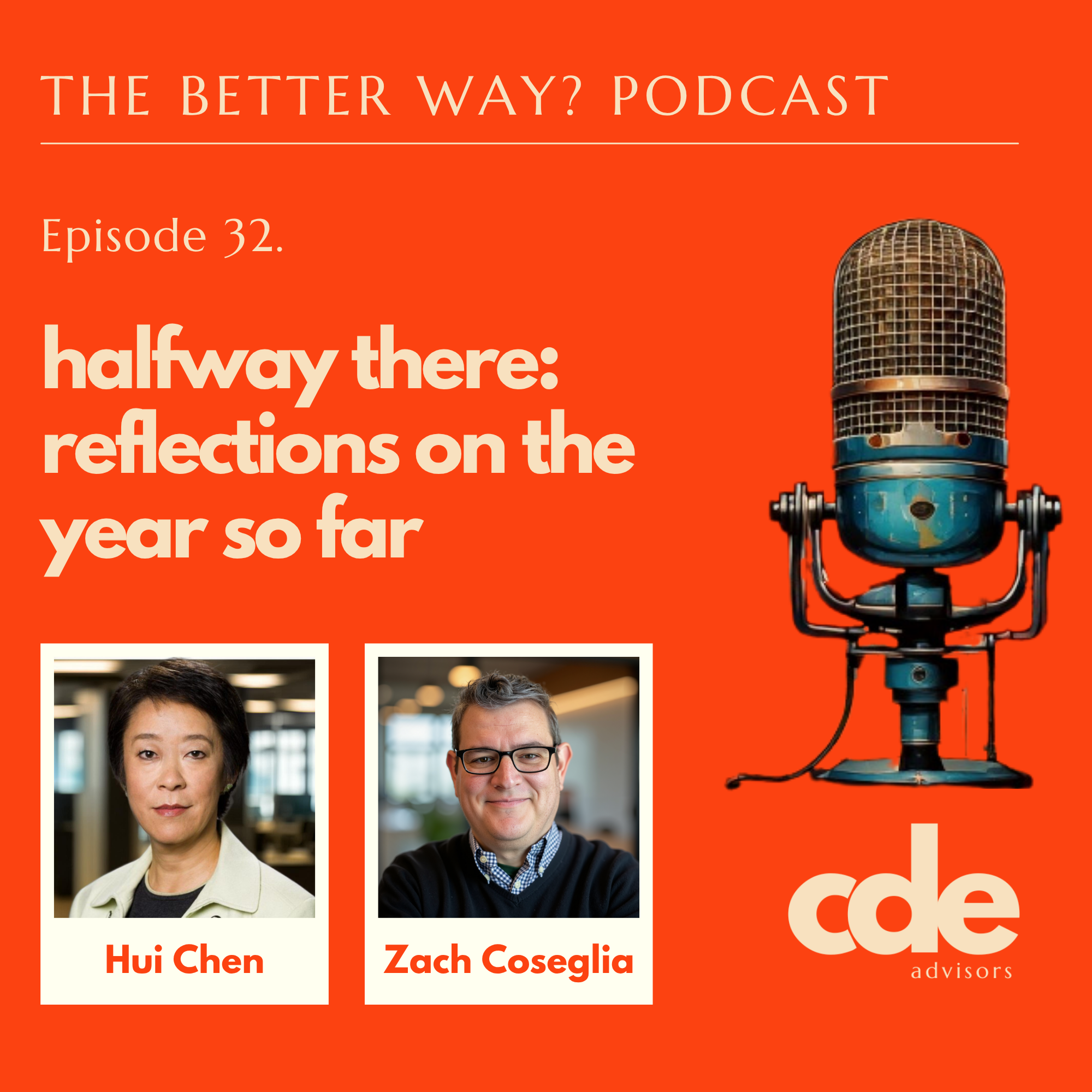
About this episode. At the halfway point of the year, Zach and Hui pause to reflect on the ideas that have defined recent conversations in compliance, ethics, and culture. From the role of curiosity as a professional superpower to the growing push toward outcome-based reporting, they unpack why critical thinking—and better questions—remain at the heart of effective programs. Along the way, they highlight the persistent gap between activity and impact, and why simply doing more isn’t the same as doing better.
They also dig into today’s productivity obsession and what it’s getting wrong, including the unintended consequences for culture, innovation, and decision-making. With insights ranging from inefficient meetings to shifting enforcement dynamics, the conversation ultimately points to a deeper issue: many compliance functions still lack a clear, articulated strategy. The episode closes with a call to move beyond outputs, rethink long-held assumptions, and build programs that are truly aligned with meaningful outcomes.
Who? Zach Coseglia + Hui Chen, CDE Advisors
Full Transcript:
ZACH: Welcome back to The Better Way? Podcast brought to you by CDE advisors. Culture. Data. Ethics. This is a curiosity podcast for those who ask, “There has to be a better way, right? There just has to be.” I'm Zach Coseglia and I am joined as always by the one and only, Hui Chen. Hi, Hui.
HUI: Hi, Zach. Hello, everyone.
ZACH: Welcome back. It's just us today, and we're right about at the midpoint of the year. And so, Hui, as we often do, we're going to take a pause, look back, and reflect on some of the top moments from the podcast over the course of the past six months, and just some of the trends and observations and reflections that we have
on the year so far.
HUI: Sounds good. It really scares me that we are already at half year point. I don't know how time could go so quickly.
ZACH: I know it really does seem like it's just flying by. You know what they say about when you're having fun.
HUI: This is true, this is true.
ZACH: All right, so I guess I'll just start. My first reflection on the podcast and on the year so far is curiosity as a professional superpower.
HUI: Go for it.
ZACH: You know, we start this podcast every other week saying it is a curiosity podcast, and I felt like it only made sense for us to really shine a light on curiosity. Now, we've done that over the course of the past, well, over the course of the past years, but we've especially done that in recent episodes around critical thinking, around getting to the root of problems when we talk about root cause analysis and the value of taking that moment to reflect back on why something happened and making sure we're asking enough why questions to really get to the root. We talked about this also in a recent episode that we called Out of the Echo Chamber, which was an effort to make sure that we had a real grasp on what's happening in our profession or what's happening within our companies. And so when I say curiosity as a professional superpower, it is critical thinking to the nth degree. It's making sure that we are asking better questions. It's making sure that we're resisting assumptions. It's making sure that we're avoiding simplistic explanations. And maybe better said, avoiding the explanation that feels most comfortable or the one that may be most readily available or the one that we want to go and share with our stakeholders. It's ultimately also about thinking critically before reacting. We crafted this podcast as a curiosity podcast because we are innately curious people. And I think we feel sometimes like there's not enough curiosity in our profession. There's not enough of those asking better questions and seeking better ways. And so I felt like if we're going to reflect, that was the best place to start.
HUI: Oh my gosh, I just love that. And I'll tell you, I was recently reading something that was talking about on the topic of curiosity. And I find myself arguing with the paper, which I do sometimes. I read a paper and I say, well, but that's not entirely true. Or I challenge their assumption.
ZACH: That feels like curiosity… That feels like curiosity and critical thinking at play right there. Yes.
HUI: Yes, so I was reading this thing that says curiosity is this… it describes curiosity as a series of feeling there is a problem or a question and the desire to know and find the answer. And I argue with this because I feel like it was missing the pairing that you made, which is, curiosity coming from critical thinking. Because a lot of times what is not happening is people are not feeling there is a question or a problem. Right? And they just… they, you know, it's the problem, I think, is sometimes seeing something or hearing something or reading something and just accepting it the way that's the way it should be. There is no question. And having, you know, it's not really just that desire to find the answer to the question. It's really realizing there's a question in the 1st place.
ZACH: Yeah.
HUI: And that comes from critical thinking.
ZACH: 100%, 100%. I mean, some of the places that we see it in our work are things like someone looking at data around the rate at which people speak up or the percentage of people who speak up not anonymously, but in a transparent way who say, hey, this is me and I've seen something and I want to let you know about it.
And they'll maybe compare that to a benchmark.
HUI: Yes.
ZACH: And the conclusion that we see in those scenarios is often something like, well, our data is consistent with the benchmark. And so we believe we have a healthy speak up culture. And to me, I see that and I'm like, I understand the instinct to reach that conclusion. But that conclusion is like at least two or three steps removed from the data that they were ultimately reviewing and using. And critical thinking is looking at that and thinking, are we sure? Is there more to the story? And curiosity is having sort of the wherewithal and the skill to go out and seek more information to answer that question.
HUI: Exactly, exactly. Yes, yes. And then in questioning, you know, how good is the benchmark? What does benchmarking mean? Are we really comparing apples with apples? All of those questions come from both critical thinking and curiosity. Oh, I love that.
ZACH: Yes. It's just so core to what we do. I mean, look at the sort of skill sets that are involved in ethics and compliance and culture work. It's investigations. You have to be curious to be an investigator. Otherwise, you're going to rely on your own biases or you're just going to believe the first person you talk to. In monitoring, right? Monitoring is all about curiosity. It's about going out and seeking answers to understand something about behavior, what is going on, and then collecting some data and probably asking more questions about what's going on and what does it mean and how do I tell a story about this? We spend a lot of our time, and we'll probably get to this at one point with our reflections today, focusing on the end story that's being told. The only way you can tell a good end story is if you were curious and exercised critical thinking all of the steps along the way. Otherwise, you're going to have a pretty empty, not very layered, probably inaccurate story to tell. So to me, it's like foundational.
HUI: That is so good. And it seems to be the perfect segue to my first observation. And I swear, I have to tell the folks out there that when Zach and I do these things, we agree we would each come up with three things. And we intentionally do not tell the other person what we have until we're live.
ZACH: Great. That's right.
HUI: So, we are always a little nervous. We wonder if we're going to come up with the same thing. But right now, I have one that dovetails perfectly, I think, to what you just raised, which is the growing interest yet continuing struggle with outcome-based reporting that we see in the profession. And so we've been talking about outcome-based approach to compliance, this whole idea that we want to focus not just on how hard we tried to prevent, detect, and remediate misconduct. But to try to measure if we have succeeded in doing that. And I just, you know, just in preparation for that, I went back to look at my first sort of official published work on this topic. That was actually presented, the idea of that I presented at an academic conference. I think it was maybe back in 2018-ish. I was invited to write about it in 2020, and the book, Measuring Compliance, edited by Benjamin, our friend Benjamin Bendroy and Melissa Rory, was published in 2022. And the second chapter in the book was my piece on this topic. And that was the first time I had put it out there as a coherent piece. So it's not been that long, but, you know, certainly in the last four years, we, well, even longer, frankly, because it takes a long time for a paper to become published, certainly a book, it takes even longer. So for probably 6 years at least, we've been talking about it. Even before you and I worked together, we have both been talking about it. And then together, this is what we always, always, you know, sort of raised when we're working with folks or when we're speaking.
ZACH: Indeed. Yes.
HUI: I think, I'm glad to see that I think it's beginning to take traction.
ZACH: Yep.
HUI: Because it's beginning to make sense to people, especially in the work that we do with boards and senior leadership. We asked them, right? You don't manage your organization in other aspects by counting your efforts. You don't just count how many sales calls your salespeople made and don't count how much revenue they actually brought in. That's not what you do. You don't count how much you spent on marketing and how many marketing activities that you've run, campaigns you've run. But not count incremental revenue generated by the marketing efforts. So, you need to take the same approach with compliance, that you're making people sit through things, you're making people read policy, you're doing all of this stuff, but what is it accomplishing for your organization? And I think in the days where we're facing now where there's a lot of uncertainty in the regulatory and enforcement landscape, that question is even more important because in the past, people sort of… most people did it to satisfy enforcement and regulators. But today, they don't know what's going to satisfy them. So if you're going to keep doing things that cost a lot of person hours and a lot of money, then you need to be able to show impact. So that concept resonates with people increasingly. What I think we're seeing is the struggle from a very deeply entrenched way of reporting. Because people have been doing it, counting the same thing, the output metrics for at least a couple of decades now. Some people sort of grew up in the profession with them.
ZACH: Yeah, for sure.
HUI To try to reimagine what that looks like or what that can look like, has been difficult for not just the compliance professionals, but even for board members, because they haven't seen some of what it could look like. So to the extent that when we have been doing this work and we've been able to sort of help them visualize what this framework of outcome-based reporting could look like, it's generated a great deal of interest, particularly from senior management and boards. But for the compliance teams, a lot of that difficulty comes from not just the entrenched sort of way of doing things, but it requires them to really look at new data sets that they haven't paid attention to. They have, but they haven't used them in that way. So, I think this is sort of both, I don't think it's bad news. I think it's good news and potentially more good news. But there is a struggle.
ZACH: Yeah, there's definitely a struggle. I mean, I think what's so interesting about the conversations that we have with those who are really interested in making this transition, who are really interested in making this transformation, they always seem to think that they're behind. And so I actually take a lot of… I like being able to say to them, you're not behind, you know, this is the future and you're not behind because everyone is struggling with this. And a lot of folks remained content to present those output-based metrics, both because they're content and because they're not getting pressure seemingly yet from their stakeholders, whether it be executives or the board. But I think that part of the reason why it's so hard and part of the reason why it remains an area of focus and an area of opportunity is because in compliance, perhaps more than most other functions, there's, well, there's under-resourcing. There's misaligned resourcing, you know, skill sets to need. And there's a really important day-to-day that has to be maintained, which makes it difficult to support transformation. The problem with that is that a lot of that day-to-day that's keeping you from the transformation may actually be super low value, low impact activity. And the whole reason for the transformation to a more outcome-focused approach is to empower you with data and information that says, I can stop doing that thing.
HUI: Exactly.
ZACH: But there's just such a… the stopping of doing things in the compliance world has always been a challenge. I mean, even with folk who are lucky enough to have resources and to be able to make some of these investments in, you know, program transformation, they often say we need more resources to do it. Because we're going to keep doing all the old stuff that we used to do anyway, because we can't stop doing those things. We've told people we do them. So it becomes additive. And that then perpetuates the problem at a micro level within that company. And it also sort of perpetuates it at a macro level because the community, the discipline of compliance reinforces this idea.
HUI: Right, so we're just adding more things.
ZACH: That once we've started doing something, we can't really stop doing it. How would that look? And that's a real problem.
HUI: Yes. Yeah, this is… I also… this this additive approach right is where I have so often seen companies end up with like, you know, 500 controls for something some activity that barely happens anymore because every time they do an audit every time they do some monitoring they find some problem.
ZACH: 100%. Yeah.
HUI: Instead of revisiting, you know, sort of what's already there, how can we improve on what's already there? Maybe what's already there is already too much. None of that thinking happens. It's, we found this problem, let's add one more rule to it.
ZACH: That's right. So my second is, this is always an issue. This is always on people's minds, but I feel like more now than ever, there's a narrative happening in the corporate world around productivity. Productivity is the word of the day. It actually, I think in some ways is more buzzy than AI. Although the two very much go together.
HUI: Yes, yes.
ZACH: And what I mean by that is that there was a period—we talked about this recently, there was a period of time where we talked about, we heard a lot about organizational culture. We heard a lot about people really focusing on the experience of their people. We heard a lot about things like inclusion, but not exclusively inclusion, just a broader sense that for a company to achieve its ultimate goals, it had to be not just serving its customers, but it had to be serving its people. It had to be serving all of its stakeholders. And human resources, and I don't mean that by the function, I mean that about the actual resources of the humans within the company were real focus. And I don't want to say that I think that that's not the case now, but the narrative really more than it has been in a long while seems to be about productivity, about efficiency, about doing more and doing it faster and doing it cheaper. And the result of that is, well, a few things. One, I think that it's resulted in the discussion around artificial intelligence being primarily about how AI can serve efficiency and productivity goals, and not about how it can actually serve substantive strategic outcomes. And that's a shame, because chances are, if you're using these tools, if you're using advanced technology, if you're evolving with the times to support a truly better program, you're probably going to get those productivity and efficiency goals as well.
HUI: Indeed.
ZACH: And so, focusing on it exclusively as a productivity or as an efficiency gain and not looking at the substantive opportunities, I think is a big miss. The other kind of thing that I think it's doing and dovetailing with what we've already talked about is it's making it so much easier to really focus on the output as opposed to the outcome. Because productivity metrics are easy to track. How many emails did we send? How many tickets did we close? How many hours did we bill? How many meetings did we attend? How many communications did we send? How many investigations did we do? And those things are interesting and important, but they're not ultimately answering the strategic insights that we want.
HUI: Yes.
ZACH: They're not necessarily pushing people to ask the right questions. They're not necessarily focusing on the behaviors that we want to shape. They're not focused on the judgments that people are making. They're not focusing on creative problem solving. And so it reinforces this output focused approach that I think is problematic. But more than anything, I think that it's creating… it's creating a cultural issue within a lot of the organizations that I talk to where the things that are often important to the employee don't feel like they're as important to the employer anymore. And when people start feeling that way, it's a slippery slope to some of the toxicity that we discussed in our last episode with Guido Palazzo around the dark pattern.
HUI: Yes.
ZACH: And I worry about the kind of broader macro level cultural implications of a so acutely productivity focused environment.
HUI: It is definitely worth worrying on your first point about it being easily linked to output metrics, you know, that is a real danger. It's sort of a built-in danger. And one of the things that it struck me with was that's that makes it all the more important to frame everything in terms of outcome, because ultimately productivity, even if you just, you know, count whether you're productive, it's about what you produced at the end, right? So it's not about how many bricks you made, it's about did you actually build something with it? And so that is a pitfall that comes naturally with that drive. And in order to overcome that reframing what is being produced is important. And in terms of that impact on culture, I mean, that pressure to perform, that pressure to produce up to a certain point is a healthy one. Every organization wants that. We want people to push themselves to produce, to be productive.
ZACH: Yeah.
HUI: But at what point does that become unhealthy? So, it suppresses the kind of creativity or voices of dissent that the healthy organization also needs?
ZACH: Yes, exactly. It's, well, we started by talking about curiosity. I think there's a lot of people sadly who feel like, well, curiosity sounds like something that's going to slow us down. You know, compliance feels like something that's going to slow us down. Innovation is a word that we all want to say we support, but what goes into innovation?
HUI: Right, right. Yes, yes.
ZACH: Curiosity, asking questions, critical thinking. And suddenly it's like, well, if I do the things that support innovation, am I actually slowing us down? And that's the paradox: is how do we strike the right balance between focusing on productivity without putting the brakes on these things that are critical to the ultimate success of a compliance program and the ultimate success of a business.
HUI: Yep, so I am going to take this and bring us to my other observation, which is really highlighting our interview with Professor Rogelberg.
ZACH: Yes.
HUI: I mean, it just seems so ironic that you have this over super focus on productivity. And at the same time, you waste, you organizations, waste so many hours, thousands, 10s and thousands of hours on something that not only in itself is not productive, but actually decreases productivity. When you have people who say that, you know, I feel like death.
ZACH: Just, just to say, we're talking about, we're talking about meetings. That was what we talked about with Professor Roberts. Meetings, yes.
HUI: Exactly. Yes, just in case. Thank you. Yes, meetings. When you have people say that being in a meeting feels like slow death that is not productive.
ZACH: Yeah. Definitely, definitely not.
HUI: That is not productive. And I find myself, you know, we've had so many wonderful guests and, you know, I have enjoyed our conversation and been, you know, lots of thought-provoking conversations that leaves us wanting to do more work, to be more curious. With Professor Rogelberg, one of the things that I've taken away is something that I now you know, becomes even more habitual for me than it had ever been, which is the kind of approach that, Zach, you and I take when we facilitate workshops. We always ask people in the beginning, when you walk away from this workshop, what do you want to have walked away with to make you feel like this was a good use of time? In essence, Professor Rogelberg was telling us to do the same with every meeting, right? So what are the questions that you want answered by the end of the meeting? What is the coordination that needs to happen by the end of this meeting? Basically, back to what we always say, what is the outcome, right? You want from this meeting. So that it's, you know, if it's an outcome is I just want to tell them about the new policy update, then think about whether you really need to do that in the meeting. So, I just, I felt like it was very practical in terms of changing how I plan for meetings. We always plan sort of for our workshops in that way. So all his approach, a lot of what his approach that we read in the book and also, you know, talked about in the podcast was incredibly validating to the way that we've been handling a lot of the meetings we facilitate. But doing a workshop to me required a different mind frame, designing one and running one, than just, you know, having a meeting. Because we do habitually go into meetings, oh, let's have a meeting. And we're not as thoughtful about it. I think that conversation had made me more mindful and more intentional about meetings…
ZACH: Absolutely. I mean, I think that the thing that I found most powerful about some of what he talked about in his book and then what we talked about with him is this idea that meetings are a tool. You know, we have software that we use. We have other tools that are like part of the tool set of just accomplishing our work. And we invest a lot in optimizing those tools and that software. And yet meetings, when you really start looking at data, meetings far more used as a tool than some of these other tools that we use to do our work. And they are not being managed. And so, like that to me was just this wake-up call. Like, this is a tool just like any other. Why are we not investing in managing this tool more effectively? And then when we started talking to him about ways to manage, I felt to kind of echo back our conversation about output versus outcome, I feel like so much of what people focus on are more output-based metrics around meetings. They start trying to fix meetings by saying, you know, instead of scheduling it for an hour, schedule it for 30 minutes. Or instead of scheduling it for 30 minutes, schedule it for 25 minutes and make sure you have an agenda. And like, there's value to those things, but they're disconnected from a why. If the meeting needs to be 60 minutes, then we should have a 60 minute meeting. If the meeting needs to be 30 minutes, we should have a 30 minute meeting.
HUI: Exactly. Yes.
ZACH: But we shouldn’t decide how long the meeting is, based on an effort to limit the amount of time that we are in meetings. We should determine how long the meeting is based on how much time we need to accomplish the tasks. But unnecessary we shouldn’t have an agenda just to have an agenda. I mean, we should have an agenda, but that agenda shouldn't just be a bullet of things we're going to go through. It should be, as you said, and as he said, a list of questions that we need to answer, a list of things for us to accomplish. And it all just seems so obvious and yet I sit in meetings still and I'm like, apparently, it's not that obvious because...
HUI: Apparently, it's not. And, you know, when it's done right, meetings can be the place where people do engage in creative thinking, where they really break silos and communicate with each other when it's done right.
ZACH: Totally. 100%. It's just, there's so much work to still be done on that front. And Professor Rogelberg was so impressive. And check out his website for those of you who haven't. Listen to the episode for those of you who haven't, there's all kinds of resources that can support both your strategic goals and your productivity goals around meetings. All right, my third and final one, again, somewhat related to much of what we've talked about. And there's probably a lot of people who won't agree with me on this one. But I feel like we continue to see teams who are managing compliance, ethics, culture, still lacking a clear, articulated strategy. And I think in the interest of curiosity, in the interest of productivity, in the interest of risk management, in the interest of building a stronger culture, in the interests of focusing more on outcomes, I think that the real next evolution of compliance probably isn't actually in more controls or more data, the things that get a lot of talk, but really more in greater strategic discipline. Clearly defining what success looks like, aligning resources to that mission, communicating performance in ways that leaders can actually understand and act upon. Having a strategy. You know, if you were to ask us, like, what would our strategy be? Well, we would say when it comes to measuring performance, we would say without skipping a beat, prevent, detect, remediate, and support and foster a culture that enables success in all of those realms. And if you ask us how we would do it, we would, without skipping a beat, say with a data-driven, human-centered, evidence and outcomes-based approach to compliance. And when we talk to folks about their strategy, again, consistent with the discussion around output and outcomes, what we often get is a list of things that they're doing. It is investigations and monitoring and policies and procedures and training and governance and committees, and that's not a strategy. And so, I think that what we have to have at the foundation to start, I said curiosity and critical thinking, and that gets us to a place where we can actually then define a clear, cohesive strategy, which then supports decision making about the things that we do. And yet I think so much of what's happening is we start with the things that we do or the things we have to do, and we're missing that why. And as a result, we're then measuring what? Instead of performance, instead of what has it actually accomplished. And so that's what I have observed. That's a reflection for me over the course of the past six months, a year. And it's something we talk with the companies we work with a lot. And it's something that I just want to see more of in this space, more intention focused on strategy.
HUI: I think in connection, very closely connected with that are concepts like a mission statement, having smart goals, specific, measurable, action-oriented, relevant, and time-bound. Because those things… I know… have been around those concepts have been around for a long time. The problem is they have become more sort of formalities, more like the posters on the wall. Like people now do goals and objectives, like they're just checking some boxes and file in the HR system, that's the end of that.
ZACH: 100%.
HUI: We are not so much saying that you need to have a mission statement displayed on your wall. We're saying you need to have a mission statement internalized in your head. Right? So that when someone asks you what it is that you do, you can say that. Yes, and I'd rather you don't have it on the wall, because when you have it on the wall, it becomes decoration, you forget about it, and sometimes it might even become a joke. But if it becomes something you internalize and that guides your decision and strategy and priorities and choices every day, every moment, that's when it matters. And that's the same thing with smart goals, right? We want smart goals so that we can be all those things, be smart in what we actually do day to day. You can just say it like an elevator pitch.
ZACH: Yeah. And so that you can use it to check yourself when you're thinking about, okay, should we do this or do we need to do this? Go back to that, go back to that mission statement, go back to that sort of strategic guiding light and ask yourself, is it consistent with that?
HUI: Yes, and I’d rather that you don’t have it on the wall. Because when you have it on the wall, it becomes decoration. You forget about it. It might even become a joke. But when it becomes something you internalize, and that guides your decision and strategy and priorities every day, that’s when it matters. And that’s the same with SMART goals. We want SMART goals, so we can be smart in what we do every day.
ZACH: Yeah, I mean, for me, it's also about... The most important thing to me I have found over the course of the past 20 years is, I want to be around people who have ideas. You know, if I were hiring a chief compliance officer, my question to them would be, what are your ideas? Whether you call it a strategy or you call it goals, we don't need to give it a name. I just want to know that you have… what is your idea about what this program needs to be, what your team is going to do? The other thing…
HUI: Yes, that's right. Yes, and how to get there.
ZACH: And how to get there. And to the point about how to get there, the thing that I also think is really important that you talk about all the time is when we're setting those smart goals, let's not just, you know, oftentimes what happens, right, is it's that time of year. Everyone has to set their goals. You've got to get them into a system. They need to be approved. And what you talk to the companies we work with all the time about is, I understand that the ask of you right now is that you need to do your annual goals, but I'd like to see you show us your goals for the next five years or for the next three years, making that not so acute, but instead thinking longer term about what you're going to do.
HUI: Yes, exactly. All right.
ZACH: All right, what's your last one?
HUI: My last one, it might surprise you because I usually run away from this topic, but I do feel like it's important to address it, which is the enforcement landscape. So, we continue to see, and again, this is one of those habits that people have, because for again, for decades, compliance folks have been running around trying to get funding and attention by scaring their business stakeholders with the big scary DOJ.
And the big, scary DOJ acts very differently now than it used to. Its priorities… its priorities are very different than what it used to be. I mean, just this morning, I got a press inquiry about sort of the latest DOJ move relating to the fraud division versus the pre-existing fraud section. And this journalist says, you know, I'm really confused about what DOJ is doing. I think he's not the only one. I think even people in the very act of those reorganization are probably a little bit confused because what is being done with the new fraud division is really unprecedented. In several ways, the most important of which is there had always been a very deliberate effort to preserve independence of the prosecutors. It was always, certainly through my career as a prosecutor, you know, we do not take orders from the White House. In fact, if there's any hint of that, we kind of tend to run the other way. This whole new division is set up with the opposite of that approach. And it is explicitly set to be sort of running out of the White House in some way. You also have a real factor with the fact that DOJ, that used to turn away the top lost graduates of the country, now can't fill their positions, are coming out with signing bonuses and whatnot to try to get people to even apply. And I talked to my colleagues in DOJ, you know, when they have vacant positions, then when they had 10 open positions before, they would have 500 applicants. Now they have 12. So, you have to think about what that means in terms of who is on the other end of that enforcement stick that you're you've been focusing on. Are they able to make a case? Not just investigate a case, but really actually make the case go all the way to a conviction in court should the other side choose to fight it. The other interesting thing is people are not necessarily paying attention to the cases that are not resulting in any settlement. So I used to always talk about this that people focus on the latest settlement coming out of DOJ. You're only seeing a very small portion of the picture because there's a lot of other cases still in the pipeline. You actually don't know what happens to them. Some of them just go away, in which case you would never hear about them. Those are the ones you actually want to be. Does this quietly go away? Not even an announcement. You know, there's an investigation. It just went away. That happens, way more often than people think. But you never hear about those because it's not something they have companies have to disclose and they certainly won't disclose if they don't have to, right? So, these are the things that people… that always… there was always like a number of cases that's under the surface that people do not see. Now, some of those under the surface are actually very visible. So let's take, you know, a couple of cases relating to DEI enforcement. You have IBM settling a case that's now garnering attention among compliance folks. You also, for longer than that, have Harvard University essentially fighting a DEI investigation. That's still not resulted in anything. So, I think when compliance folks now present this sort of enforcement update to their stakeholders, they have to be very careful to balance that picture. You can't hold up that one settlement and say, this is it. See, we have enforcement risk. We got the settlement. It's for this amount and for these kind of practices. You are focusing on one settlement out of many, many cases most of which are still unsettled and may never be. And if there's actual enforcement action taken like litigation, there are more and more organizations that are choosing to litigate and not just settle. So, if you want to present on the landscape, you have to present all of those. You can't just focus on the one settlement and say, this is it, this is the enforcement trend. That is not the enforcement trend. One case or two cases do not a trend make. That need to walk away from that kind of myopia is ever more important today.
ZACH: I agree. And it actually to me is part and parcel of the point that I made about a need to have a clearly articulated strategy, a strong why and goals supporting it. I think that the observation that you've made is largely tied to the fact that for a very long time, the why to get resources, the why to exist, the why to get a seat at the table has been articulated as DOJ / regulator / enforcement whatever. And as a result, in a world in which enforcement becomes much more complicated and potentially, recedes, we have folks struggling to articulate why they exist or why they need to continue to get attention. And so, the instinct then is to take not the trend, but the case that comes out and say, here, look, that's the rule. Remember, that's why we're here. And look, it hasn't gone away. And I think that what we need to ultimately do is shift the reason for our existence away from so exclusively or so heavily enforcement and regulatory based… because one, that's just not a good reason to exist. That's not a good reason to get resources in and of itself. And none of us really believe that that's why we're there, exclusively. And so, I feel for folks who are managing this and managing, you know, a complex environment within their organization and trying to continue to show why they need to be around and why people need to pay attention to them. But I think that sometimes the result of what we've created with that focus causes us to color things in a certain way.
HUI: So true.
ZACH: And that's not always based on, to bring it full circle, critical thinking.
HUI: Full circle.
ZACH: Yeah. I love it when we do this. I love it when we have guests, but I love it when it's just the two of us reflecting and sharing our thoughts. Any final reflections or observations for folks, Hui?
HUI: Well, I hope you all enjoy a wonderful summer. We are probably going to take a little hiatus during the summer for July and August, but we will be back with a roar in the fall. And we will have things to keep your critical thinking engine going during the summer. So, it may not be a podcast, but maybe other things.
ZACH: Absolutely. Stay tuned. You know where to find us. Thanks, Hui. This is fun, as always, and thanks to all of you for listening.
ZACH: And thank you all for tuning in to TheBetter Way? Podcast. For more information about this or anything else that’s happening with CDE Advisors, visit our website at www.CDEAdvisors.com, where you can also check out the Better Way blog. And please like and subscribe to this series on Apply or Spotify. And, finally, if you have thoughts about what we talked about today, the work we do here at CDE, or just have ideas for Better Ways we should explore, please don’t hesitate to reach out—we’d love to hear from you. Thanks again for listenin.