Ep.31: The Nine Circles of Corporate Hell
Remember, you can always listen here or follow us on Apple Podcasts or Spotify. Either way, thanks for supporting us.
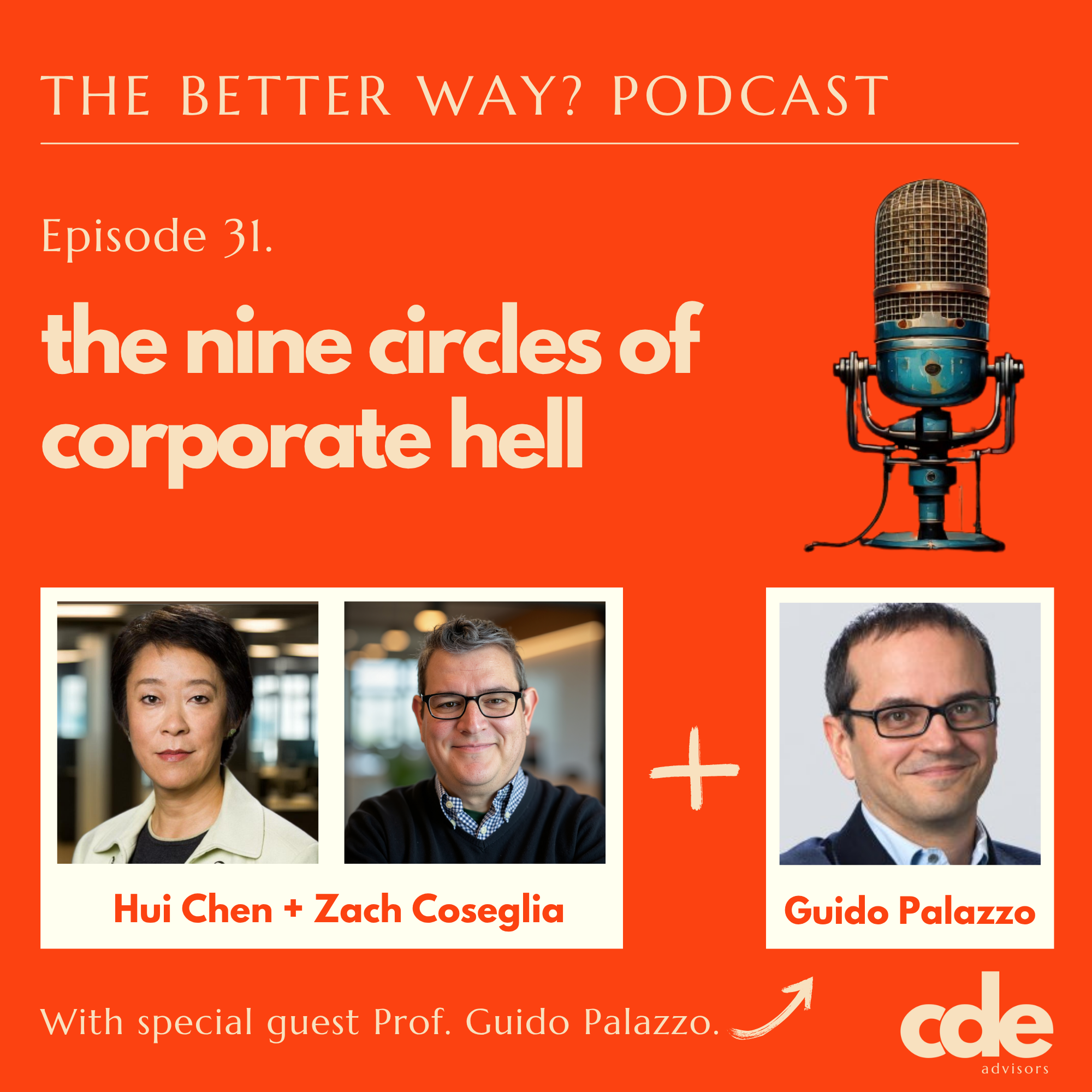
About this episode. What really drives corporate scandals? In this episode, Zach and Hui sit down with Professor Guido Palazzo, co-author of The Dark Pattern, to explore how organizational environments shape behavior in ways that go far beyond individual intent or values. Drawing on cases like Wells Fargo, Theranos, and Boeing, Guido explains why misconduct is rarely about intent alone—and instead emerges from a powerful mix of pressure, incentives, culture, and context that can override judgment and values.
They walk through the nine elements of the “dark pattern,” a set of recurring conditions that show up across major corporate scandals. Along the way, they also challenge the limits of “do the right thing” messaging and explore what it actually takes to build cultures where people can navigate ambiguity, speak up, and make better decisions. The result is a deeper understanding of how context shapes behavior in powerful and predictable ways.
Who? Zach Coseglia + Hui Chen, CDE Advisors; Prof. Guido Palazzo
Full Transcript:
ZACH: Welcome back to The Better Way? Podcast brought to you by CDE advisors. Culture. Data. Ethics. This is a curiosity podcast for those who ask, “There has to be a better way, right? There just has to be.” I'm Zach Coseglia and I am joined as always by the one and only, Hui Chen. Hi, Hui.
HUI: Hi, Zach. Hi, everyone. We are joined today by a very distinguished guest. So we have with us today, Guido Palazzo. Professor Palazzo is a professor of business ethics at the University of Lausanne in Switzerland. He is also a business advisor whose research and work focus on trying to understand why big corporate scandals happen. His work has been published in leading management journals, and last summer he released The Dark Pattern, The Hidden Dynamics of Corporate Scandals, co-authored by Ulrich Hofraguet. Welcome, Guido.
ZACH: Yeah, we're so happy to have you. And look, we pretty much start every episode in a pretty standard way. We hear a formal introduction of our guest, but we like to ask our guests to tell us about themselves in their own words. So, Guido, who are you?
GUIDO PALAZZO: I am many things. I'm a Swiss, I am a German, I'm an Italian, and I'm many nationalities. I studied philosophy and business. So for business people, I was always the philosopher. For philosophers, I was the business guy. For Germans, I was the Italian. For the Italians, I was the German. So I'm always in between things.
and places and cultures. So that's my destiny.
HUI: We appreciate that.
ZACH: I love that. I feel simpatico with you in that kind of feeling often like an outsider or having multiple identities. Hui mentioned your book, and we want to spend quite a bit of time actually today talking about your book. And I think the best place to start is actually to talk about something that we talk about a lot on this podcast, which is context. We are deep believers in the idea that context matters, that decisions aren't made by people in a vacuum. They're influenced by and they in turn influence the context in which they're made. Now, this is one of the core theses of your book. You write, in fact, quote, “context can be stronger than reason, stronger than values and morals, and stronger than the best intentions.” Explain to us the importance of context in understanding and managing risk.
GUIDO PALAZZO: If you think about how corporate scandals are represented in the public debate, let's say on a newspaper article, in a book or in a Netflix documentary. It's always the same way. It's a story of some villains at the top of an organization and maybe some heroes who make this public and then it leads to collapse and healing and everything. So, it's a story of heroes and villains. And the assumption is that the bad stuff is happening because there are a few bad people at the top of the organization. And if we just understand their motives and their character, we understand the scandal. But then if you look into these scandals, if you go deeper, you see that there's something wrong with that story. Take the case of Wells Fargo, biggest American retail bank. At one point, roughly 100,000 salespeople we are committing fraud on their own customers, 100,000. So how you, can you explain this by looking into people's character? What strange company would that be to attract only criminal bankers, right? Or what kind of HR department would hire with that focus on criminals? It doesn't help you to understand this. So, the real question we have to ask is, what is it that makes those 100,000 salespeople break the law? And that is not their character. That's the context they're in. So ,there are forces that, in a way, push them into decisions that are not explainable by their character, but by their pressure by their situation, by things that somehow distort their ability to make proper decisions.
HUI: I just want to say we so appreciate what you just said, because a lot of times you have the context of the organization. You also have the context of the individual's sort of life. That's also right part of part of that person's decision making. You have the overlap of those contexts. And it just makes things so much more complex. And one of the things that really irritate both Zach and me is when we hear people say something like, just do the right thing. As if there's some kind of universal North Star, that the right thing means the same thing to everybody. And this is really one of the favorite phrases that a lot of people in the ethics and compliance profession default to, and we are very uncomfortable with this sense of some universal North Star. And I'm going to quote from your book here. You write, “in their compliance training, companies often advise their employees to apply simple rule of thumb to assess the morality of their own decision. Can I still look in the mirror tomorrow if I make this decision today? Will I still be able to look my children in the face? Will it be okay for me if what I did today was in the newspaper tomorrow?” You then paraphrase Andrew Fastow, the former CFO of Enron, who notes that he, quote, “was initially praised and honored for the same behavior for which he was later locked up as a criminal”—end quote. Now, if the mirror, the children, and the newspaper aren't the right questions to ask, what are the right questions to ask?
GUIDO PALAZZO: The challenge is that, like in this case of Andy Fastow, the people who get routinized in breaking rules, so who do it again and again and again, they don't feel anymore that they break rules because they... in a way, they push this to their unconsciousness. Routines are actions we engage in without thinking. So when I am at Wells Fargo and I commit fraud once, it might feel not well in me, but I do it again it feels already a bit easier. And then I keep doing it and I stop thinking about it. And even if I then ask myself, can I look in the mirror? The answer is of course, yes, of course I can. Like Andy Fastow could, like probably also Elizabeth Holmes from Theranos. So, there's this Stanford drop out to create this blood testing startup, which then turned out to be a big fraud. I'm sure that until today, and she's in prison now, until today, she's probably convinced that what she did was right. She was just on the way of making it happen, engaging in what all these people in Silicon Valley do when they create a startup, fake it till you make it. You over promise, and you run behind it, and you make it sooner or later happen through hard work. It's just that in her case, it didn't work. But if you are engaged in that, in the middle of that process, you probably think, I just need more time. And we have this little progress already. Give me more time and I will make it. And in the meanwhile, I have to fake it like everyone does. So, you do the wrong thing, and it feels right. And on top of that, if you look into the typical ethical decision making situations, they are not black and white. They are dilemmas. Dilemma means I have trade-offs. Trade-offs means I have to figure out how do I solve a problem or find an answer to a question, make a decision when none of the answers is perfect. So, all these do the right thing talk is not very helpful.
ZACH: Definitely, definitely.
HUI: Exactly.
GUIDO PALAZZO: It even creates pressure on people, right? Because the assumption is there must be that right thing to do. It's only me who cannot find it. So I have to think harder. But maybe it's not there. Maybe it's just the fact that to achieve A, you must compromise on B.
HUI: So true.
ZACH: So true. When you talk about the 100,000 employees at Wells Fargo, it actually sparked for me this article. I don't know if you saw this yesterday in the New York Times, this article by Amanda Taub called Actually Democracy Dies in HR. And one of the things that she writes in this article that I thought was very interesting in the context of your work is new research, this is what she writes, “new research drawing on an extraordinary data set from Argentina's dirty war in the 1970s and 80s suggests a sort of different explanation for employee behaviors. It turns out that the kinds of career pressures familiar to employees everywhere, the desire to revive a stalled career or obtain a minor promotion can be enough to incentivize lower and mid-level officials to violate professional obligations, fundamental norms, and even basic morality. The people who make those decisions, the research suggests, are neither extremists nor victims. They're often just middling workers looking for a way to get ahead.” Does that prove true from your research?
GUIDO PALAZZO: That's in a way the argument that Hannah Arendt made long ago, the German Jewish philosopher, when she was in the 1950s, no 60s, sorry, was in a courtroom in Israel when Adolf Eichmann, the former SS officer in logistics manager of the Holocaust was sentenced to death. And she was shocked by what she saw, because she saw what you just described from this article, that there was a bureaucrat doing his job, following his incentives. And what he just lacked was moral imagination. Whether she was right about him has been disputed, but this basic idea that the -- that evil is banal. It's people trying to make their career, doing their job, following their orders, and hunting their incentives. That you find in all these scandals. I mean, all these people are exposed to expectations they try to fulfill, because they know if they don't fulfill them, then something happens. And they don't want that.
ZACH: Yeah. When I was reading your book, it didn't take long for you to get to examples from Nazi Germany. And I knew when that happens on page 10 or 15, I was like, Hui is going to like this book! As a history buff and as someone who…
HUI: Yes, yes. Zach knows.
GUIDO PALAZZO: No, I guess we had to open the book with the Adolf Eichmann story because we have to pay tribute to Hannah Arendt, who invented this whole discussion. I mean, without her, we wouldn't think about evil as being something that is banal. We would still hunt the bad guys, right?
HUI: Yep. So, we've been hovering, or actually maybe perhaps more than hovering on a phenomenon that you previously have labeled ethical blindness. So maybe we take this opportunity to just dive into that concept or at least define that concept for a moment. What is ethical blindness and how does it materialize in the corporate setting.
GUIDO PALAZZO: Take the example I just mentioned, Elizabeth Holmes. I would ask her, did you...behave in a wrong way, she would say no. I was just an entrepreneur trying to make it happen. And I had the bad luck it didn't happen. But so does it happen to many entrepreneurs, right? So she would not feel wrong about her behavior. She would think that what she did was appropriate, was normal, was what everyone is doing. Or take the example of another example we use in the book of Lance Armstrong, the former professional cyclist. When he was winning the Tour de France, so the main race in professional cycling, seven times in a row, 1999 to 2005. And when he was doing that, he was using EPO, a drug that gave him 10% more performance, which he always denied. And he tried to crash and destroy people who made that claim. When he could no longer deny, he went to the Oprah Winfrey show. And he said, okay, I confess, I used EPO, but I never cheated. I never cheated. So, in his mind, what he was doing was just, it was fair. If he had not used EPO, while all the others use it, that would not be fair, right? Because then he would have a disadvantage. If everyone is using it, you just create a level playing field. So in your mind, what you do is right, is morally right, is just. So, he could not see any more that what he was doing was wrong because everyone is doing it. Ethical blindness is this inability to see that what I do is wrong. And that is temporary. It's not always there. It's just in the heat of the moment. When I'm doing these bad things, under all these pressures, then I do not realize anymore what I do is wrong. When I'm out of that context, I might feel ashamed. You see this very often if corporate criminals are pep walked by the police in the US, on their face, this shock, how could this happen to me? How could I do this? This is so alien to how I feel inside and I still did it. So you wake up and you suddenly feel ashamed. But as you are doing it, you don't see it. As Andy Fastow said, I was receiving awards for something I would be put in prison later on. So ethical blindness is that, is this routinized inability to ask yourself, is there a moral component in my decision, or is there something wrong with what I do?
ZACH: We've been sort of skirting around the core of your book, and I think it's time to dig in and to talk about the dark pattern. We highly recommend that those listening check this book out. I'm guessing many of you already have. As we said, you take us through some number of corporate scandals, including Elizabeth Holmes and Theranos. You also use fairy tales, you use Nazi Germany, as we said, and you use the Divine Comedy and its nine circles of hell as a framing device. It actually inspired the title of the book. So, you call the dark pattern “the underlying pattern and hidden dynamics at play in corporate scandals.” You call it “the toxic context” for the people working within those organizations. And as we'll kind of dig in, it's composed of these nine building blocks. So these are kind of like the symptoms, I guess we could think of them, the symptoms of what can lead to a corporate scandal.
GUIDO PALAZZO: It's the driving forces of what we until now here in our conversation have called context. Because if I look at a cyclist at the Tour de France or a manager at Wells Fargo or an engineer in the lab of Theranos, the question is why do they do this? And is there maybe something that is happening in all these cases. That was the question that we asked when we looked into scandals. Is there a repeating… Are there repeating phenomena across Scandinavia? On the surface, they're all different, right? The blood testing machine at Theranos, the Boeing crashers, the fraud in Wells Fargo. But is there something that they all have in common? Because if there would be, that means we would have maybe a way of analyzing scandals or risky situations before they become a scandal and prevent it if we work in compliance or if we are leaders in organizations. So that was the idea. And as you said, we found… we claim that we found such a pattern that exists of nine building blocks, like…
ZACH: Yeah. Well, let's dig it, yeah, let's dig into them and let's start, yeah.
GUIDO PALAZZO: That is like Dante's hell, so this… yeah, this is the corporate hell, this is corporate hell.
ZACH: This is literally the corporate hell. So let's start with the first one. And it's, you call it rigid ideology. Define this for us and tell us what the warning signs are. What should we be on the lookout for?
GUIDO PALAZZO: When you, when you study business in a business school, you get taught a certain way of thinking about the world. How is the world? And this includes things like you must maximize profit for shareholders, and that's your only social responsibility, Milton Friedman. Markets regulate themselves, so governments are really bad. You don't need regulation. It's inefficient. Humans are egoistic, consumption makes us happy, and innovation happens through smashing stuff, disruption. So just in a nutshell, these are beliefs that together form an overarching narrative that then dominates a society like ours, the modern liberal democratic society is having that kind of what we call neoliberal ideology. So if you have an ideology, it means it limits your thinking. You start to manage a company and you are convinced that you have to maximize profit at any price. And then you do things that are just following that one goal. Take the sea of Boeing. One of the scandals we discuss is the Boeing 737 Max crashes. Harry Stone Cipher becomes the sea of Boeing in 1999. And he does what he has learned from his own boss at GE, Jack Welch, how to maximize profit. And this is 2 things. First, you fire 25% of your workforce in the first four years to brutally cut cost. And he did this at Boeing. So he fired especially the older engineers, the experienced one. He shifted production to places without unions, but also without competences in building airplanes. And then he did a second thing, which he learned from Jack Welch, which is buying back shares. If a company buys its own shares, they get cancelled out, so there are fewer shares around, value goes up. So, two things that you do to just maximize shorter value without any kind of substance, without product quality, customer satisfaction, it's just for sake building, right, but you hollow out the organization. But this is what they think they are supposed to do because of what they believe in, right? The magic of the market, as Ronald Reagan called it. So this is ideology. If you are too strongly believing and not questioning the overarching ideological context, then you just do wrong things and you just don't see it.
ZACH: Yeah, it's the rigidity of the ideology—or the problematic nature of the ideology is less the maximizing profit or maximizing shareholder value, it is more the at any cost part of that, right?
GUIDO PALAZZO: Yes. It can also be any kind of ideology. In our case it’s the liberal ideology, because that’s what companies are embedded in. But you can also think further. Look into NGOs where they are feeding, they are on a mission for humanity. Or UN organizations. And this being on a mission might also liberate you from rule following because you think, well, we do good things, so we can break rules. So anytime that you have a very strong belief system that makes it not possible to challenge what you do or to have a broader, more holistic view, that is dangerous.
ZACH: Yeah, and that is sort of the antidote to rigid ideology, what you just said, which is holistic responsibility. Give us a little bit more detail what you mean by that.GUIDO PALAZZO: If you are narrowly shareholder value oriented, you'll just look at shareholders. And you assume someone else takes care of the rest. If you have a more holistic view, you manage stakeholders. You have customers, you have governments, you have the environment, you have human rights in your supply chain. You have many, many topics, expectations, and people with conflicting expectations. That might even conflict with the shareholder value. So you have to not maximize one thing, you have to balance many things. And that's the danger of maximizing. If you maximize mathematically, just you cannot do more than one thing. And you must do it at the cost of everything else, because that is maximization.
HUI: Yeah, becomes a zero-sum game, yeah.
GUIDO PALAZZO: Yes, exactly.
ZACH: Indeed. All right, well, let's talk about the next one, which is toxic leadership. This is kind of self-defining, but give us a little bit more detail of what you found and how you've defined toxic leadership in your work.
GUIDO PALAZZO: Think about the case of Volkswagen Diesel Gate. So Volkswagen 2007, they are informed by the US authorities that they have to reduce diesel car emissions by three quarter. They're given two years, which is super tough technologically wise. And the engineers start to work on it. After one year of working on this new filter, they realize we cannot make it, not in the limits of the budget and the time we are given. So, they have two options. They can go to the CEO, Martin Winterkorn at that time, and tell him we have a problem. But they find a solution. As we know today, they found a solution, which was to manipulate the software of the car to simulate compliance in the lab test. So, why did they not go to him? Winterkorn, first of all, had forbidden the word problem. If you had a problem, you were a problem and you might be fired. There was a German news magazine, Der Spiegel, publishing an article about him two years before the scandal happened. And they followed him in his, these journalists followed him in his work and then analyzed the culture. And there's one sentence that sticks out of this article. And that is, as they describe it, Volkswagen is like North Korea minus the concentration camps. So, you have a CEO at the top who is choleric, who yells, who humiliates people, who throw stuff at them, who destroys parts of cars because he doesn't like the quality, who creates a climate of fear around him, in which speaking up is not possible because it would be the end of your career. So, this is what we call toxic leadership that you have a culture of fear where when you're on Sunday evening, think about going to work on Monday morning, you have stomach pain because you cannot imagine going there. There's this wonderful quote from a salesperson at Wells Fargo who said at one point, I have been a soldier in the Iraq War, 1991, the Gulf War, and I must say working for Wells Fargo was worse. So you say the climate at Wells Fargo is even worse than fighting in a war. That is what we mean for toxic leadership. And that excludes any kind of speaking up, any kind of problem that you mention to your own leaders, because it's just not possible.
ZACH: Yeah. So, you've defined speak up culture as the antidote to toxic leadership. And I'm sure you've seen, it's been on LinkedIn, it's been on social media, it's been in the news, the Bolt CEO recently giving a talk about how he had all of these problems arising within his company. And he realized that he could make them all go away by firing all of the HR people. It was the HR people who were creating these problems. And so he fired them and magically all of the problems that they once had went away. I suspect that's not what you mean when you talk about a speak up culture.
HUI: That's almost classic shoot the messenger in a way.
ZACH: That's right.
GUIDO PALAZZO: That's toxic leadership, right? I mean, you fire people because they have problems, and then who else is still surviving this firing will not have problems anymore. Because magically, when there's fear, the problems all disappear. Of course, they don't disappear. They are hidden in quality issues, in fraud, in burnouts, in suicides. But they are not there in words anymore. No one communicates.
HUI: Yeah, they just go underground.
GUIDO PALAZZO: Yeah. And the speak up is, well I said the speak up is so difficult to achieve. I haven't seen many companies doing that because this climate of fear is even in companies that are not as extreme as the ones we describe in the book.
ZACH: Yeah.
HUI: So true. We do see that commonly. So, let's dig into your next concept or next circle of hell, manipulative language. What are you talking about when you are describing those?
GUIDO PALAZZO: Think about the CEO of Lehman Brothers, which is the only bank that went bankrupt in the financial crisis, because we know they took too high risks compared to their peers. The CEO, Richard Food, he used to say to his traders, you have to cut the throat of your enemy, and he would give them plastic swords. The enemy was, of course, not Goldman Sachs or JP Morgan. The enemy was your colleague next door because 20% of them would be fired by the end of the year. So, if you want to survive in this organization, you must symbolically cut the throat of some of your colleagues. So, if you use war language, it creates this feeling, people that rules don't count for me because I'm in an exceptional situation. I'm in a war. I'd have to survive. So, language is never innocent. Language guides our thinking and it guides our behavior. We make sense of the world through words and then we execute that. And the other language that you often find is in scandalized companies is euphemistic language. So, you would never, at the Tour de France example of Lance Ermstrong, no one would ever say doping. And the doctor… team doctor, will tell you, I'll give you an injection to prepare you for tomorrow, or I'll help you to recover, or this is good for your health. Right? So, you frame it in banal, seemingly nice and harmless words. And we know from research that if you package doubtful practices in your for mystic language, it makes it easier to commit those crimes or to break those rules. So, language is something that reveals the wrongdoing but also pushes people towards the wrongdoing in organizations. So the way leaders speak and the way that people act, that's connected.
HUI: It's so interesting because in a way the corporate world is a world of manipulation of language, right? So, you know, we, you know, we don't like to talk about problems. We like to say challenges. We don't say layoff, we say downsizing. And then downsizing became right sizing. So, the entire corporate world is very much entrenched in this way of making things sound a lot better than what they're… what they might really be. So what would you say is the antidote?
GUIDO PALAZZO: What you see in companies that manage this well, and this is typically companies that had a scandal and then wake up to the importance of ethics, is that if you normalize moral conversations, then people feel free to talk about moral issues, to speak up. What does that mean? It means that if a leader of a team from time to time engages the team in talking about a dilemma, picking up a scandal from the news and saying, is this, could this happen here? If not, why not? Talking about a corporate value when making a decision or recalling a previous decision asking… knowing what we know now, what we have done the same. So, these kind of conversations, if you normalize them by engaging in them, you signal to the team that it is okay to talk about ethical issues in my team, in my organization. So they will not hesitate to do so, and they will be trained to do so by having regularly these conversations. So that is the antidote to the narrow language games that we investigate in the book.
HUI: That is so, so rare. So rare.
GUIDO PALAZZO: It is, yeah.
HUI: All right, let's let me ask you about corrupting goals. What do you mean by corrupting goals?
GUIDO PALAZZO: Imagine you have that climate of fear. And then your boss gives you a goal you cannot achieve. I'm not speaking about ambitious goals. I'm really speaking of totally unrealistic goals. And your boss knows it, that these goals are unrealistic, and you know it, but no one dares to say it. So what will happen next? You will try to achieve those goals. But these engineers at Volkswagen could not build this filter in two years. It was just not possible. Not at the price it would need to be sold at, or built in the car, not within the limits of the budget, not in the time. So they couldn't do it. It's not realistic. What do you do? Find a solution, right? Or the cyclist at the Tour de France, if you would not use EPO, that drug, you would not have 10% more performance. You would never achieve anything in these sports, not even stay within the group. You would just fall behind and would be kicked out of the system. There's no way of doing it without. So you have goals that you cannot achieve. And under the pressure, the fear, you still go for it because you cannot say it. And that leads you to rule breaking. The quotas of Wells Fargo salespeople were completely unrealistic as well, right? But you have to achieve it. There's no way out.
HUI: And what is… so, what's the antidote to corrupting goals?
GUIDO PALAZZO: Well, you give people goals they can achieve, right? They are ambitious goals, but they can achieve them, realistic goals. It doesn't mean there should be easy goals, because easy can lead to being bored out, because if you achieve your things too fast and you sit around and have nothing to do, that's mentally difficult as well, like the burnout situation. The bore out is a challenge. So ideally find this middle ground between the burnout and the boreout and give them goals they can achieve, but they have to engage and work hard to achieve them. And give them, and maybe this to add away, give them a way of voicing it that leads back to this speak up. If I still cannot achieve it. There must be a way of going to my boss and say, we have to do something. This is not working, right?
HUI: You were reminding me of a time when I worked with a company that has a set of problems, there I call it, in a market. And it really directly come from the pressure to perform and to achieve goals that are well above all their competitors' goals. When we work with the company and their team, and this is voiced by everyone, when we went in as consultants to talk to them. And then when we convene them together and say, how are we going to address this issue? The first thing we were told basically by management was adjusting the goals is off the table. Right? So, that's, we are not going to go back to our shareholders. We've mentioned this goal to on our shareholder calls, our quarterly calls. You know, this is not negotiable. So let's see what else we can do. And so, you know, in working with them through it, we saw, we saw the difficulty because we can imagine the CEO doesn't want to go back to an earnings call and adjust the potential earnings because of this never should have set those goals in the first place. But at this point, they can't walk it back anymore. And they certainly can't adjust it downward. So they're trapped in that situation. And we, you know, that's not the only time we have seen this kind of thing, but it is a real problem.
GUIDO PALAZZO: And what you often observe in goal setting processes is that if your leadership team defines overarching goals, the next level adds to this, let's say it's 100% goals, the next level adds 5% because they want to be sure that their teams achieve it. And then the next level adds 5%. So, the further you go down, the more unrealistic these goals become because everyone adds something just to be sure that they achieve their particular goals.
HUI: Yep, exactly.
ZACH: Yeah, indeed. Well, and the cousin, I guess, of corrupting goals is destructive incentives, which is the next building block in our journey through corporate hell. So tell us about destructive incentives.
GUIDO PALAZZO: Incentives can contribute in two ways. The first is if you have two narrow KPIs, they make you blind for what is important as information left and right. Take Boeing. Boeing built the 737 Max with two KPIs, speed and cost. So the engineers developing it and the people building it, they were incentivized to do it as fast as possible and as cheap as possible because Boeing didn't have money. They had bought back their shares, so they had no money. And they had fired entire teams for not cutting costs fast enough. So, there was pressure. And there's this tunnel vision that you create. So, I have these two KPIs, they must achieve them, and you don't see the warning single steps. You don't see quality as an issue because it's not what you're told to do, right? You see that. So incentives narrow your perspective if they are too narrowly defined. And the second thing is, and that also leads back to Jack Welch again, the manager of the century from GE. When he became CEO of GE, he argued, well, in any team, performance distributes along a Gauss curve. So there are very few high performers, many average performers, and low performers, right? And I don't want low performers, he said. He called them deadwood. Again, the language. So, he created the rule that every leader on every level of the organization had to fire 20% of their team every year. And you could be the best performing team or department or section or division of GE in the whole group. Doesn't matter. You must fight 20% because even in a high performing team, there must be low performers. And what you create by this is hunger games. People do not collaborate. They fight each other because I can only survive, let's say we three built a team and one of us will be fired at the end of the year. I don't want to be that one. I want this to be Zach or Hui, right? So I would not cooperate with you. Of course not. I do what I can to stick out. So, this destroys collaboration. It might in the short run improve performance because fear is a great motivator. But over time, it destroys the performance of the company. And we have seen this again and again in companies that this doesn't work and still they keep doing it. Mark Zuckerberg recently said, we have to have more masculine energy in the company. How do we get this? Layoffs. We don't learn.
HUI: We don't learn.
ZACH: Well, let me ask you this before we move on through the circles. I feel like there's been this shift in the past year plus, and it was probably a long time coming. You know, there was a time not too long ago that leaders and organizations were talking about building stronger cultures, nurturing their cultures, building places where people could thrive. And it went far beyond just concepts like inclusion. Now the narrative seems to be almost exclusively laser focused on productivity in this age of emerging AI. And I'd love to get your thoughts as we're talking about things like corrupting goals and destructive incentives, whether you think that is a fair observation and how you think this sort of age of AI impacts the potential for corporate hell.
GUIDO PALAZZO: Just before I came to do this podcast with you, an hour ago, I was doing a presentation in another workshop on my new project, which is Fascism in Silicon Valley, which in a way answers your question. I think what we see right now happening in Silicon Valley is the dark pattern on steroids. It's a new ideology, this transhumanism, this techno-utopianism, where if you just listen to Sam Altman, the OpenAI CEO, how he talks about the world, we upload our brain to the machine, we become immortal, all that stuff is a very new, very dangerous ideological context because it shifts this whole industry above us. So, we are creating this future, this beautiful future, and you, society, you are an obstacle. Democracy is an obstacle. So, we are not pro-democracy anymore, Peter Thiel, we are for freedom. We are against regulation. So, you see that in the over promise, narrow incentives, climate of fear. So, you can tick all the boxes for most of these companies. It's just way more dangerous because the impact on society is bigger than in any of those little scandals. So, I'm very concerned about what we observe there.
ZACH: Yeah. To close the loop on destructive incentives, what are the antidotes there?
GUIDO PALAZZO: You give broader incentives. You must also include ethics and incentives, or you should maybe, and that would be the most difficult solution, you just stop paying a bonus. You pay people a decent salary and they don't go and hunt for the bonus all the time and do whatever trick they can to achieve it. And this has also been shown in research, but also in the practice of companies, you do not reduce performance if you just drop bonuses and pay fair salaries. But people believe that if you don't pay bonuses anymore, people don't work. And this is wrong, but hard to change, very hard to change.
ZACH: Yeah. It's an interesting one because I imagine a lot of people are listening and saying the last thing I want is my bonus to get cut. So it's like, it's a tension between what actually may be in the best interest of the employee and the organization and where you might actually get support for an idea like that. Let's talk about the next one, ambiguous rules. What does that look like? What are the warning signs?
GUIDO PALAZZO: Imagine your boss sends you to an ethics training in the morning and tells you, here, these are our values, important, follow them. And in the afternoon, your boss calls you and says, bring me this contract of this client until tomorrow. And I don't give a **** how you do it. I don't micromanage you.
HUI: Sounds familiar.
ZACH: I don't have to imagine very hard.
GUIDO PALAZZO: Many know this situation. And what it means for this person who gets these two pieces of information, so the ethics is important, but bring me this contract until tomorrow, the person realizes I cannot achieve both. It's contradictory. In psychology, this is called a double bind. Double bind means you get contradictory orders. But you have to make a choice. You cannot follow both. What will you do? Well, you probably look around. You ask yourself, what are my colleagues doing? Who gets promoted? What kind of behavior is tolerated by my boss? And then you realize that there are probably two types of rules in your organization, the official rules and the informal rules. And in between those two, the gray zone opens up, and that is the gray zone of interpretation, ambiguity, where another fear that you have, the pressure of the goals, the incentives, the aggressive language, you of course push towards the darker gray in this zone of gray, and you do not even probably realize that when you slip over into the illegal stuff because it does happen in small steps. So it's this gray zone of unclear routes that is very often intentionally promoted by the companies.
ZACH: Yeah. Let's talk about the antidote, because my question is really like, what do you say to folks who are compliance officers or leaders in organizations who are like, okay, how do I combat that?
GUIDO PALAZZO: You have to be strict on rules. You have to understand that as a team leader, you send a signal to the team if you let them, for instance, break a small rule because you think it's just a small rule, right? But every small rule break will lead people to see that my boss is relaxed about rules as long as we achieve our goals. Or if you have a high performing person, a salesperson maybe, but this person is doing borderline illegal stuff and you still promote that person or tolerate it, the signal is sent is as long as you're successful, you can do these things. If you're a toxic, toxic leader of a team, and they let you do this, the same message. You can be toxic as long as you're successful. So, it opens the door to rule breaking because people observe what are the factors that make me succeed in this organization. So you must be strict on rules. It doesn't mean you punish people when they break rules. It means, as a leader, you say, we don't do these things here. I don't want you to succeed at any price. Stop doing this or that.
ZACH: Yeah. So, you call that antidote moral clarity and the problem is ambiguous rules. What happens when it's not the morality or the rules that are ambiguous or clear or unclear, but it's the perceived impossibility of achieving the goal, where the leader looks at that dilemma and says, that's a you problem. That's a performance problem. That's a productivity problem, not an impossibility.
GUIDO PALAZZO: That's again, the framing, right? You frame away through the words you use that there's a problem. And you shift the blame to the people. There's no problem. You have just to be more efficient, right? But again, the important message here is also that these nine elements, each of them might be harmless. It's the combination of those. So we have these unclear rules, and you have fear, and you have these goals that are unrealistic, and you have narrow incentives, and the aggressive language, and all that together creates this powerful context that removes the ethics from your site.
HUI: Yes, they clearly interact these elements with each other to create that context. And a lot of what you talked about in terms of the unambiguous rules and the double bind, to me, goes to what I call sort of that credibility behind the organization—the organization is telling you one thing and then it tells you another thing. And in that, it loses some credibility, at least in parts of what they say to you, right? Because you have to discern what do they really mean, because they're saying this to me, but then in reality, I'm seeing something else that reduces the credibility when you let people break rules and not only let them get away with it, but we perhaps reward them for it. It takes away your credibility about, you know, behind the rules that you have set. And another aspect of organizational credibility is that perception of fairness. And another element in your book is the perceived unfairness as one of these mosaics of the dark pattern. So tell us more about that.
GUIDO PALAZZO: Coming back to the example of Lance Armstrong that I mentioned, when Lance Armstrong says, I did not cheat. Or his competitor, Jan Ulrich, the other cycling superstar of his time, said the same, I'm proud, I never cheated in my life. That's the fairness issue. That is a sense making in their mind that comes from this idea that I do not get an additional advantage when I do it using the doping. I just do what the others do, create a level playing field. That's fair. But not using it is not fair. Jan Ulrich, when he recently confessed, so more than 20 years after his lies, he said something interesting. He said, at that time we thought if you do not use EPO, this drug. It's like going to a shooting with a knife. You have a knife, but you go to a shooting, you have no chance. All right? That's not fair. Well, think about diesel gate again. When you are an engineer in this team working on this filter, you know that this goal that the Americans gave to you, reduced by three-quarter in two years, is just completely unrealistic. At the same time, you know that American trucks are unregulated. So these trucks, they don't have these rules. They can blow out emissions as they want. And then you start asking yourself, so why do they do this? You realize maybe that 80% of the cars at that time produced in Europe are diesel cars. In America, it's 2%. So what you maybe perceive is an unfair regulation. They do this to shift market shares to their own companies, to block us Europeans on their market. That's not fair. So, you get angry about unfairness. And when we get angry about unfairness, what we also develop is this feeling, I have the right to rebalance things in my own favor. I have the right, this is justice. So, we paradoxically use a moral argument to justify illegal action. And if a sales team says, for instance, all my competitors cheat and I cannot do this because of our strict compliance rules, that's a warning signal. Because sooner or later, they will cut corners because they think everyone is doing it. And I have these ambitious goals and it's not a fair competition.
HUI: And how would you combat that? What would be the antidote to perceived unfairness?
GUIDO PALAZZO: A manager must realize that managing fairness is super important in the team, but also in the context of the market. If my organization has this atmosphere of frustration, of perceived unfairness, as a manager, I must fight against that. I must highlight the rules, especially in moments when everyone is frustrated about something that seems to be unfair. People must realize that there's a psychological effect here that when they have this perception, it's so easy for them to break rules suddenly. And if you tell them, if you teach them these things, by the way, if you teach the whole dark pattern, to managers, it makes them more robust against all these temptations.
HUI: Indeed. I think so much of it, again, in our work with companies is getting people to really start talking about that big white elephant in the room.
GUIDO PALAZZO: Yes.
HUI: Let's move to your eighth level, dangerous groups. What do you mean by dangerous groups?
GUIDO PALAZZO: That was probably the easiest one, because if you look back in the history of social psychology, the experiments done by psychologists in the 1950s, 60s, 70s, you learn that people tend to behave like their own group. They want to be perceived as good group members. They don't want to stick out as troublemakers or criticize the group. And you always tend to feel right about what your group does and wrong about what the others do. If you, for instance, take the Uber scandal. So, when Uber invented their replacement of taxi drivers in enter cities, what they were doing was illegal. They couldn't enter the cities because it was against local laws. But they entered nonetheless, playing all kind of tricks to force their services into the city. Taxi drivers became angry about this. They were even beating up Uber drivers or Uber managers. Your drivers start to cheat on you. Your customers cheat on you. So, you feel that you have this wonderful innovation and everyone is blocking you. Everyone is against you. You are the future. They are the past. That's making you angry. And you have this, you develop this feeling of inside are the good guys, outside are the bad guys. And if that is your perception, of course you can do stuff to those people because they deserve it. You are the good guys, they're bad guys. You bring wonderful stuff. Or take this feeling of hubris so you feel that you are above the rules. Rules don't count for you because you are special. Enron used to say we are the new economy, early 2000s internet technology. We are the new economy. The others are the old economy. And if we are the new economy, the rules of the old economy do not count for us because we recreate the rules. So you can break them because you feel they're not for me. I'm innovation and they are the path. So groups can reinforce what I just described for all the other factors.
What you need is fostering a climate in which people feel the moral obligation to support those who speak up or those who are arrested. Allyship. This is what I think is missing in so many companies. So if I'm speaking up in a culture as we describe them here, I'm probably alone because no one dares to support me. If I'm harassed no one supports me because they fear to be the next. That's a typical bully situation. Go to HR, like at Uber, these ladies that were sexually arrested and the Uber HR people tell them, you're the only one. So ask yourself why you and how you provoke these things. So we need to create a climate in which those who are courageous or those who are humiliated find support. And that has to be trained because this is, again, a psychologically effective. We do not leave them alone and abandon them because we want to, but because we sometimes don't know what to do, how to say it, we are afraid. But if we have a bit of time to get prepared if we know how to do it, if we learn it, the skills of allyship, we will support them. So you can break this group coherence. And of course, diversity helps A lot. Most scandals are old white men.
ZACH: All right, we are deep in the circles of hell. It's time for the last one, which is slippery slope. Tell us what this looks like.
GUIDO PALAZZO: None of these scandals happens from one moment to the other. It is always creeping in in small steps, right? And one of these Enron traders who was committing fraud on his customers, he once said this, he said, you do it once, it smells, you do it again, it smells less. And I would add, you keep doing it stop smelling. Small compromises. At Wells Fargo, the cheating was very simple. So you would take the electronic signature of your customer and would open a bank account for them and they wouldn't know about it. But he would charge a fee on their regular account, hoping they wouldn't see it. These salespeople, they wouldn't start doing that. They would start in the evening by opening a bank account for themselves, just to achieve their quota, just to go home, just to stop the yelling of the boss. And next day they would close it. So you do something that is similar to what you do next, but it's not exactly the same, but it makes it easier. The injections of doping at the Tour de France for two years as a young cyclist, you get all kind of injections, iron, vitamins, they're all legal. And then the doctor after two years comes and gives you another injection. It's just one more injection, right? So, because you have the routine of injections, it's already easier to just do the next. And that's what we mean. You have a small process of moral erosion in an organization, one compromise on your values after another that leads to the final moral collapse of the organization. And the antidote, be careful with your first steps. Be careful with the moral compromises you engage in. Clayton Kristen, the late Harvard professor, once said, it's easier to stay true 100% to your values than 98%. Because if you stay 98% true to your values, it means you do this little compromise. But this creates a breach in your values. It makes it easier to do another compromise and then another one. So the antidote is that, stick to your values. Know who you are, what your red line is, and do not cross it.
ZACH: All right, Guido. So we've gone through the 9 circles of corporate hell. We've learned the dark pattern. And my last question to you is this: we often meet with a lot of leaders. And we talk about things like their culture. And we hear leaders having a very positive view of the culture that they've built. Sometimes it's not the most self-aware perception of their culture. And so how do we become more self-aware to the potential dark patterns within our organizations when it requires so much self-reflection and introspection.
GUIDO PALAZZO: When we discuss this point, we need this culture of speaking up. And when we talk about speaking up, what we sometimes forget is that speaking up has this other side, which is listening down, also listening to your team, listening to someone who is below your position, your hierarchy, and learn and be humble. And do not stop challenging yourselves. I mean, there's one thing I find amazing about CEOs. I've worked with so many CEOs when I do my workshops. And they're all very good at talking. But most of them are very bad at listening. Because if you have become the CEO, it means you have been right so often in the past. And people keep telling you that you are right. So you unlearn to listen over time. And that is dangerous. And you very often have still this feeling, I'm a person, people can go to and speak up. While in reality, it's not the case. The CEO of Volkswagen, Martin Winterkorn, when the scandal happened, he had to appear in the German parliament to say something about this. And there he said something interesting. He said, I always had an open door. I was always there for my people. And this is so ridiculous. He was a psychopath. But in his own perception, he had an open door. Of course, he did not have an open door. If you're a CEO Volkswagen, you sit, I don't know, on the 7th floor of a highly protected building, no one can come and speak to you. But in his view, he had an open door. So, leaders, the more they move up, the more they need to ask themselves critical questions or let others ask them critical questions. There is a reason why in ancient Rome, when a general had won a battle and had this victory parade in Rome, there was a slave on his chariot behind him, whispering in his ear, you are mortal. You are mortal.
HUI: I love it when an ancient Rome example is brought to this discussion. I cannot tell you how much as a history geek I appreciate that. So true.
ZACH: All right, it's a great place to end. And now we're going to finish up the same way that we started, which is to get to know you a little bit better with some sort of rapid-fire questions from our Better Way questionnaire.
HUI: All right. So, Guido, the first question is two options, so you can choose to answer one of two questions. If you could wake up tomorrow having gained any one quality or ability, what would it be? Option one. Or you can answer, is there a quality about yourself that you're currently working to improve? If so, what?
GUIDO PALAZZO: I choose option one. I have already bought more books than I can read in my entire life. So if I had a superpower, it would be to read faster, to process the information better, and to make... I like the dots better in what I read.
HUI: Love that.
ZACH: It's a great one. All right, question #2. Again, you can pick one of these two. Either who is your favorite mentor or who do you wish you could be mentored by?
GUIDO PALAZZO: I never had a mentor in my life, but if I could have a mentor or a person that I looked up to when I was doing my career was the German philosopher Jurgen Habermas. So I wrote my PhD about his work. I met him on several occasions and I always admired his humbleness. He was a superstar already. One of maybe the most important living philosopher, he died a few weeks ago, of our time. And he was humble. I said, that's how I want to be. He knows everything. He writes clearly. And he's humble. So, I would… I took him as my role model when I developed my career.
HUI: That's great. Next one, what is the best job, paid or unpaid, that you've ever had?
GUIDO PALAZZO: My current one, professor. I mean, I chose this profession because as a student, I thought, well, you have total autonomy and you get paid for reading books and talking about it. This is amazing. So I went for it.
ZACH: Yes, that's a pretty good gig, alright.
HUI: Yes, it is.
ZACH: What's your favorite thing to do?
GUIDO PALAZZO: My favorite thing to do is next to reading, but that will be repetitive. I practice hot yoga so that I'm a big fan of hot yoga since a few years and it's magic.
ZACH: Okay, I have to... I'll take your word for it.
HUI: Wow.
GUIDO PALAZZO: Try it out, try it out.
ZACH: I will, I'll go, I'll give it a try, yeah.
HUI: All right. What is your favorite place? And you can define place however you want.
GUIDO PALAZZO: You will love it Hui, but my favorite place is Rome, because I, I'm like you, I'm a fan of history and I find it so spiritual to be in a place that is so old, where you walk on a street where someone walked over 2000 years ago and you know maybe in another 1000 years that someone else will walk on the same place so you are not important. That’s a good learning.
HUI: Agreed. Agreed.
ZACH: All right, number six: What makes you proud?
GUIDO PALAZZO: What makes me proud? Every little progress in yoga, because at my age, doing the down dog a little bit better is already A lot. So whenever I do progress, I'm proud.
HUI: Right. Next question is, what email sign-off do you use most frequently?
GUIDO PALAZZO: Cheers.
HUI: Ah, yes, that's a popular one.
ZACH: Good one. All right, number 8, what trend in your field is most overrated?
GUIDO PALAZZO: Max Weber once said, I'm not a donkey, I don't have a field.
ZACH: I'll take that.
HUI: I love that.
ZACH: That's great. Perfect.
HUI: Oh, I love that. All right, final question. What word would you use to describe your day so far?
GUIDO PALAZZO: Very full, very full.
HUI: It's wonderful. Thank you so much, Guido.
ZACH: Thanks for joining us.
GUIDO PALAZZO: My pleasure.
ZACH: And thank you all for tuning in to TheBetter Way? Podcast. For more information about this or anything else that’s happening with CDE Advisors, visit our website at www.CDEAdvisors.com, where you can also check out the Better Way blog. And please like and subscribe to this series on Apply or Spotify. And, finally, if you have thoughts about what we talked about today, the work we do here at CDE, or just have ideas for Better Ways we should explore, please don’t hesitate to reach out—we’d love to hear from you. Thanks again for listenin.