Remember, you can always listen here or follow us on Apple Podcasts or Spotify. Either way, thanks for supporting us.
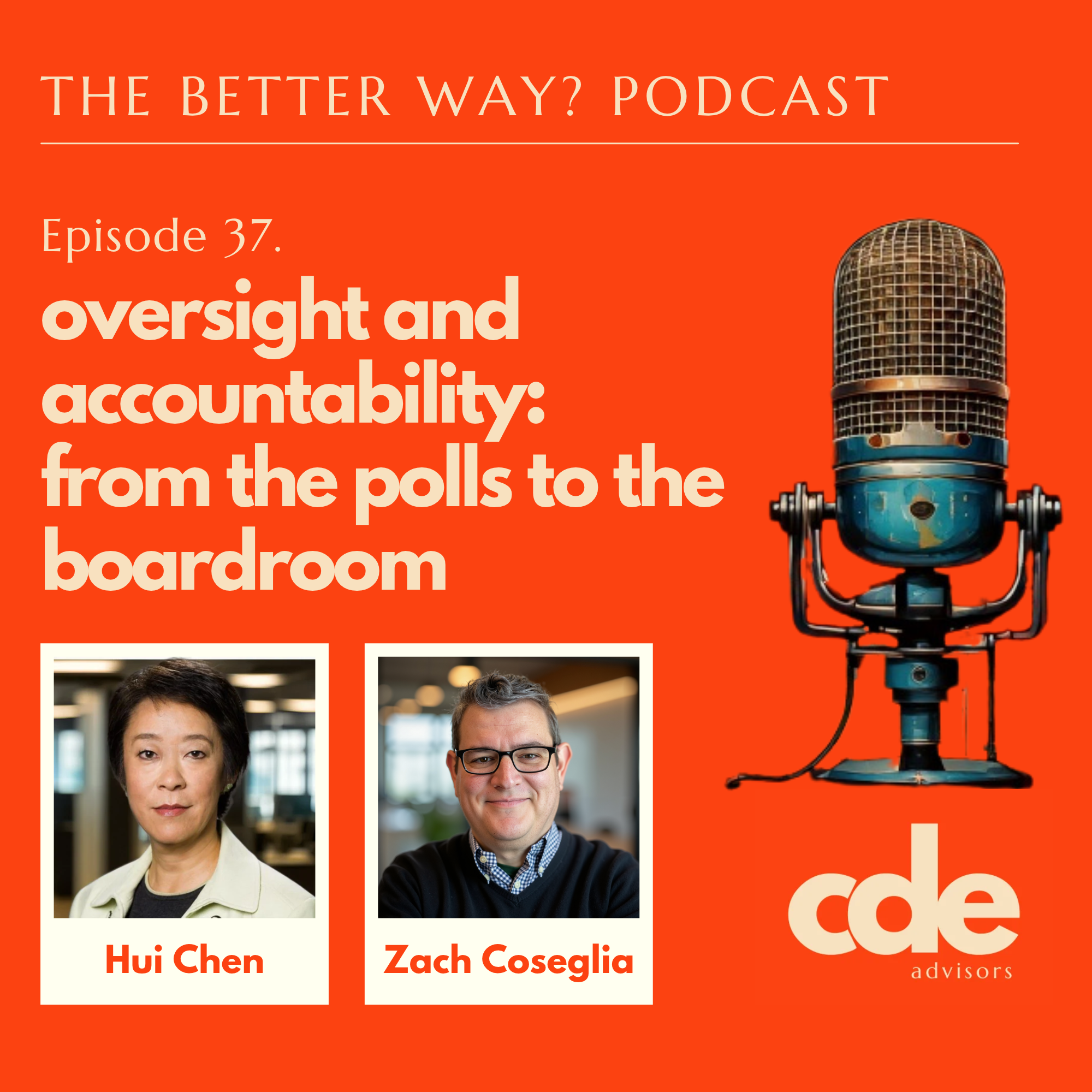
About this episode. As the final votes are counted, Zach and Hui use the U.S. midterms elections, and the potential for a shift in political power, as a starting point to explore a broader question: what makes oversight effective? Drawing parallels between government and corporate governance, they examine the limitations of independence on paper, the challenges boards face when information is filtered through management, and why accountability depends not just on structure but on culture, incentives, and the willingness to ask difficult questions.
The discussion then turns to one of the most persistent challenges in ethics and compliance: what happens when the boss is wrong? They explore why organizations too often rely on individual courage to surface concerns; why speaking up remains risky in many workplaces; and how boards, compliance officers, and leaders can build systems that make accountability routine rather than heroic. In an era marked by growing public skepticism and declining trust in institutions, they argue that credibility is earned through transparency, scrutiny, and consistent follow-through, not slogans or organizational charts.
Who? Zach Coseglia + Hui Chen, CDE Advisors
Full Transcript:
ZACH: Welcome back to The Better Way? Podcast brought to you by CDE Advisors. Culture. Data. Ethics. This is a curiosity podcast for those who ask, “There has to be a better way, right? There just has to be.” I'm Zach Coseglia, and I am joined as always by Hui Chen. Hi, Hui.
HUI: Hi, Zach. Hi, everyone.
ZACH: Welcome back to The Better Way folks. Now, by the time this episode airs, Americans will have voted in the midterm elections. We don't yet know the results because we're obviously recording this a couple of days in advance. But let's imagine a familiar scenario, shall we, Hui? A CEO who has been accustomed to getting his way now faces a different voice in the room. Now, up until this point, the institution that was supposed to provide oversight has largely been controlled by the same party as the executive. The Republicans, in short, have had control of both houses of Congress, as well as the presidency. Now, perhaps, there's a different balance of power. Again, we don't know what the results are going to be, but if you listen to the polls, it would suggest that we're likely to see a change somewhere. Whether that's within the House, within the Senate, or both. And that brings with it the possibility of more scrutiny, more questions, and potentially more resistance. So, here's an interesting question. Does a change in who holds power necessarily lead to better oversight? Or does effective oversight depend on something deeper than just who has the votes?
HUI: A different balance of power can create new opportunities for scrutiny, but opportunities are not the same as truly effective oversight. So, in the corporate context, the oversight body that we think of is the board, the board of directors. And in Europe, they have, actually, two layers of boards. But I think typically an oversight body needs three basic things, independence, information, and the will to act. Now, most organizations focus on the first criteria there, independence, and assume the other two will follow. They don't. Because directors can be formally independent, but still lack access to critical information, or they possess the information, but they lack the incentive or the confidence or the culture needed to ask difficult questions. Effective oversight occurs when people have both the ability and the expectation to challenge management. And that expectation really is very much of a cultural thing.
ZACH: What's interesting about sort of the compare and contrast between the political context and the corporate context is that in the corporate context, it's not, I guess, just to say it, it's not a perfect metaphor, because in the corporate context,
management really is accountable to the board. I mean, management really reports to the board. The board is definitively a plane above management and makes decisions about management and makes decisions about strategy and has a level of influence that is distinct from the oversight bodies that exist in politics. In US politics, you know, the check on the executive, or the checks on the executive, I suppose, are the other branches of government. The legislature, which is what we're talking about today, is not definitively above the executive.
HUI: Correct, correct, but...
ZACH: And that makes a big difference in talking about both the impact of their oversight capabilities and the limits of their oversight capabilities.
HUI: In a political situation, you know, the willingness, typically from an opposing party, to ask difficult question is a given. But in a business organization, that willingness from the board is not at all a given. We have all seen a lot of situations where the CEO is also the chair of the board. Even if the CEO is not the chair of the board, there are times the CEO is a very charismatic public face of the company, wields a lot of power and influence. He's the one who decides whom to invite to the board. So, that whole willingness to act is not at all a given in a corporate oversight body like a board. And the information piece is often missing because the board relies on the management to give it the information. And it's difficult for the board to probe oftentimes beyond the information that they're simply provided.
ZACH: Yeah, yeah. The question was, does a change in power produce better oversight? And when we talk about oversight, we're talking about the board. But I also thought about, you know, a change in power within management and how so much of the work that we've historically done has actually been shaped around changes in management. You know, using that opportunity to come in and look at things with the fresh eyes. So for us, that's often been, well, a new chief compliance officer comes in and will come in and do like an assessment of the program to really set a baseline about like what's working and what's not; or there's been a change in CEO and folks want to do a culture assessment to really come in and understand, you know, what has happened historically, what folks are sort of hoping for in the future. And, you know, really pulling that story together to use this like line drawn in the sand around a change in power, as an opportunity, whether you think of it as better oversight or just think of it as an opportunity to assess and reassess.
HUI: Yep.
ZACH: I mean, it just makes sense. And, you know, I think we can fully expect in the political arena that there's going to be a lot of new questions asked, probably a lot of subpoenas issued, probably a lot of people being called in to testify and quite a bit of renewed investigative activity if there is a change in power.
HUI: That's fully expected, and I believe it's been articulated already by Democratic leaders.
ZACH: Oh yeah. Yeah, indeed. It would be nice if I could just say, it'd be nice if folks also govern, you know, legislate and not just investigate. All right, so let's move on to question #2, which I just have to say I'm pretty cynical about. I think the past couple episodes, I've maybe been expressing my cynicism a little bit louder and stronger than in the past. But that next question is, what happens when the boss is wrong?
HUI: Big one for compliance folks and for many employees, frankly.
ZACH: I mean, even with formal checks and balances, we know that accountability can fail. We know that people make bad decisions. And we also know that at times, nobody's willing to stand up and speak up and call them to account. So what do we do when that happens, Hui? How do we teach within an organization the ability to distinguish between legitimate authority and unquestioning obedience?
HUI: Boy, you know, we can talk for hours about it, and as you know about my interest in certainly 20th century European history. There are lots of lessons there, but let's not go, at least.
ZACH: Oh man, I was going to say, I didn't think it would take us 17 minutes to get to a World War II reference. I really didn't think it would take that long.
HUI: I'm really not going to make one, just a vague reference to that. I'm not going to go there. But I think the important...distinction here is we need to link authority with accountability instead of infallibility. Leaders in a democratic tradition are accountable. They're not infallible. And when we start to think of someone as infallible, we have problems. And employees and constituents should understand that leaders have decision-making authority, but no one should be exempt from scrutiny. No one. And organizations and countries that teach this not through slogans but through actual examples would be the better off for it. So, what we would like to see is leaders who welcome challenge when concerns are investigated fairly, when employees and citizens who raise difficult issues are treated as contributors rather than troublemakers. Yes, they might be. Yes, you're right. You're going to see troublemakers. But don't let the troublemaker status disguise what might be real issue behind the troublemaker's facade. So yes, someone can be difficult and annoying to you, but they may still be . . . bring you a very legitimate concern. So, I think it's that attitude and when you take attitude and multiply it to lots of people, we're talking about a culture, a culture that understands the importance of accountability and scrutiny, I think, is the stronger culture in my opinion.
ZACH: Yeah, I mean, I agree with you. I just think this is one, again, I'm coming back to my cynicism, but it's one where it's all well said. But if you operate within a culture that isn't holding leaders accountable, then you've got a fatal flaw in the system. And, you know, it comes back to what we often talk about, which is that the companies that have the best compliance programs are often the ones who need it the least. And so . . .
HUI: That is so true.
ZACH: And so, I mean, I think we . . . I think we might have said it in our last episode, and so, you know, I, I'm, I'm . . . I'm skeptical of . . . the outcome for someone who does come forward in an organization where the boss has been allowed to make the decisions that they've made that ultimately are the subject of the complaint.
HUI: Yeah, and a boss who thinks himself about, you know, infallible is not going to be one who is welcoming criticism or scrutiny by nature.
ZACH: Yeah, I mean, like, we don't have to look… yeah, I mean, like, we started this by, we're framing this around politics and like, I mean, what good would it possibly do if you came forward with a concern in the Trump administration?
HUI: Well, newspaper articles and TV shows, and not to mention lots of people have. But I do think it's very important that we have, and this is to me part of the accountability system that is not formalized in the structure of the federal government, but is really critically important to democracies is the freedom of the press. You know, thankfully, we still have a free press that is pointing out concerns and that is applying scrutiny because I think by not… by not voicing these concerns, you risk normalizing bad behavior. So this is what we don't want. When we already have a situation where certain behaviors that we as a society hope not to see so much of, I think the last thing we want to do is to normalize that bad behavior as of that is perfectly normal. And I think these voices of scrutiny contribute to that enormously. And I think that is the same in the companies too, right? It's not just something that everybody sort of sees bad behavior and they don't say anything, they tolerate it, that's one thing. But when somebody does speak up, that somebody sometimes may pay dearly for that, but that's breaking that normal perception of normalcy.
ZACH: All right. Well, let's talk about who watches the watchers. You know, a board can't provide effective oversight if management controls what it sees, how problems are framed, and which issues reach the agenda. This is the information deficit point that you made before. So, what information should boards receive directly rather than exclusively through management.
HUI: This is something we have worked with a number of companies on, which is board reporting, right? And we work with boards too, on this precise point. Boards really should seek independent visibility into areas where management's interest may not be perfectly aligned with objective assessment. And this could include misconduct reports, significant investigations, details of it, how it's done, hotlines and speak up data, not just how many, but trends and what they indicate, internal audit findings, compliance assessments, cultural assessment, and information gathered directly from employees, customers, or even external reviewers. An oversight body should never rely exclusively on management's interpretation of what is the reality in the organization.
ZACH: Well, this goes to a bigger point that I know you have strong views on, which is the reporting relationship between someone like a chief compliance officer and the board. You know, can a chief compliance officer challenge the CEO if the CEO effectively controls that officer's resources, their access, or in the case of reporting,
literally their career.
HUI: You know, when we talk about an independent structure, that's a legal concept. It's an org chart, how the line is drawn. But ultimately, we are all still talking about things like who controls the resources, the budgets, the headcounts, who controls the reviews, the performance reviews, the hiring and the firing. So, having that direct line between the chief compliance officer and the board is critically important. Critically important. I, in fact, you know that shortly after I came out of DOJ, I was actually offered a very lucrative position to be the chief compliance officer of a very well-known company that really needed some help. And the person who approached me was… it's new GC. And the new GC is someone that, you know, I respect. He said to me that the chief compliance officer would report to him. And I told him that was a deal breaker. And I maintained that position. I really think legal and compliance goes back to other episodes where we have talked about this, have different interests. And for that reason, the compliance function, like the audit function, needs an independent line.
ZACH: Yeah. And what would be the alternative for you? Because everyone always talks about, well, should it be its own department and report directly to the CEO? But I get the feeling from what you've shared that you felt like the best scenario would be for it to report directly to the board.
HUI: I would, I would. And you can play with different structures. It could be, you know, compliance, audit, and risk collectively as one function and that reports to the board. That's one way to do it. So, yeah, I mean, I can understand why board doesn't want to have a lot of direct relationships with different functions in the board, in the company, so they can consolidate that. But I think it's important to recognize that these functions, compliance, audit, risk, have fundamentally a different interest than legal, finance, and operations.
ZACH: Well, I think we'll probably talk about this a little bit more in an upcoming episode where we talk about the role of the chief compliance officer, more specifically. But we've also hit on this in the past because just because the chief compliance officer reports to the board doesn't mean that all of the concerns are dealt with. You can have a chief compliance officer who reports to the board, but who has to have all of the presentations and all of the information that they feed to the board go through the general counsel as a filter before it gets to the board. You can have a chief compliance officer that reports to the board, but ultimately still has their performance evaluations written by management. You could have a chief compliance officer who technically reports to the board but who has all of their resources, their budget, their headcount determined by management without necessarily consultation from the board. So it's the reporting relationship and also the other things that build credibility around the idea that this is truly an independent function.
HUI: Yeah, like I said, the legal reporting line is basically a legal construct. I mean, it's a box and a line on, you know, and that's all it is. All the things that you say are the reality, but all, you know, when you say, oh, they have a reporting line, that's, it's a box and a line.
ZACH: Yeah. All right, so the last question here is probably my favorite question. And it's, how do you build accountability that doesn't depend on heroes? And to kind of build off of what we talked about before, my cynicism says that we've got to often rely on heroes because, in the places where things really go wrong and you have issues at the very top of the organization, the way we have historically found out about these things, is from the heroes. And sometimes we have heard about them from the heroes, and the hero had a really hard time getting their point across. So, Hui, how do you build accountability that doesn't actually rely on the heroes?
HUI: I really think the key is building a pathway that doesn't depend on the consent of the person being challenged and having a very transparent process where employees know how concerns are raised, how they will be evaluated, who will be informed, and what protections exist against retaliation. So, we work… again, this is an area where we have worked with companies on an investigations, protocol, policy, procedures. Those things are important, not just because they ensure consistency in how you conduct investigations. They also provide transparency about how these matters are dealt with, so an employee can actually understand when I raise a complaint, this is how they're going to assess it. And if I raise a complaint against certain levels of people in the company, that's how it's going to be routed. Because the truth is, most companies will not treat an anonymous complaint against a mid-level manager and the CEO the same way. It shouldn't in some ways, right? There's different, there should be different sort of routing procedures and notification procedures when it hits a certain level of seniority in the company that ensures further insurance in the independence of the investigation, the review. So, employees should understand that and not just by, you know, word of mouth, but this really should be documented in a consistent set of policy and procedures of how these things are handled in detail. The other thing that I've… I find interesting that I have seen organizations do is teach people how to make complaint. Because you know something, we who have done investigation work oftentimes complain about the quality of complaints, right? Somebody makes a complaint, well, you know, it's so muddled, what do I do with it? How about if we teach people? If you see a concern, these are the pieces of information that we need from you, and this is why we need them. So, making this process more consistent, more transparent, I think gives a certain level of assurance to people of how their concerns will be evaluated and dealt with. You can't just have those policy and procedures on paper, you actually have to follow them, right? So if they understand what is supposed to happen and they believe that that is actually how it happens, I think that would engender confidence.
ZACH: Yeah, for sure. I mean, from a data perspective, you know, we see countless board reports that talk about how many times people came forward and whether they came forward anonymously and, you know, whether they came forward through the hotline or whether they came forward through other means. Like these are basic metrics. What I want to see more of is like, let's really make an effort to understand the experience of the people who did come forward. So if someone submits a complaint, let's not only ask them follow up questions about the facts that they're trying to bring forward. Let's also follow up with them to ask them about their experience in the process. Let's understand what that felt like to someone so that we can understand whether or not we are in fact living up to our values, whether we are in fact living up to the standards that are set on paper for how we handle these complaints. Let's do the same thing, post an investigation. Let's ask the people who participated in an investigation, whether as an interviewee or witness, or if they were the person who came forward with the issues, to ask them whether or not they felt heard, whether or not they felt like they were dealing with people who were unbiased and in fact independent in that process. Let's also look at data around the outcomes from our investigation to determine whether or not it really is unbiased as we say we want it to be. So let's look at whether or not people who have come forward were retaliated against. And that doesn't mean just looking at the results of an investigation. It means looking at how that person's career progressed in the months and years following them coming forward with an issue. How many of those people stuck around for any meaningful period of time? Did those people get promotions? Did they have a similar path to other people who were previously similarly situated to them? I mean, there's so many questions we could be asking to better understand and hold ourselves accountable to ensure that when people do come forward, we have a process and a system that supports those types of behaviors. Or whether or not we're not only relying on the heroes to come forward, but we're doing them dirty once they do.
HUI: Exactly.
ZACH: Okay, Hui, so I want to go through, we talk all the time about outcomes, not output. We talk all the time about effectiveness and evidence, not just checking the box. So I want to go through a series of things, i.e. output, and I want you to tell me how you would reframe that in terms of evidence or an outcome. So the first one is we have a quote, independent board. That is a thing that is an output. We say we have an independent board. What's the evidence that you want to see whether or not that is actually creating the outcome that it that it aims for?
HUI: I would want to see directors challenging senior executives, just asking hard questions, doesn't have to be hostile, right? But just asking real probing, curious questions. I would also like to see follow through on difficult issues, you know, when they don't get an answer and the senior management says, you know, we'll come back to you on that one, do they follow through? Do they actually forget about it at the next meeting? Or do they actually follow through and say, hey, you know, I'm still interested in, you know, the data that you told me that you would share that I asked for. So I would add, those would be the evidence that you have some level of independence on that board.
ZACH: Well, and look, and I put an even just finer point on this, and I think I'm just restating what you said, not in any way disagreeing with you. We know that they're challenging senior executives and they're pushing for follow through on difficult issues when it relates to a plan of business action. Or when it relates to the financial health and bottom line of the company, we're talking about doing the same when it comes to ethics, compliance, and risk. Where not only our directors at times not challenging senior executives on those issues, but the framework is such that the people who are reporting on these things are the chief ethics, compliance, and risk officers, not management. And so it's like on both fronts, we want to see management talking about these things at the board level, and we want management to be held to account by the board for the gaps in their answers or the questions that remain unanswered.
HUI: Indeed.
ZACH: All right, so the next sort of formal output is an independent compliance function. We will say we have an independent compliance function. Great. Let's reframe that in terms of the evidence that it actually works.
HUI: I think similar to that, I would want to see, for example, the board having executive sessions with the compliance, chief compliance officer, where he or she can talk freely about concerns with management, if any. So that effort of structuring that time and that privacy for that discussion I would want to see occasions where concerns are raised about senior leaders by compliance and not resulting in compliance, losing access, resource, or influence as a result. Now, I will caveat this by saying there is a lot on the compliance officer too. I expect the chief compliance officer, to be able to handle himself or herself at the board level by bringing appropriate questions and concerns in appropriate ways. And that is something that's on us, not on the board.
ZACH: Indeed, it goes . . . we actually did a whole episode on this recently where we talked about the sort of the seduction of good news and how too often what winds up happening at the board level, and this is on the compliance people, is essentially compliance theater. It's a positive message being kind of carefully orchestrated in front of the board, as opposed to, as you said, the sort of freedom, the expectation that compliance really does raise tough questions at that level. And freely acknowledge the places where they don't have all the answers today. Okay, the next thing is we've got to speak up policy. We've checked the box. We've got to speak up policy. What's the evidence, though, that we want that it works?
HUI: Well, one, people are actually speaking up. That's data point one. And two, how does the organization respond? Does it respond with promptness, credibility, fairness, openness? All of those.
ZACH: Absolutely. Absolutely. All right. Another output. Well, we have an escalation process. What's the evidence that an escalation process actually works?
HUI: Well, again, one, people actually escalate. And when the escalation process involves people who are implicated in the concern, that there is actually a process that excludes them. So basically recuses them out of that process. And it's clear so that they know next person up this escalation chain is A, but my concern is precisely with A. So in that case, people need to know what would happen.
ZACH: And one last output. A code of conduct. Everyone has a code of conduct. We've got to look at it. It's on our intranet. It's on the internet. Anybody can read it, see it, touch it. Congratulations. But what's the evidence that it actually works?
HUI: It's that the principles don't just live in that document, that they're alive in how decisions are made in, you know, in discussions as people are discussing how to take a course of action, making a decision. They're actually using the principles in the code of conduct. It may not be spoken out loud, but that you can tell palpably that those issues, the principles, are alive and part of the consciousness in those decision making.
ZACH: Yeah, I mean, this is where… I mean, I just sound like a broken record on this, but this is where I feel like meaningful, data-driven cultural assessments are so critical. We do the risk assessment, and in some ways, I think that the culture assessment is actually way more telling and way more powerful because at the end of the day, most risk assessments identify the things that anyone in that business could identify as a risk without spending six months doing a risk assessment. But the culture assessment often unearths things that really challenge the assumptions that leaders have about the way in which their business is operating and give a voice to people who might not otherwise have a voice and yet a voice that is reflective of way more than just that one person who may find and feel like they're living on the margins. So, Hui, to close, if you could change one thing about how companies govern themselves to make it harder for a powerful executive to override ethical concerns, what would you change? You can give more than one. We've got time. I've got time.
HUI: Only one thing? More things in there. I think one of the things I would do is something I already mentioned is requiring the chief compliance officer to have regular private sessions with the relevant board committees without the CEO or other members of management being present. And I don't know if I can just sneak it in by saying related to that, but I would say give the compliance function access to important data, investigation data across organizations, not just compliance investigations, allegations, substantiated concerns, retaliation, management override. Having those data and having those private sessions, I think would go a long way in helping the board get a better picture of what is actually going on.
ZACH: Okay. Well, I think you have more. So we will make space for more. I know one of the things that you've talked about in the past is shifting the incentives. So how might you shift the incentives in ways that actually serve as a potential counterpoint to the very powerful executive who might have a tendency to make questionable decisions.
HUI: Yeah, I mean, changing the incentive to make challenging authority part of the job. Stop treating speak up as a personal virtue and start treating the capacity to challenge as an organizational competency. We routinely tell employees to speak up, exercise good judgment, and act with integrity. But if employees see colleagues penalized for raising uncomfortable issues, they learn a different lesson. So, the problem is not that people necessarily lack courage. It may be that they just learned that the organization is making the courage very costly. So, we can change the incentive by evaluating leaders on how they respond to challenge, not just whether they meet their business goals, but how do they address challenges that are raised. Include evidence of constructive dissent, responsiveness to concerns, and appropriate intervention as part of the leadership evaluation. And examine whether employees who raise concerns, like you suggested earlier, do experience adverse outcomes. And finally, holding managers accountable for suppressing concerns or retaliating when you have evidence of those behavior.
ZACH: Yeah. You know, as I hear you talk about that, it sort of makes me think about the question that we asked earlier, which was, how do you build accountability that doesn't depend on heroes? And I think the problem is if people who come forward are viewed as heroes, or if that's the burden that someone who comes forward holds, we've probably already failed.
HUI: Yes. Yeah, very much so.
ZACH: It shouldn't be heroic to speak up in these moments. It shouldn't need to require bravery.
HUI: It should be expected.
ZACH: It should be expected. And we talk about . . . we talk about it like it is. But the truth is, I still think anyone who speaks up is brave and heroic because it's very rare to find an organization where it's met with anything other than risk.
HUI: Yeah, I mean, I think we keep going back to this culture point. It is the culture you built. And I also think a lot of people have the misconception that speaking up has to be something very adversarial. There are ways you can raise concerns. And my favorite way I always tell people is this raising a question. Like, does that seem right? Right? So that seems much more innocuous and not as threatening as what you did is wrong. So, I think teaching people how to speak up and building that organizational culture that welcome some of these questions, curiosities, or gentle pointing of maybe we're a little bit off course here. And this is about teaching people both how to give these, share these concerns and how to receive them. And I think everybody thinks of it as something that just has to be very adversarial. And I think that's something we need to change.
ZACH: Yeah, well, it reminds me of something else that I hear you talk about a lot, which is we talk about speaking up so much, but we don't actually talk about or train on listening nearly as much. And I will say, in the past few years, we've definitely heard more and more people talking about how it's a speak up and a listen up expectation. But how many leaders are actually trained on how to listen effectively? How many leaders are actually given opportunities to really build that capability to not be defensive, to not be retaliatory, to really be open when confronted with… to be something other than as you said, it's not, it doesn't have to be an antagonistic thing. It doesn't have to be a conflict creating thing. But how many people are really taught how to make it not so.
HUI: Yeah, I want to say, you know, executives, managers who've been trained on how to listen, I don't think I've ever seen any sort of HR training courses on those in all the years I've been working with corporate America. So very unfortunate. But I also think back to one of the episodes that we had earlier this year, I think, on bystander intervention. That is the perfect example of how to teach someone how to address a concern.
ZACH: Yes. Yeah, indeed. We'll link to that one. Folks should go back and listen to that one. It was a great one. A really, really great… a really, really great one. I might venture to say that in politics, it would appear as though some of our leaders have not received the training around how to receive critical information. And you know, it's funny because we did a podcast episode several years ago around a team that brought behavioral science to the US House of Representatives. It would be fascinating if someone could bring leadership listening training to the executive branch of the US government. I would love, I would love to hear about that.
HUI: I would love that. You would think that that's what they do. They're supposed to be listening to their constituents, but the system is such that I think it takes a certain personality to go into politics, and those personalities don't tend to be great listeners.
ZACH: Ain't that the truth. I want to end on one other point, and it's around the board itself. You know, we just talked about a lot of the things that employees experience and the training that they receive and the messaging that they receive. We talked about leaders and the expectations on them and what we might like to see to ensure that they are doing their part in the process. But what about the board? From time to time, you hear about organizations who do meaningful ethics and compliance and culture focused board effectiveness reviews, but they're very rare. So how do we make the board accountable for its role in all of this?
HUI: I think one of it is watch what it does when it receives bad news. How do they exercise their oversight when a concern has reached them? And it's not directly connected to the election analogy, but a change in the balance of power could create opportunities for more scrutiny, but scrutiny itself is not the outcome. The outcome depends on whether the institution investigates, challenges, corrects, and follows through. And the same principle applies to the corporate boards. They can get comprehensive reports. And we see many times boards in the wake of some big scandal hire an external firm to do a full and complete report. What I'd like to know is how many of those boards actually follow through on the recommendations that come out of those big investigations that cost millions of dollars. I also think it's interesting to see because, you know, I've been reading, because of research that we're doing, I've been reading a lot of these corporate scandal investigation reports that the boards have commissioned. And I think this goes back to our constant sort of refrain about the compliance being at times too legally driven. Many times, especially with high profile investigations, they hire law firms. And almost every single one of those is a law firm. And lawyers give legalistic recommendations to fix things. But the boards really should be asking a different question is how, you know, if these huge scandals are indicative of cultural issues, how are we fixing the culture? And you really should expect, you can still go to a law firm, but you should ask the law firm where are you getting your culture competency from? That's one of the things that when I was at DOJ and part of the team for selecting monitors, you know, the monitor candidates traditionally would just come, the law firm, they're typically law firms once again, they would come. And I literally one time said to them, please don't come without your forensic partner because we're expecting to do a lot of forensic and analytics work. And you are lawyers, so you're going to need a forensics and analytics person, or at least not a person, a team. I want to see that team as part of my evaluation of your competency. I think boards should do the same when they're commissioning these big after the fact investigations, making sure that the people they turn to have the culture competency and make sure the board follows through on not just seeing the . . . implementation of these recommendations, but measuring them.
ZACH: I couldn't agree more. And with that, I think we're just about out of time. I'm wondering, any predictions on the election?
HUI: No, because, you know, as people hear this on the day after, I'm always not confident in my ability to make predictions. But I do hope that as you're listening to this, we are seeing more diverse voices in our government and more calls and actions towards greater accountability. That's what I'm hoping for.
ZACH: So, what you're saying is you won't be placing any bets on Kalshi over the course of the next four to five days?
HUI: No bets.
ZACH: No bets. But I couldn't agree with you. No bets, but I couldn't agree with you more. I mean, as we… I have not enjoyed the weeks and months leading up to this election, but there have definitely been new voices amplified. And it would be really exciting to see the amplification of our broader set of voices going forward as well. Fully agree. And with that…
HUI: With that.
ZACH: Thanks, Hui. With that, we'll see what happens. Thanks, all.
HUI: Thanks, everyone.
ZACH: And thank you all for tuning in to TheBetter Way? Podcast. For more information about this or anything else that’s happening with CDE Advisors, visit our website at www.CDEAdvisors.com, where you can also check out the Better Way blog. And please like and subscribe to this series on Apply or Spotify. And, finally, if you have thoughts about what we talked about today, the work we do here at CDE, or just have ideas for Better Ways we should explore, please don’t hesitate to reach out—we’d love to hear from you. Thanks again for listening.