Ep.35: Risk People in a Risk-Taking World
Remember, you can always listen here or follow us on Apple Podcasts or Spotify. Either way, thanks for supporting us.
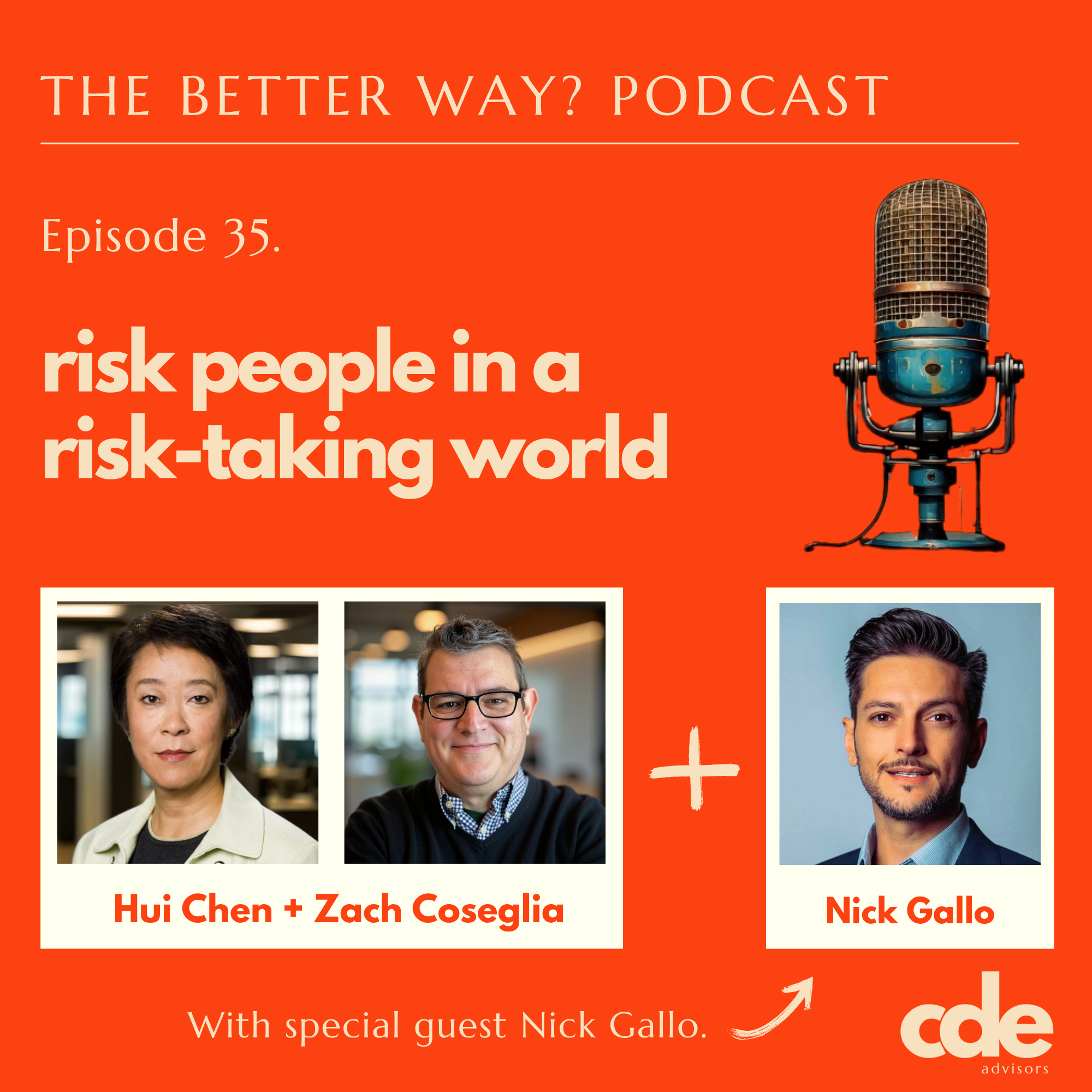
About this episode. The future of compliance and HR is "wide open," but getting there may require a different way of thinking. Ethico Co-CEO Nick Gallo joins Zach and Hui for a candid conversation about influence, culture, measurement, and the opportunity for both functions to move beyond activities and become more meaningful drivers of organizational success.
The conversation spans culture, influence, board reporting, measurement, and the challenge of moving from activity-based reporting to outcome-based impact. In a lively rapid-fire exchange, Zach, Hui, and Nick debate which practices should be retired, the ideas everyone talks about but few fully embrace, what boards should be asking management, and why the future of compliance and HR may belong to those willing to challenge old assumptions, tell better stories, and make new bets.
Who? Zach Coseglia + Hui Chen, CDE Advisors; Nick Gallo, Ethico
Full Transcript:
ZACH: Welcome back to The Better Way? Podcast brought to you by CDE advisors. Culture. Data. Ethics. This is a curiosity podcast for those who ask, “There has to be a better way, right? There just has to be.” I'm Zach Coseglia and I am joined as always by the one and only Hui Chen. Hi, Hui.
HUI: Hi, Zach. Hello, everyone out there. We have a very exciting guest today. We have Nick Gallo, who is the chief servant and co-CEO of Ethico, which provides compliance solutions to some of the largest organizations in the world. He's also the host of EthicsVerse, a weekly webinar series in which he interviews and moderates discussions with leading thought leaders from throughout the ethics, compliance, and HR space. Welcome, Nick. So glad to have you.
NICK GALLO: Thank you. Oh, I'm so glad to be here. Thank you.
ZACH: Welcome. I'm going to ask you the same sort of introductory question that we ask all of our guests, which is the existential question. Who is Nick? We've heard your sort of formal professional bio, but we want to give you a chance to introduce yourself to our listeners as you choose. So, who's Nick?
NICK GALLO: Oh man, what a question. Well, I am a husband, I'm a father, and I’m a brother. I run a company with my brother, so I'm an entrepreneur. And, you know, I was recently, I recently hit this sort of 10-year mark in my company and it's way longer than I've worked anywhere in my life. And I've been reflecting a lot you know, over the last really kind of couple of weeks. And I would really like to be, you know, thought of as, you know, somebody who helps, who helps like optimize, you know, businesses or helps optimize, you know, somebody on my team's like career. That's really what I kind of view myself as, as like a helper. I feel like I'm probably a problem solver. I love, I love, you know, untangling knots and, you know, solving puzzles, you know.
ZACH: Definitely. Well, you're very much among friends in that department. And that's a lot of what we're going to talk about today, some of the ways in which you do that in your work and some of the ways in which we'd like to see more of that in our disciplines. So, Hui, where should we get started?
HUI: Well, why don't we start by the state of compliance today? Nick, we would love to hear how would you describe the state of compliance today?
NICK GALLO: Man, what a question. You know, the state of compliance today, it feels to me like we're at a really exciting time in the space. It seems like the next 10 years can be a lot different than the last 10 years. I feel like we're kind of at this kind of inflection point in our industry. I have, though, not to kind of be cynical, I have been a little bit surprised at like how slow the pace of change has been. You know, it was like, it's like been, you know, I feel like, you know, we continue to talk about a lot of the same things. You know, again, I'm a gray hair now. I've been in this industry for you know, a decade. And a lot of the things that we're talking about as best practices were the same best practices from, you know, when I first got into the space. And I've been a little bit surprised at how slow we are to adopt new things and try new things and push the envelope and kind of like solve for outcome. And I've been thinking a lot about that, like, what is it going to take for us to be that true strategic lever in the organization? It's probably going to take us kind of becoming more like businesspeople and less like regulators because we have to interact with like the human beings. And so that's kind of one aspect of it that we have, that we need to move, you know, we're moving, but we need to move a little bit faster. And I think, you know, again, I'm not trying to be cynical here, but like there is kind of an existential threat right now to our industry in a lot of ways. It feels like with the advent of AI, with, you know, this same moniker of Department of No or all these other things that like I've been hearing about for 10 years, the fact that we're still talking about those things, makes me feel like, as I kind of look down the road or kind of see around the curve, that like we have to do things different. Like we have to show up in different ways, or we have to kind of think about our role in some new ways if we're going to, you know, if 20 years from now compliance is going to not be absorbed into something else or be absorbed into some AI brain.
HUI: I cannot tell you how much everything you've said resonates with us because I've been, well, not to age myself, I've been in this industry longer than a decade, just a bit. That's right, longer than.
ZACH: We'll just leave it at that, just longer than a decade.
HUI: And I feel like most of the conversations that I'm hearing today is pretty much the same as I heard when I started in this industry. I think the only thing that's new today that wasn't present more than a decade ago was all the discussion around data and AI, of course, right? So, I think I'm very happy to say that I think I was really among the pioneer to really start pushing the concept of using data to enhance the work we do. Zach was on the forefront of making that happen. But you're right. I think this pace of change has been very slow in this industry. And you are absolutely right. We're facing an important inflection point. It's either adapt or disappear.
NICK GALLO: Yeah. And I think, and I… you know, I spent a lot of time thinking about this, like, you, Hui, are probably like a high dominance person, right? Like, you'll walk into a room, you'll say what you think. I mean, I've seen, you know what I'm saying? Like, you're just kind of wired that way. And I'm kind of wired that way as well. And so, to me, it seems so apparent.
ZACH: That is true. That I can confirm that.
NICK GALLO: It's like, you just have to put the ball in the net. You have to solve for outcome. I'm worried less about like, you know, stepping on a toe. I really am trying to like solve, this is just kind of the way I'm wired. I'm worried less about stepping on someone's toes and more worried about like, okay, how do we kind of solve for outcome? And I wonder if part of our challenge is that our industry, at a high level is sort of like occupied by people that maybe don't have that high dominance trait, which is okay. I think there's things you can do to kind of, you know, bolster those qualities. But again, if we don't kind of start to feel comfortable taking up space in meetings, feel comfortable taking up space in the organization or like leaning into the unique things that are inherent to a compliance program, then we're going to continue to be the barnacle on the ship. We're going to continue to be this, you know, “office of no,” or be apart from the business instead of truly being a part of the business. And I just did a podcast with somebody that also has this sort of high extroversion, high dominance kind of personality. And the way that she talks about her challenges are very different than kind of the, you know, stereotypical challenges that a compliance officer, you know, kind of discusses. She's really talking about like, how can I do more, not like, how can I get invited to that meeting? And if we… and if we live the next decade in like, how can I get invited to that meeting land, that's a bad kind of outcome.
HUI: And there's so much we can dig into there. I mean, getting invited, you know, I always say to people, we always talk about getting a seat at the table, but that seat has to be earned. You don't want somebody just to give it to you because the regulator tells them to. That really doesn't give you a voice at the table, even if you're there. It doesn't give you the respect at the table. All of those things have to be earned. So, I think earning that trust, earning that place at the table requires so much more. You know, requires that empathy requires really truly trying to understand the business and speak their language, understand their pain. And a lot of those things are unfortunately not instinctive to people who are in the compliance jobs. Let's switch gear a little bit. What about HR? Do you find the same thing in HR? Do you find different challenges? How would you describe the state of HR today?
NICK GALLO: You know, from a high level, I feel like it's a lot of the same challenges, but I think there are some unique challenges to HR. I feel like over the last, you know, five or seven years, the reputation of HR has not… I feel like it's gone down inside organizations. You know, when I first got into the work world, you know what I'm saying, into the professional world. I didn't feel like… you know, I worked at a really big corporation when I first started, and I didn't feel like there was this sort of broad distrust of HR that like you see kind of in pockets or maybe at like a more pervasive sort of level right now. HR and compliance, they seem to be like, if not cousins, they're like maybe twins that have that tape down the middle of the bedroom. You know what I mean? Like, very similar, very similar dynamics, very similar interaction with the stakeholders in the organization, very similar view from, you know, a leadership perspective on what those functions are meant to do and so forth. And a lot of the complaints or a lot of the frustrations that I hear from compliance people are always they always seem to be echoed on the HR side about, I don't have enough budget, I need more resources, I have to make, you know, I got to make a silk purse out of a sow's ear, right? This sort of like walking hat rack that many of us in these two different departments end up turning into because, you know, stuff just kind of gets dumped to HR, stuff just kind of gets dumped to compliance. And there's a kind of a, you know, I have a different vantage point because I like work with these kinds of folks, but there's in general, there seems to be like an under appreciation for both of these functions in terms of like what they care about, the heart they have for the stakeholders and for the business in the tough spot that they're often in, HR maybe more so than compliance, when they have to kind of straddle the fence between kind of advocating for the employees, but also kind of protecting the organization. So, a lot of similar things, but maybe a couple, you know, some slightly different flavoring on the HR side.
HUI: It's so interesting that . . . you make me think of the fact that, again, I think I'm really showing my age in this episode. So, I was in school when this whole movement of renaming what used to be the personnel department into human resources, was beginning to happen. I remember this because I heard a speech from one of these early pioneers and it says, you know, we're naming, you know, like personnel department is just the department that handles benefits, signs papers, you know, do the paperwork. But we are on this concept of human beings being the most important resource in a company and we are going to be the department that really cultivates that resource. I get the sense that over the years, many departments, many personnel departments got renamed without the transformation.
NICK GALLO: Hundred percent.
HUI: You feel? Yeah, I was gonna ask if you feel the same way.
NICK GALLO: Totally. Yeah, I mean, what you were describing for the personnel department, I think, is what most, dare I'll say it, like most HR departments are.
HUI: Yeah, yeah, unfortunately, I think I think there's so much potential there, but it's still not really been reached. So, we're talking about the progress in both of these spaces. What are some progress that you've been surprised to have seen that have been made?
NICK GALLO: So, it's hard to kind of like disaggregate this sort of, you know, thing. You know, this might sound like I'm speaking to both sides of my mouth, but I've seen some really cool things. You know, despite the sort of stereotype that compliance has, the people that I talk to on my podcast or the people that I meet at conferences, these are passionate people that care a lot, you know, everybody, they seem, it seems like they really want to make the world a better place. They want to leave it better for those that come behind them. They want to, you know, fix things. They want to bring some sort of order to chaos. That's kind of a through line through all the people that sort of self-select into this industry. The people who really make their program their own, they make it their own, you know. You know, I've given this example a couple of times, but you know, the same movie script, if it was made by director A or director B, it's the same script, it's the same shots, it's the same locations. Those movies are going to look way different because each director, they make it their own. And I think there is this kind of tension in compliance, like, well, what am I supposed to do? Right? There's a lot of people that are, you know, attracted to structure and, you know, high conscientious type people kind of self-select into this kind of a role more so than like a salesman or something like that. Like there's different sort of wiring you know, in aggregate. And I think that ends up putting disproportionate sort of deference to what you're supposed to do, ends up preventing people from putting their own unique spin on the ball, so to speak, or making their own movie or making their program their own. And some of my favorite programs are the ones that really put their own personality into it. And they really are, they're down to, you know, fail. They're down to experiment. They're down to try different things. I think this is like a really fun space. I think it's a really interesting space. Like, there's always different challenges. You know, you have to be good at so many different things. You know, I mean, if you're in manufacturing, you have to be good at like pulling a lever or like pressing a button or putting things into a box. Okay, I'm kind of, you know, being a little stupid here. But like, to be to build a good compliance program, you have to be good at data analytics, and you have to be good at risk management, you have to be good at persuasion, you have to be good at marketing. It's almost like any book you read you'll find a connection to it and you'll find something that like you can implement. You know what I'm saying? And so, like that just speaks to how many different sort of facets or like the depth of complexity in the space, which to me is like extremely interesting. You know, I'm kind of the eternal optimist, but like, as I'm starting to see more people feel comfortable of like solving for outcome and feeling confident in the skill set that they have and understand that their mandate is really to help add enterprise value to the organization. And there's no right, you know, we're not making a beef Wellington, like we're just making dinner. You know, you can make whatever you want for dinner and you can solve for outcome 100 different ways, I'm starting to see more people, you know, really kind of drive this sort of transformation that I think is possible.
ZACH: I love that you're the eternal optimist, because we're usually not. But I'm actually… I'm actually going to add something kind of optimistic to this that I think is really interesting based on what you just shared. You multiple times say self-select into this discipline. I think one of the more positive things that we have seen in the last several years is people actually self-selecting into compliance, coming from all different walks of life, education, background, and experience. I think part of what has actually held compliance back is that for the first 15 plus years of compliance’s existence, people weren't self-selecting in. People were happening upon compliance, oftentimes from a legal department. And part of why we're not seeing as much change, I think, is because compliance arose as this twin to legal and pulled talent from legal and pulled a very specific way of making decisions and managing risk and interacting with the business, that I think need to overcome in order to realize the true potential of the discipline.
NICK GALLO: I think that is a spot on point. And I think I think you're exactly right. I think more people are starting to see this as a thing and as a career path to go. I mean, you're seeing all these different programs pop up and, you know, as you know, certificate studies or like, you know, augments to or like additions to other graduate programs and stuff that are really focused on corporate ethics or corporate compliance. And I think that diversity of thought is super critical for the innovation to actually happen. You know, and it seems also that like people are getting more and more open to having somebody on a compliance team that is not a lawyer. You know, nothing against lawyers by any means, but like having somebody who has a sales background or in the healthcare space, having somebody who is a nurse, help interact with your program, like, you're just going to get so much more traction. You're going to get, you know, you're going to see so many different angles, you know.
ZACH: 100%. And I think that what's held back in some places is we see opportunities for those people, but in those places that arose from this legal offshoot, we're not seeing them rise to chief compliance officer. We're not seeing them leading the way. And I think that would be really exciting to see more of in the future. We see it, but we can definitely see more of it.
NICK GALLO: But it's sparse. Yeah. And I just wonder if, I wonder what's at the root of that. Is it that the ultimate decision maker is somebody in legal who, you know, yeah, you're smart, but you don't have a law degree? Like that's actually what's actually, you know, happening. Or is it somebody at like executive level that's like, well, we obviously need a lawyer in this because . . . as long as they've been in, you know, the professional world or in business, that's been this sort of, you know, offshoot of legal. Like we have to shatter that frame though, to your point.
ZACH: Yeah. Agree. I think it's both of those things. All right, you just mentioned diversity of thought. So, let's use that as a way to sort of pivot. Every profession has its own conferences. You reference them as places where you actually get inspired and see really exciting things happening. We have our influencers. One might argue that you're one of them. We have our own jargon and rules. Compliance and HR are no different from any other profession in those respects. But have compliance and HR become too self-referential? Are we getting enough fresh ideas, enough fresh thinking from outside of the profession, or have we gotten comfortable in a bit of a professional echo chamber?
NICK GALLO: I think it's the latter 100%. I don't know. I mean, it's just like, you know, what I was describing before, you can be getting ideas from everything. Like, literally, you watch any YouTube, you know, I love… you know, I keep going back to, you know, I love movies. I love, you know, watching, you know, videos about how movies are made and like interviews with directors and stuff. It's just so fascinating to me. Maybe in another life, I'll be a movie director or something. But like, there's so much to gather from that. Like literally anything you can be pulling from. And I think there is a certain desire in this space to like get a recipe. You know, I mean, you hear about it when the freaking DOJ puts out some guidance and everybody's like, well, that's not clear enough. And it's like, well, how clear do you want it to be? Like, we're not baking a cake. It's crazy. It's like, this is the concept. This is the guidance. Like, that's enough to like run with. And I think it's this sort of deference for authority, the high conscientious, like, we're not line steppers. We don't want to kind of step over a line. And so it ends up kind of paralyzing us. And thus, I think that what you're talking about is an offshoot. It's almost like inevitable that there's an echo chamber because you're only going to be looking to other people kind of in the same space. And it's all these lemmings sort of, you know, on the cliff, like, are we running off or what? You know what I'm saying?
ZACH: Yeah, 100%. I mean, Hui and I have this conversation every time the DOJ says something. We have this conversation every time someone wants to talk to us or talk to Hui about the ECCP as if it is the, not a, not a set of questions that prosecutors are supposed to consider, but the recipe. So, it comes up all the time. I'm interested in what you would think. I mean, you are an entrepreneur. You have a soft spot for innovation and for untangling knots and building things or breaking things and rebuilding them. What do you think the average CEO or other senior executive would make of the common discourse that we hear at your average compliance or average HR conference or in those echo chambers—if they could listen in about what we say, what do you think they would think?
NICK GALLO: All right, I'm being really real here, so I might get sort of canceled for this. But they would… I think they'd be like, why are they worrying about that? That's what I would think.
HUI: I agree. I so agree with you.
NICK GALLO: Yeah, I think it's a risk tolerance thing. And I think... I don't know. I mean, I kind of look at everything from a persuasion perspective. And it's like, if you're viewed as a cost center inside your organization, it's because you're not showing up like a businessperson inside the organization. And it's probably due to like you expressing certain qualities or characteristics that are kind of the antithesis of the risk seeking behavior that all the executives have. Which means like, it's not like an executive doesn't care about risk. They're trying to, but they are trying to maximize return in the, you know, while minimizing the risk or keeping risk the same, how can I maximize the return? So, they're comfortable looking into the future and making bets about the future and thinking it's an expected value and so forth, which inherently there is risk in that. And I think the discourse, to your question, the discourse in our community is there's too much risk aversion in it at its core. That's why I would boil it down to.
ZACH: Yeah, yeah. I mean, one of the things I was going to ask you was, when was the last time you saw like fundamental change in the compliance or the HR world? I want you to, I want to hear your thoughts on that, but I also wanted to use this as an opportunity to reflect back on something that we talked about before, which was the kind of emerging role of AI and the impact that it has or could have on compliance. Because I too have actually been in this for more than a decade. And in fact, it was more than a decade ago that I built the analytics program that I'm kind of known for, that's sort of been the highlight of my compliance career. More than a decade ago that I did that. And for the 10 years plus since, we heard so much about data analytics. You couldn't go to a conference without hearing about data analytics. You couldn't go on LinkedIn without someone talking about data analytics. And yet, we never really saw much meaningful change. We saw some, for sure, but we never really saw much meaningful change. And now we're just talking about AI in the same way. And I can only be left to think what's going to happen when we have this conversation 10 plus years from now. So, with that…
HUI: You'll be having them with AI.
NICK GALLO: Exactly. There should be 3 AIs talking to each other. Exactly.
ZACH: We'll be having them with AI. Exactly. I won't even have to show up for this podcast anymore. It'll just happen for me. But yeah, I mean, can you think of a time, that's the pessimist in me coming out as using that example. But can you think of a time in either compliance or HR where we have changed our mind about something.
NICK GALLO: I just would have expected by now, it's like, you know, we're three, you know, decades beyond where we're at. Just like there's so much opportunity in this job. There's so much opportunity in this space to actually add enterprise value for the organization. I haven't seen this sort of seismic shift sort of in mass. I've seen it on individual levels. Like I have a friend who's phenomenal, maybe you know her, her name is Hemma. And she runs a really cool program and she's such a forward thinker. She is like… I was like, if the whole industry was like this, then we would see this kind of shift. And you, you know, it seems like I'm seeing more sort of pockets of that kind of forward thinking sort of, you know, it's unfortunate to call it a unicorn, but like that sort of unicorn type, you know, posture within a compliance program that sees the opportunity and is energized by it and sees opportunities to actually serve the business and so forth. Um, you know, I'm kind of thinking back to like the ESG thing. I remember when ESG was coming out and I was like, this is like a great opportunity for compliance to like elevate. You know, everybody's talking about getting a seat at the table and getting invited into things. And it's like all the stuff that's in ESG, it's all kind of stuff that we're doing or touching at least tangentially. This is a way, you know, from a power perspective within an organization, this is a way to really kind of elevate yourself. And like what happened? It feels like compliance got passed by. Compliance was not spearheading the thing. It got passed by. It turned into total greenwashing. And like in a lot of cases and like broadly across the market, it feels like, I only hear ESG when I'm talking about how like ESG was like a cautionary tale or something. You know what I'm saying? And I think the same thing has happened with data analytics to your point. Like it's this sort of like Gnostic thing. It's like it's not. You do that with your checkbook. You're analyzing data all the time. Like it's not like this crazy thing. Like you don't have to be an Excel expert. Not to diminish anything, but there's all these things that seem to pop up. AI is the most recent one, where it's like, oh man that seems so interesting. I wonder if I could, man, maybe one day I can sort of like learn how to leverage that thing. And I just don't think it's that complicated, you know? You just got to jump in the pool, you know?
HUI: I mean, I think the AI opportunity, I remember when ChatGPT first became popular, I guess it was only a couple of years ago. This is how quick the pace of change is in the real world, right? And I remember writing about how compliance has real opportunity to take leadership in AI governance. I think that ship has sailed.
NICK GALLO: I agree with you.
HUI: And I don't think compliance is on it.
NICK GALLO: Well, I mean, that's kind of the cautionary tale with ESG that I'm kind of talking about. They had an opportunity to like take a lead on that, and then they didn't. And then I was hearing about, oh, well, I'm helping with it. And then I'm on the committee or, you know, and then they're just kind of feeding it. And that ship has moved on. And the same thing with the AI thing. And what I found so striking with the AI thing . . . Look, I don't think AI is the silver bullet. We're probably in like a massive AI bubble right now. You know, we can go, we could have a whole podcast on that whole topic, but there are significant like gains you can get from leveraging it. But I have felt like, you know, they don't even want to get near the pool. They don't even want to get near it because we're still talking about the story from 2 1/2 freaking years ago of some lawyer who lost their license or whatever from putting that brief forward that had a bunch of hallucinations in it. And so, it's like, well, we heard that, you know, I'm never gonna get in a car. I heard about a car wreck one time, you know what I mean?
HUI: Yep. Exactly, exactly, yep.
ZACH: Hui, one of the things that you talk a lot about and that we've talked about here before is fear as a business model and how that has in some ways evolved from really the legal, regulatory, and enforcement focus of compliance, and in its own way, HR, too. So, what are you curious about around fear as a business model?
HUI: Well, I think it ties into a lot of what we're talking about. You know, we missed so many boats that have sailed out because there's no enforcement action on them, right? Or we're focused on the one car wreck so that we're frozen in place because we are not figuring out how to drive in a way that's safe. We're waiting for some police officer to tell us when we can get into the car, right? And it's that very, to me, unhealthy focus on law enforcement, on regulators. And it becomes a default language for compliance. Every compliance officer that I have seen presenting something to the board, I can say without exception, always wants to have an enforcement update. It doesn't matter the enforcement update is like two cases in the last quarter. That's what they're going to focus on.
ZACH: And it and not just and not just an enforcement update, but it's often colored as “there's a trend” or “there's a continued pattern of”… yeah. And we're always like, it's just one case, guys. It's just one. That's not a pattern.
HUI: Yeah. Exactly. And by the way, there is one case of enforcement. There's like 25 cases of people actually fighting that enforcement. But because they're fighting, those actions have not resolved in a final, you know, sort of resolution of the case yet. So it is that fear instinct. Why do you think it has become the default in how compliance people sort of tell their stories?
NICK GALLO: Um... I mean, I honestly think it... I think it's maybe two things. I think it’s a personality type thing. I just think like no one's picking between I'm going to be a hedge fund manager and I'm going to be a compliance officer. Which one should I choose? Those are different types of people. Those are different like personality types, right? The high conscientious, relatively low openness, relatively low dominant, you know, mid to low dominance. It's kind of the archetype of compliance. And I think what comes along with that is a high sort of like self-preservation instinct. And that high self-preservation instinct is an awareness for what might go wrong. I just think it's a natural kind of concentration within, like, there's a lot of people in the world that are not worried about downside, that they look before they leap. They get out over their skis, you know, they say things that…that are not, backed up with citations. Like there's half the population are kind of like that. And so, I think if you're somebody who has a high self-preservation instinct for whatever reason, because that's how you're wired, that's how you're brought up, whatever, a high conscientious, high self-preservation instinct, well, then you're naturally going to be able to think about what goes wrong. Like my brother, my partner we're very complimentary. And when I have like a harebrained idea for something, he's like, well, have you thought about this? Have you thought about this? Have you thought about this? And he's very, you know, enterprising, extremely intelligent, all those kinds of things. But like, he has a view that I don't like instinctively have. He has a view for how things might go wrong. He can kind of see a couple of moves down the chessboard on, you know, which is extremely valuable for me. And so I think, though, what comes along with an industry that is disproportionately sort of concentrated with these sort of high self-preservation, just as a shorthand type of people, is that we disproportionately look at only one side of the motivation triad. So, the motivation triad sort of articulates why anybody does anything. And it kind of comes down to three things. It's like pain avoidance. You know, you do things to avoid pain. You do things to like, you know, gain efficiency or to seek pleasure. And so if all you're seeing is pain avoidance, then all you're going to communicate is pain avoidance to a bunch of people that might have the same sort of corresponding focus on pleasure seeking or on efficiency gains, right? Like a lot of ops people, they look at everything as like efficiency, right?
HUI: Exactly.
NICK GALLO: So, I'm just saying we really, because of our concentration, this is my kind of thesis, because of this concentration of personality types, we just kind of automatically start talking about paid avoidance. And then that's all we see. You know, my friend, my friend's daughter got, you know, they were on vacation and they got into a, or she was like on one of those scooters. And she had, you know, she fell off the scooter, and she hit her head and it was like a terrible thing. And he was just telling me, he's like, after that, all I saw were like risks. You know, oh, that person's dog is off a leash. Oh my gosh, those guys need to be driving with a helmet. Like, if that's all we're wired to see and that all gets reinforced because of the echo chamber that we're in, and then that's all that we sort of speak to the rest of the business, who again, are watching a very different movie than we are—well, no wonder we're kind of stagnating.
HUI: Exactly, exactly. I also wonder, because you talk about, you know, this high . . . this industry with high preservation, self-preservation instinct, yet they're trying to sell this concept to a completely different set of people, the CEOs and the boards, right, who are not the same type. I mean, they tend to be more high dominance and higher risk tolerance. How do you think that message lands with them? Do you think this approach, this fear-driven approach, which almost every compliance officer I know takes in some way, do you think really lands with their boards and executives?
NICK GALLO: I don't. I don't. And you know what? It doesn't land with me.
HUI: Yeah.
NICK GALLO: I'm on the other side of it in this, you know, I'm a co-CEO of this company and it doesn't land with me because there's all kinds of risks. And I'm really kind of weighing against, like, I don't know, you have to speak to your audience. And this is why I'm constantly trying to talk about like the influence, the name of the game in compliance to me is it's all about influence. And it's all about like human behavior or behavioral psychology or whatever. And it's like, if that's actually the game. I'm trying to influence behavior, and I can never eliminate risk. Well, then I need to like optimize for the situation I'm in. If I'm in a high-risk kind of an industry, well, then I need to understand who my audience is. I need to understand what animates my audience because I can't compel you to do anything. Even if I have five enforcement actions, the person… the risk taking person who also thinks they're 10 feet tall and bulletproof. And also in their mind, you know, in their life, they're the main character and in their life, it always happens to the other guy. Well, then this also happens to the other guy. That's not going to happen to me. Or they're going to have this sort of subconscious, almost at like the id level conversation with themselves to say, well, those people are idiots. I'm smarter than them. That's who the audience is that you're communicating to. So, I think the real game is to like, how do I get you, high risk executive, to care about what I care about? Well, either I need to kind of come toward you a little bit and I need to like lighten up a little bit and loosen up and like be willing to take on a little bit more risk, or I need to get smart on persuasion on how I can frame what I care about into terms that you actually care about.
HUI: That's right. Do you see that change happening?
NICK GALLO: Um... I don't know. I don't know. I think it can happen. I think it's just a muscle to build. It's just a perspective to start to see. I think a lot of the people that have trouble with this at work, they're probably pretty persuasive to their spouse if they want to go on a vacation or they want to get a new kitchen. So, it's like, we're all built with influence. Like I read this cool book and she made the point, the author is a woman named Zoe Chance. And it's called Influence Is Your Superpower. And this example she gave really has always stuck with me where she was like, when you're a baby, you're very influential. If you're hungry, you cry and you get it. And at some point you start to kind of fall into this personality type and you start to, you know, build this sort of carapace. And, you know, we like lose this thing that's in us. So I think it's possible. You know, again, I kind of was saying earlier, the rate of like shedding that carapace or shedding that whatever that that armor that prevents us from being as naturally influential as I think like we're all kind of wired with has been surprisingly slow to me. But I think it but it's a battle that happens like punch by punch. It happens fight by fight. Like it's conversation by conversation, you know what I mean?
ZACH: Indeed. I think I almost add a little bit of nuance to it, too, because while we all see the sort of fear-based messaging and storytelling around the enforcement environment, we also see the opposite when it comes to actually telling the story about the things that are within our control. Meaning, I'm going to the board and I'm going to tell them how our program is working. And most of the time, I see folks who have said, okay, my message is going to be positive. That message is going to be, it's working. We're doing all the things. We're mitigating the risk. We're preventing things. We're detecting things. We're remediating things. And we're doing it in a timely manner. And that message winds up being overwhelmingly positive and not fear-based at all. And so we've got this fear messaging happening on one hand, positive messaging happening on the other. And I think, you know, most businesspeople hear that and they're just like, okay, well, it sounds like we're all good here. When in reality, the message about the things that really is within our control is way underdeveloped compared to where it should be. And yet I would venture to guess that nine-plus times out of 10, it's just a positive message.
NICK GALLO: I just feel like, you know, so I started doing this thing where I'm like helping people when they want it to, you know, I'm helping with their board slides in their messaging. And I've been impressed with myself. I'm just kidding. I've been impressed at how like these little tweaks that like we end up making, I get an e-mail after the board meeting, oh my gosh, it was a totally different meeting. And like, I'm not reinventing the slides or putting new graphics and stuff on them. I'm just trying to say like, that is an opportunity. Like, if it's just good news, then that's no news. If it's really an opportunity. If it's bad news, that's bad news. If it's good news, look at all the activities we're doing. Nothing is going wrong. That's not good news. That's just like nothing bad is happening. So I think what the game really is, and again, maybe this is like a power game or a politics or a perfect courtier game, but like you have an opportunity to, you know, and again, I'll circle back to this in one second, but like if people think compliance is a cost center or if they think that compliance is, you know, I got to have, I have to have it and whatever. Well, then they have a pattern that they have sort of applied to your program. And so, there is one of the most persuasive things in life is what's called a pattern interrupt. That's how, you know, in the Sahara, how a lion sees, you know, a gazelle, right? They see the pattern move, right? Like they see the zebra move, you know, even though the zebra sort of camouflage, once that pattern moves, then they, then, you know, they notice it. We're all, you know, all human beings are like that. And so, if you can just assume that that's what everybody thinks about you, and then you can kind of take the opportunity to break that pattern. And so like, the tweaks that I end up making to people's slides are very freaking simple. I'm just like, what are the objectives of the organization? Great. Here's what you want to talk about. Our organization cares about A, B, and C. These are our big initiatives. These are our big OKRs this year. This is what we're doing to try to reinforce those things. It's a very different conversation than saying, this is how many calls we got, and this is a concentration of whatever. It’s just white noise. It’s just stuff that guys look at their phone and give one ear to.
HUI: We work with a lot of clients on similar type of sort of board reporting improvements. And what we find sometimes really is making that tweak, we call tweak, is a fundamental change in how they collect data, what kind of data they collect, how they narrate their own story. And sometimes it proves to be pretty challenging for them that they can't… they have a hard time moving away from the storyline that they're already familiar with, right? How many trainings we did and how many due diligence we performed. And when we start moving them towards those more outcome-based narrative, they get a little uncomfortable. They're not as sure that they have all the answers and this need to be the one who has all the answers, I think, is inhibiting some of that change.
NICK GALLO: My dad used to say, if you wait for all the lights into town to turn green to get off the porch, you'll never leave the house. And it's like, you're never going to have all the answers. Or if you're only relegating what I'm talking about to the things that I have all the answers for, that's going to be a very boring presentation. So again, that's that self-preservation thing, though. I don't want to be, I need it, you know, my confidence comes from me knowing everything. It's like, you have the job because you know enough. Like nobody knows everything. Everyone, nobody actually knows what they're doing. They're all just kind of figuring it out, which is actually super freeing. But you said a really important word, which was like the story they tell. How are we not telling stories that are anecdotes? Like people's entire lives are built by these anecdotes and these moments of . . . And there's so many anecdotes and stories that can be indicative of the broader whole, but it's a, you know, some people are kind of bottom-up thinkers, and some people are top-down thinkers. This is maybe like a broad brushstroke. I just find it's sometimes hard for bottom-up thinkers who kind of start with the details and have to like kind of assemble those details to get to the story. It's sometimes hard for them to have confidence in that story. Similarly, on the other side, like kind of those top-down thinkers, it's hard for them to deconstruct these stories or these broad-brush strokes into those sort of composite pieces. So, you know, one are kind of detail… you know, one's detail oriented and one is like too high level or something like that. But again, your audience is probably pretty high level. They're high level on the org chart and they're probably high-level thinkers because you can't process all that data without being able to like synthesize that or aggregate it. So, we have to be able to like change our communication styles, whatever, to your point, and tell stories that are actually going to be compelling if we're ever going to break that pattern.
ZACH: All right, we have some, before we get to the better way questionnaire, we have some lightning round-ish questions for all of us to sort of tackle. Yeah. So, the first one, and Nick, we won't make you go first on all of them, but the first one I'm going to throw to you is, what is one compliance or HR practice that should just be retired immediately?
NICK GALLO: Oof. I just think, uh, like... Like, I don't want to say training, but fine, training. Like the typical annual training. Yeah.
ZACH: Training? Yes, I don't think you're gonna get much pushback from this group on that.
NICK GALLO: Well, I also sell it, by the way, okay, so...
ZACH: There's a certain kind of training that should perhaps be yes, a certain kind of training. Hui, what about, what about you? What's one that you think should be retired immediately?
NICK GALLO: Totally.
HUI: Stop measuring output, what we're just talking about.
ZACH: Of course, yeah, of course.
NICK GALLO: Yeah.
HUI: Yeah, stop measuring all the things exactly that you do. Start measuring what impact you have achieved.
NICK GALLO: Activity focus. Right.
ZACH: So for me, related to that, mine though is . . . the unironic sloganization of the discipline. And by that, I mean really no longer defining ourselves by our kind of self-righteousness and more defining ourselves by our business value. So, we talk all the time here about not being a big fan of things like “we help business win the right way.” Or “enabling smart growth” or “just do the right thing or doing the right thing when no one is watching.” I could go on and on. We have really perfected this art of saying words but saying very little. And I would love for us to start approaching it, honestly, from a little bit more of a serious position as business people who have earned that seat at the table, who are not enablers or cost centers, but who are, Nick, as you have said throughout this discussion, meaningful contributors to the ultimate mission of the organization.
NICK GALLO: I got a buddy, his name is Ross Ronan, and he told me this story of a CEO that he was working for or working with. And the CEO said, man, I don't even think about you as a compliance person. I just think of you as a businessperson. It's like, that's the game. That is the game. Totally, totally.
ZACH: That's a great compliment.
HUI: That's a great compliment, yes.
ZACH: All right, the second question, I'm just going to play, I'm just going to play host here. The second question is one idea that we talk a lot about, but aren't really following through on and Hui, I'll pass it to you.
HUI: Okay, I swear we have no coordination among the three of us before these, but the answer I have with this question picks up exactly where Nick left off in the last question. The answer I have is moving beyond the standard annual training.
We talk about things like just-in-time training, behavior modifying interventions. I don't really see them happening. We are still pretty much stuck at the standard annual training.
ZACH: Yeah, very little. Mine picks up actually where you left off, Hui, which is, or where you left off with your last response, which is, there actually is a lot of discussion around measurement. If you were to look through the things that are being said in the echo chamber, you would see a lot of people talking about measurement. People are constantly asking Hui to speak on this topic, constantly asking us to write on this topic, but very little of it is happening. It's hard, but very little of it is actually happening. And too much of it is still focused on silly things like the percentage of people who complete trainings or sign certifications. All right, Nick, what do you think? What's one idea that we talk about but aren't really following through on?
NICK GALLO: Oh man. I think we talk about continuous improvement, but because something is hard to measure, we end up not even trying to like address it. So, like we talk about, you know, I have like 3 things to say on this one, but like, we want to build a culture of integrity. Okay, great. Well, how do I know I have a culture of integrity? It's like, I don't know. You know, how do I know I'm overweight or not? It's like, I don't know, you can take a measurement, you can step on a scale, you can count your calories. Like there's a bunch of different ways that you can sort of like validate and falsify, you know, give yourself a data point to like falsify if you have something to improve and then you just have to make like incremental improvement on it. But I think because there's not like a conclusive way to measure something that is in its essence ethereal and in its essence like quasi-subjective, then it's like, well, we just can't even get anywhere near that thing. And I think if we can look at a little bit more incrementalism, then we can get kind of continuous improvement. You know, we can make continuous improvement not just sort of this platitude or this concept, but actually make it sort of like a catalyzing force to like actually drive improvement, you know? Do you know what I'm saying by that? Yeah.
ZACH: Amen, absolutely.
HUI: Yes.
ZACH: 100%.
NICK GALLO: Well, I can't measure it, so I don't know what the inputs are, so I don't even know if this is right. And it's like, you know, there's a guy on my board who, this guy was like a consultant, super smart. He like doesn't have to know that much to get like 80% right on an answer. Literally on the back of a napkin, he can ask me a couple of things and he can kind of train it and he like, he's always like 80 or 90% right, without even looking at a spreadsheet. And it's like, okay, well, that's available to humans. There's that to apply your patterns and like get kind of close enough to it. And like, this game is way closer to like horseshoes and hand grenades than it is to brain surgery. It just is.
ZACH: Totally. And the truth is, folks may say things like, oh, culture is so soft, it's so ethereal, we can't measure it. And yet, there's plenty of books, plenty of validated scientific research, and plenty of practitioners who have built businesses around doing just this. Some of them might actually be here right this moment. So, it can very much be done. All right. Next question is, what is 1 question every board should ask management? One question every board should ask management. I'll take this one first. For me, from a compliance perspective, it is, what does it mean for your compliance program to work and what data can you show me to say that it actually is? So again, just continuing this discussion that we've been having around measurement and to perfectly sort of connect with what you just said, Nick, from an HR perspective, I can think of a lot, but the one that I'll pick is what's the culture that's needed for us to achieve our goals? And what data can you show me to demonstrate that we're actually nurturing that kind of a culture? Nick, what about you? What are the questions you think every board should ask?
NICK GALLO: It does. That was mine. That was mine. I'm just kidding. I think every board should ask, I mean, it is actually a little bit related, but like, it's kind of two questions. Like, how do you know your team is like doing a good job? Like, what is the kind of North Star metric? Like, what is everybody kind of focused on? And the other thing is, what is preventing that from happening on a day-to-day basis.
ZACH: Love it. Hui?
HUI: I think board should be asking what is the impact of all the activities that you're reporting. So great, you've trained lots of people, you've put lots of business partners through third party due diligence, you've done all these, they rolled out all these policies. How exactly do any of these activities impact our organization?
NICK GALLO: See, that's a great question. We need to be thinking in that way ourselves, like within the compliance space. Like how are the things I'm doing translating to the North Star metric, which for every organization, I would argue is like enterprise value. How can I make the case that what I'm doing is connecting to enterprise value at a minimum? You know, bonus points if you can connect to sort of the quarterly goals or the business objectives, but like, that should be what we're like solving for, you know what I mean?
HUI: Yes.
ZACH: Yeah, 100%. Okay, couple more quick questions. We've talked a lot about the compliance discipline generally. We're going to talk about, we are vendors, so we're going to talk about vendors specifically. What's one thing vendors should stop saying, Nick?
NICK GALLO: Gosh. Yeah, you know, yes, we can do that. It seems like every… it seems like that's kind of the broad answer that everybody gets. Or, you know, maybe put a little bit different. What I'm trying to get to is, like, vendors need to be able to push back on their clients a little bit more. Like sometimes when you park at, you know, you have one house, you pull in the driveway and you turn to the left because your garage is on this side. Well, if you move to another house, sometimes you have to move that wheel the other way. That doesn't mean it's like a different house. And I think in order for a vendor to really add value, they have to be a partner. And A partnership is a back and forth. And I think there is a lot of weakness on the vendor side. You know, I'm probably guilty of this to some degree as well, but like there's a lot of weakness on the vendor side that causes them to just kind of be a yes man along the way that ends up leading to like, you know, trying to clean up a mess down the road. So I think, you know, stop saying that like nothing is going to have to change if you change houses. Something will change. The light switch at least might be on a different wall, you know.
ZACH: Yeah. I really like that. I think Hui and I are more likely to say, we're more likely to say, yes, we can do that, but we wouldn't. That's more… that's more our flavor. Hui, what about you? What's one thing vendors should stop saying?
HUI: It aligns with my objection to fear-based selling, so it would be regulators expect. They should stop telling, they really should stop saying that.
NICK GALLO: Well, I mean, if you think about the basis for that is like, it is to your point, it's fear-based selling, but like how many businesses are there in the country and what proportion of them ever really even come in contact with the regulator?
HUI: Exactly. And sometimes what they're saying is not even true.
NICK GALLO: Yeah, right, right.
ZACH: Indeed. For me, I'm just in a mood about this maybe recently. For me though, it would be “our product is AI native.”
HUI: I love that.
ZACH: It may actually be an accurate statement and it may be more than a marketing statement, but when it's inaccurate or when it's just used as marketing, it just drives me nuts. I've used this example before, but sometimes I watch like morning game shows. It's the beauty of being self-employed and working from home. And I'll be sitting here working and The Price is Right will be on and they'll be telling me about the AI powered washing machine. And I'm like, but does it wash my clothes or the AI-powered toaster? But does it toast my bread? Like, when it's just used to sort of like sound new and different and innovative, it just bothers me. And it also has driven, I think, the discipline to think that like, we need an AI solution for that, when in fact you don't. We were using this example the other day where it's like, you know, Hui was like, well, what kind of car do you need? And I was like, well, you don't need a car, you need a bike, actually, like you may not need AI to solve this problem for you. So that gets me. All right. What's one thing that employees care about that leaders routinely ignore? Hui.
HUI: Being heard.
ZACH: Yes, we've got to listen.
HUI: Yep, corporate communications go one way. When we say communicate, it's sending out a message, never listening, not enough listening. Sorry I interrupted you, Nick.
NICK GALLO: What's one thing? No, I actually interrupted you. This is, the question is, what is something that employees care about that managers need to like recognize?
ZACH: Or that they routinely ignore, yeah.
NICK GALLO: That they routinely ignore. Again, this is, I kind of come to this realization, like how hard the job is. Every job is like pretty hard. And I don't know, it's easy if you're a manager or something to just be like, how tough is it? Just get it done, you know? You know, I mean, I even deal with it with my son, like he's nervous about junior high or about for something. And I'm just like, come on, dude, it's junior high. And it's like, well, that's like his whole world, you know? And so, a little bit more empathy there for like the job or at least trying to actually understand how the job gets done, I think has been eye-opening for me in terms of like some of the constraints I've seen, you know, I've had to step in on a couple of teams recently. And I have got to see how the sausages are made and it is a little bit more messy than I think I thought it was in my ivory tower.
ZACH: So is junior high. The junior high sounds about like the most horrifying thing. I'd rather go into a board and deliver very bad news than… yeah, for sure. For me, the one thing employees care about that leaders routinely ignore sounds a little weird, but my answer is poor leadership. I feel like, especially in the middle level, but not exclusively so, I feel like a lot of people become leaders because they were really good individual contributors. A lot of people become leaders because they were like really helpful or important to someone who has power and influence. Or sometimes it's just because of politics. And none of those things are sort of good markers for someone to actually be a good leader or a good manager. And there's not enough investment, I think, in people as leaders or as managers than there really needs to be.
NICK GALLO: Totally. These are all like errors that I've made, by the way.
ZACH: Of course, we all have.
NICK GALLO: Like that one really resonated with me because, you know, this has happened where someone has gotten promoted into a leadership position, exactly what you described. And I gave no sort of support to them in terms of their development, just to be honest. And then I'm getting kind of complaints about them and I'm just like, well, they're kind of indispensable. I mean, it's exactly what you're talking about. So hopefully none of my, none of my teammates listen to this. But yeah, it's so easy to fall into that trap because it's kind of a marginal decision. I'm kind of being a little defensive, I guess. But yeah, I can see why this is an issue, why this happens, because it's really, it's so easy to happen, you know.
ZACH: Yeah. All right. Last question is one word to describe the future of the profession. I'm going to choose compliance over HR, but we can use either one. And I'll go first. And Nick will give you the last word. But for me, it's complicated. I actually, though often quite pessimistic, I see a world, an optimistic outcome, I see a world in which compliance actually can be a kind of AI proof profession, because I don't believe that decision making, ethical judgment, I don't think that those things can be at least in the foreseeable future, deferred entirely to a machine. I see a real strong future for the discipline, but I also see a world in which we miss that opportunity. And so, for that reason, I think it's complicated.
NICK GALLO: Yep. And we'll miss the opportunity if we let the ship pass us by, like Hui was saying, or we don't reframe what our value is. If our value is just activities, well, the activities can be AI'd. If our value is influencing human behavior and it's the relationships we have and it's the application of that, you know, risk lens or whatever, you know, we're talking about, well, that's a lot further afield of what can be sort of AI'd, to your point.
ZACH: Hui?
HUI: I kind of wish I had chosen complicated as the word, but the word is, for me, is integrated. It's more like where it has to be, that the current state for compliance and HR, and I am talking about both, is shifting from output to outcome, from reactive to predictive, from administrative to strategic. That's the shift that we're trying to make. If we successfully make that shift, the destination is where compliance and HR are not just embedded in the company's strategies and operations but are judged in the same way as other functions by the impact they demonstrate, not the activities they generate. So that has to be the destination. If they fail at reaching that destination, then we'll likely be further relegation in terms of relevancy in organization.
NICK GALLO: What a freaking answer. That was like phenomenal. That was phenomenal.
ZACH: So true. Deep. That's what I would expect from Hui. Nick, what about you?
NICK GALLO: I would, mine has a dash in it. And so for me, it's wide open. I think it's just so much upside. There's so much upside in this space. And they're really just going to be small tweaks to our programs, to how we show up, to really elevate to this thing. Like that story I told you about my friend who was viewed as a businessperson. He didn't just like, he just made some changes. He just he was looking at the business in a different way. He was looking at how he could be useful. And so, all the building blocks are there for all of us. It's just going to be some small tweaks to our perspective to really kind of turn into what you were talking about as this integrated thing that's more proactive, that we're not wasting time, we're not making all these crappy bets with our time on things that don't even move the needle because they're vestigial holdovers from a program from 15 years ago. Like, make a new bet. It's a new round of betting. Make a new bet with your time. And it's wide open to make it your own, you know?
ZACH: Absolutely. All right. We're going to focus on you now in the last couple of minutes. We're going to do The Better Way? questionnaire, which is our version of, you know, Inside the Actor Studio or the Proust questionnaire. And I'm going to take the odds and ask the first question. So, you can choose from one of two of these, Nick. If you could wake up tomorrow having gained one quality or ability, what would it be? Or is there a quality or ability about yourself that you're currently working to improve? And if so, what?
NICK GALLO: Ohh, man. I think if I was a little less like impulsive that would probably be good. Yeah, slow down a little bit. I need to slow down a little bit.
ZACH: Okay.
HUI: Okay, next. Okay, next question. Also choose one from two. Who is your favorite mentor? Or you can answer, who do you wish you could be mentored by?
NICK GALLO: So my favorite mentor is this guy I alluded to. He's on my board. And I don't even know if he'd consider himself a mentor to me, but he's had just such a huge impact on my career. Just the way that he thinks, like he just, he doesn't waste time on this… on the dumb things. He focus, you know, he has a knack of focusing on the things that actually matter. And I've just learned so much from him about like how to make better bets with my own time and what to really focus on to achieve like our business goals. Yeah, his name's Todd Tracy and he's just, he's been a… he's just had a huge impact on my career and my life.
ZACH: Amazing. Well, shout out to Todd. Question number three: What is the best job, paid or unpaid, that you've ever had?
NICK GALLO: I feel like it's this job. Honestly, it's a . . . it's been, it's really challenging. You know, I feel like I'm climbing this mountain and like, you know, I lament that like it's steep the whole way up. You know, entrepreneurship is really hard and you have to, but like, I feel like every year I get a new MBA. I've like learned so much in it. I feel like I've gotten to meet a lot of really cool people and solve cool problems with folks. And, you know, I don't know, this has been a great job. It's been really hard, but very rewarding in ways that I didn't even really know it would be rewarding. You know, I had this idea of like, you know, me and my brother, we wanted to always run a company together and we got into this space and I just, you know, seen this whole community and this, you know, I feel like I've kind of found my industry, I found my home. And those are things I did not think I was going to get by, you know, doing this job.
ZACH: That's great.
HUI: Great. Okay, what is your favorite thing to do?
NICK GALLO: So my favorite thing to do, I'm going to sound like a little bit of a nerd, but it's to play chess. I just love playing chess. Yeah, I love it. So, my wife is always like, you're always playing freaking chess. And I'm like, I'm here, I'm listening. Go on with that story, you know? Yeah, so that's probably my favorite thing to do. And it's such like a metaphor for life. And it is, you know, how you do anything is how you do everything. And I found that like, it's really helped me slow down a little bit, you know, like to be a little slower, to be a little bit more, you know, to kind of think through and not kind of look before I leap. And yeah, I just, I could go on and on about it.
ZACH: Amazing. I like that. I think that that's the first time we've gotten that answer too. So yes, it's great. We'd love, we love a new answer. What's your favorite place? And you can define place however you want.
NICK GALLO: Um... My favorite place. My favorite place is probably the Caribbean, like kind of laying on the beach. If I could, if it all burns down, I'll be down there, you know, doing surf instruction or something, you know, do a… I'll be a parasailing guy or something.
ZACH: Nice. Sounds good.
HUI: Sounds good. What makes you proud?
NICK GALLO: You know, I'm proud of my family. I'm proud of my wife. I'm proud of my kids. I'm proud of Ethico, and what we built. You know, like I said, we've been at this for 10 years. And that seems like a, you know… It seems like a meaningful milestone. And when I look back at, you know, what we've built and how far we've come and how big it's grown and all we've learned and what me and my brother were able to do together here, I'm really proud of that. Because no one thought we could do it, okay? Some investors did not want to invest in us. They didn't think we could do it. So that's been a good fuel for me as well.
ZACH: That's awesome. What e-mail sign off do you use most frequently?
NICK GALLO: I don't know, best or something. Which is kind of cringe. Now that I say it out loud, it's kind of cringe. I should just do period NG. That's better. No sign off.
ZACH: I think that the most, I think that the most popular answer, we will pull this data together at some point, but I think the most popular answer is probably thanks. And then the question is, which is what I do, but then the question is, is it thanks comma or thanks exclamation point, which is a whole other controversy that we probably don't have time for.
NICK GALLO: That's a whole podcast in itself right there.
ZACH: It is, yeah.
HUI: That's right. Okay, next question. What trend in your field is most overrated?
NICK GALLO: I think, what is the trend that's most overrated? Um. I think like some of the AI stuff is a little overrated. You know, you know, I see a lot of people like asking about it in demos and like they don't even use it. It's like, what are you even asking about it for then, you know?
ZACH: Yeah, yeah. It's because someone somewhere in the chain is saying, use AI without any, you know, link to a business purpose or meaningful value. All right, last question. What word would you use to describe your day so far?
NICK GALLO: Totally. Right. Great. It's been a great day. And this has been so fun. This has been such a fun podcast. I was so nervous for it. And it's been really, really, really great. I just think what you guys are doing is phenomenal. You guys have such a unique voice. It's kind of a… you know, this is how you push an industry forward by shaking it up and giving it authentic, you know, not just saying the same thing everybody else is saying. You guys have a very unique perspective, a very unique angle. Yeah, it's been great to spend an hour with you.
ZACH: Thank you so much.
HUI: Likewise, it's really been a pleasure. I've seen you at these conferences virtually, but I've never really had a real conversation with you, so I have really appreciated this.
NICK GALLO: Well, same here, same here. This was really awesome. And you were such a hit on EthicsVerse Day, I gotta tell you. People on my team were like, oh, I love her. She's great. So, it was really, really cool. It was really good. Yeah.
ZACH: Nice.
HUI: Well, thank you. Thank you for your kind words.
ZACH: Thanks, Nick.
NICK GALLO: Thank you.
ZACH: And thank you all for tuning in to TheBetter Way? Podcast. For more information about this or anything else that’s happening with CDE Advisors, visit our website at www.CDEAdvisors.com, where you can also check out the Better Way blog. And please like and subscribe to this series on Apply or Spotify. And, finally, if you have thoughts about what we talked about today, the work we do here at CDE, or just have ideas for Better Ways we should explore, please don’t hesitate to reach out—we’d love to hear from you. Thanks again for listenin.