Ep.34: The Seduction of Good News
Remember, you can always listen here or follow us on Apple Podcasts or Spotify. Either way, thanks for supporting us.
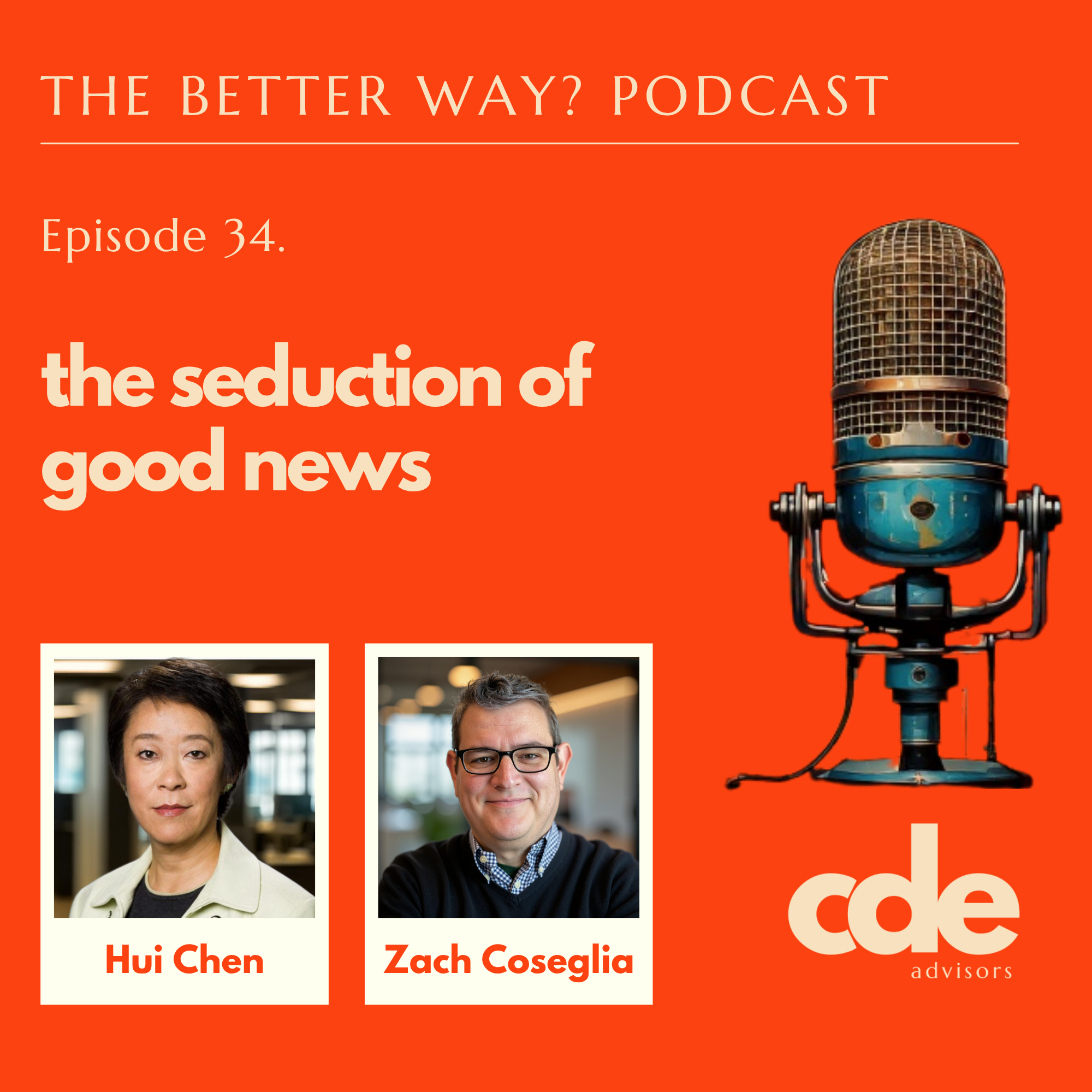
About this episode. What is the purpose of board and executive reporting? In this episode, Zach and Hui take aim at the traditional compliance report: the familiar mix of enforcement headlines, activity metrics, and reassuring conclusions that suggest everything is under control. They argue that too many reports are designed to make compliance look good rather than help leaders govern effectively, relying on metrics and assumptions that create the appearance of success without demonstrating real impact.
The conversation explores why the strongest compliance programs embrace curiosity, uncertainty, and difficult questions. Zach and Hui also discuss why outcomes matter more than activities, how "good news" can sometimes obscure meaningful risks, and why boards need insight rather than dashboards full of green indicators. Along the way, they offer practical ideas for creating more valuable board reports by shifting from activities to insights, from certainty to inquiry, and from reassurance to reality.
Who? Zach Coseglia + Hui Chen, CDE Advisors
Full Transcript:
ZACH: Welcome back to The Better Way? Podcast brought to you by CDE advisors. Culture. Data. Ethics. This is a curiosity podcast for those who ask, “There has to be a better way, right? There just has to be.” I'm Zach Coseglia and I am joined as always by Hui Chen. Hi, Hui.
HUI: Hi everyone.
ZACH: Today we are going to talk about board reporting, and I just want to set it up by sharing with you kind of a typical board reporting structure that I've seen. So, you start with a list of the scary enforcement actions—and you're probably describe them as a trend or a pattern, even if, maybe, they don't actually represent a true trend or pattern. Then you move on to the latest regulatory developments to set the stage for a risky, potentially problematic external environment. And then you move on to describing why either this applies to us, and therefore we need to act and we need to act fast and we need resources and we need people and we need attention to these issues; or you talk about why this just simply doesn't apply to us, why we're above this, why we're different. Then you start telling the internal story—this is where you share your and the internal data that tells some version of a story about your program. And then you end. And no matter what happened before; no matter what happened since the last quarter's presentation, you end by saying well everything's going well, we're good. We're good. Does that pattern sound familiar to you, Hui? It sounds like it does. And more importantly, does it make you nervous?
HUI: Yeah, I'm smiling here as you're describing the board reports that you and I both have seen hundreds of. And we also do a lot of work with our clients in helping to improve their board reports and when we do a program review it's one of those documents that are often provided to us. So that pattern…
ZACH: And it might actually be… it might actually be the single most important, the single most important document that we look at in the course of really assessing your program. It tells us so much about how you view your program.
HUI: Absolutely, I mean you know when we review a program we don't have to see all your policies. In fact, and this is the same approach I took when I was at DOJ reviewing compliance program, please don't give me your books and you know binders of policies and procedures. What you tell your board and your leadership team is really one of the single most telling aspects of your program. Because this is how, you know, this is how you're presenting your performance essentially to your critical stakeholders. So, the pattern that you describe is very, very familiar. It pretty much is the standard. It does make me nervous—for a number of reasons. So you referenced right from the start when people start talking about enforcement trends. Often those trends are made of two cases, maybe sometimes one. And what is not being shown are all kinds of developments that have not become officially resolved cases. So, there could be enforcement actions that are still being litigated or negotiated. And since you don't know about them, sometimes you do know about them, but most of the time you don't. You can't report on them. So let's say there are ten of the same similar cases. Eight of them are still being negotiated, might go away, and might result in very little penalty of significance—but you're not reporting on them. You're picking out the two out of ten ongoing cases and say that's the trend. So that makes me nervous because that is an inaccurate description of the trend. Then, here's the, everything else is going badly outside, but we're okay. That may be true, but what worries me is that conclusion is often not valid. That conclusion is often resting on a standard set of output metrics. And if you've been listening or reading us long enough, you know that we don't believe in output metrics.
ZACH: Or even not that, or even not that long, because we seem to . . . we seem to always come back to it, and I think for good reason, but we are beating this dead horse, nonetheless.
HUI: Exactly. Yes, absolutely, because just because you did a lot of training doesn't mean you have changed anything. Because you're not presenting any evidence that your training changed anything. Just because you issued a lot of policies doesn't mean anybody even understands them, or, you know, let alone following them, or people who violate them can expect consequences. We don't know any of those questions. We just know you put out a lot of trainings, you did a lot of due diligence. That really is not telling the board what it needs to know. So ultimately, it makes me nervous because it is not telling the board, or in the case of presenting to your executive leadership team, you're also not telling them what they need to know to govern, which is their job. And your job is to help them govern.
ZACH: Yes, yes. 100%. Let me say this too. I don't want to be misunderstood. I don't think folks are going about this in a deceitful way. I don't think folks are going about this in an attempt to intentionally miscommunicate the state of things. We're going to talk about what some of the drivers are for this, as we'll call it, the seduction of good news. But I don't think it's coming from a bad place. But it's still a problem that we deeply want to solve. Let me ask you this question though, Hui, before we get into all of that. And it really is the central question of our discussion today. What is the actual purpose of reporting to your board or your executive leadership team? What is the purpose of that exercise?
HUI: You know, we've never quite posed that question to compliance officers. And I really now am curious if we were to pose that question, what would the answers be? Because I suspect that we'll get some form of answers to say, you know, we want to show them that the program we are running is working. We want to justify our budget. Very important, right? To reassure them, whether it's management or the board of directors, that we've got things under control. So, this is sort of like, we see this as about our performance. It's like we get up on the stage and it's all about what we've done well and not well.
ZACH: Absolutely. And when you do that, when you do that, what you're actually doing is not reporting. What you're really doing is marketing.
HUI: Kind of.
ZACH: And I don't think that, I don't think that is the purpose of going to the board or going to executive leadership. It's not about proving your worth, at least not exclusively or foundationally.
HUI: Those are some of the sort of tributary reasons for your reporting, but I believe that your reporting, whether it's management or board, is to help them understand, to help them govern, like I said, to help them understand what is happening in the organization, to identify things that may need their attention, to give them insight so that they can make better decisions. That's why I think we are presenting there.
ZACH: So, is it possible then, Hui, that a report that makes the board feel good can actually be a failure?
HUI: Yeah, because if the basis of that feel good is not substantiated, then yes, you have just diluted them inadvertently into thinking everything is honky-dory, when there's actually reasons to be concerned and things that they can do about it.
ZACH: Well, let's start by digging a little bit into the psychology of why this problem exists. And I referenced this earlier, this idea of how seductive good news can be. And I mean, you hit on this a little bit already, but I think it starts with a very human desire to be viewed favorably. At the end of the day, yes, we have this bigger role, but we're still employees and sometimes ambitious people who live within an ecosystem and we want to be viewed favorably. As you said, we are always desperate for a budget. And I think that this plays into the thought process of compliance probably more than it feeds into the thought process of just about any other part of an organization, because compliance has a very difficult task and is often underfunded in pursuit of it. Underfunded, under-resourced, and what we're going to talk about today as we get to solutions is actually how leaning into uncertainty and leaning into an outcomes-focused approach actually is a much better way to justify your budget than to be seduced by good news. But I think that the bigger issue for us in the compliance world is less that we have bad news or evidence of ineffectiveness that we don't want to present or that we want to color in some positive light—and it's actually more, we don't know things that we should and need to know. You know, we talk a lot about, what do you do if your board asks you is our program working? And I think that the right answer for most organizations today is, here are three or four or five things that I can tell you, but there's a lot that I don't know in answering that question. And that fear, that discomfort with uncertainty is a big reason why the things that we're using are painting this wonderfully positive view because we don't have the full picture.
HUI: I think it's okay . . . because I think people are afraid to say, especially in that kind of setting, to say, you know, we don't know something because it sounds like I don't know something and that makes me sound stupid. When you point out that we as an organization, not you as an individual, do not know something, you need to follow that up with some kind of sort of suggestion or proposal about this is how we're going to find out, right? You don't just say we don't know something, we throw up our hands. But this is the, you know, here are the steps—this is something we don't know, important for us to know, and this is what we're going to do to find out the answers to this. And this is where I need your help in implementing those things that I want to do in order to find those answers. And you then can engage the board or the management in being interested in your question, having a role in helping you getting the answers to those questions. That’s a reframing that people need to position themselves for.
ZACH: Absolutely. Absolutely. I think that it's a way that you can actually get resources. You know, if you're sitting there in a room and the board is saying, I want an answer to this question, and your response is, okay, here's what I need in order to get you an answer to that question . . . you're gonna get a lot further than if you're just, you know, a thoughtful compliance officer who's like, I want that, but I don't have the resources. I need to get it. If you get the board saying, I need and I want this, it's gonna go a long way. Look, I also... I don't want to be too hard on compliance officers. I don't want to be too hard just on the people who are reporting, because I think some of the responsibility also sits with executive leaders and board members and others who are in that room. I don't think they are as curious about their compliance and risk management efforts as they probably need to be. I think that they probably give those compliance officers the feeling that . . . that positive discussion, that quick presentation, the let's check that box and be done with compliance, they give the impression that that's what they want and what they expect. And we want to see more curiosity. And I don't think it just comes from a place of like putting their heads in the sand. I think it actually on the part of the board and on the part of leadership, it comes from a place of not knowing what questions to ask.
HUI: Yes, I, you know, I love these analogies, particularly relating to healthcare, because I think healthcare is something that every human being thinks about, and certainly in regard to their own health. I think of the role of compliance officer kind of like that primary care doctor, right? So you go in for your annual check and they come back and tell you what are the things that you need to work on. That's your role, vis-a-vis the board. If you don't tell them, if you don't run tests, you just tell them your health is great. You're, you know, basically performing malpractice, right? Because what you need to do is to tell them, okay, so your cholesterol is high here. And we're not sure what it's driven by. It could be genetics, it could be your diet, it could be lack of exercise. So, here's what I propose that we do. This is what doctors do. And this is what compliance officers need to do, which is say, here are the signs that we're seeing. I'm not saying organizations don't have good news. Most of the time, I'd say 80%, hopefully, of what's happening is good. There's nothing wrong in talking about what's good about it. And again, think back to your doctor. They would tell you like, you know, your blood pressure is good. Do the same thing. Here are the things that we see as a potential risk. We need more answers before we can know how to treat this, but here are some steps we're going to take immediately. But ultimately, it's the patient that has to do the work. The physician doesn't do the work. Because the physician eating more healthy is not going to help you. It's going to help her, not help you, right? So I think that's the role sort of reversal in a way that we have to think because I think compliance officers walk in there as both the doctor and the patient right now.
ZACH: Yeah, 100%. I mean, I think that we, I don't think it's, there's a lot of things that we say that may be controversial. I don't think it's controversial to say that most compliance leaders feel like they're going to be evaluated based on the perceived quality of their program and what really needs to happen is that leaders, business leaders, the CEO, the C-suite, they should be perceived and evaluated based on how well the program is working. It's them, it's their people that are ultimately the ones that are creating or mitigating risk, which is it to say that it's not a shared responsibility, but like that's how you really . . . We talk a lot about partnering with the business and, you know, where accountability really should lie. And in a lot of cases, I feel like it's a talking point rather than a really embraced behavior. When it's a really embraced behavior, you as a compliance officer can say, here's what I'm going to do or what I can do, but then I'm handing it off to you and you got to do it, folks . . . Let's talk a little bit about this paradox that we sometimes see in compliance. The strongest programs often find more issues. That's a kind of paradoxical concept. What do you think?
HUI: I think that's true. And the issues can vary in their severity. But I would almost frame it in a slightly different way. The strongest programs are curious. So, therefore, they find more things because they're constantly asking questions. And sometimes, the answer is not what you hope it to be. So they dig more and they find more answers. And in that way, they find more issues, but I do believe they find more issues in their early stages. So they find smaller issues that have not festered into bigger issues. And that's good news. You would rather have small infractions that you can deal with and learn from than major scandal that blows up.
ZACH: Yeah, yeah, I agree. I lean into that idea of curiosity. And I think that it's not that the strongest programs find more issues. I think it's that the strongest programs are led by folks who are there to answer questions before things become issues. They are, we talk a lot about like, you know, wanting a seat at the table. The strongest programs are ones where the compliance team has earned their seat at the table and are sitting there in the room as risky decisions or as new business strategies that potentially carry risk are being discussed. And they're there to provide an important perspective, not to say no, but to help manage and mitigate that risk going forward.
HUI: Exactly.
ZACH: All right, so let's talk about output metrics. It's a trap. It's a… it's a trap.
HUI: Our favorite topic. It is a trap.
ZACH: Why don't you describe, not that we haven't done it before, but just for the purpose of our discussion today, why don't you describe what that traditional compliance dashboard looks like?
HUI: Yeah, I'm gonna voice over for all the, who are listening because you can all do this, right? The 99% training completion rate, the 100% policy attestation rates, the hotline posters, the campaign, communications campaigns, number of audits completed, number of due diligence, percentage of third parties who's gone through due diligence. Yeah. That's… those are the standard metrics.
ZACH: And look, I mean, sometimes it's 95% training completion. Sometimes it's 97% training completion. Everyone loves a number that starts with 90 something.
HUI: That's right, yeah. Nine, yes.
ZACH: But if I were a board member and you presented to me something that said 95% completion. All I'm seeing, is why are 5% of people not taking the training? You think you're presenting, you're seducing them with a positive message, but I think that a curious board member is going to look at that and actually say, this is terrible news. How is 5%?
HUI: Or it may not be, right. It may not be terrible, but that's what we don't know, right? Because, but you're right, because my curiosity would always be drawn to the outliers. And when you're presenting high 90s percentile of something, I want to know about the outliers. Because this is something that should be 100%, right? So why is it not 100%? So, let's dig in. Maybe you have a particular business unit that is just really resentful of training, or maybe that business unit feels like the training that you have presented is not relevant to them. Right? There are a lot of explanations for the 3%, 2%, 5%. That's not in the good news category. But they do not necessarily mean bad news. They mean a learning opportunity. In the very least, you learn about your organization.
ZACH: 100%, but when you present a metric like 95, 97, 99%, and you then are communicating to the board that the success of our program is communicated in terms of our ability to compel people to take a training, that's what you're telling them. You're saying that our success is measured by our ability to compel people to do this thing. And then I, as a board member, say, but there's this meaningful percentage of people who you haven't even been able to compel. So, if you're not good at compelling them to actually do something that is compulsory, what confidence do I have that you're able to actually shape behaviors in the way that we need in order to be a successful program. I don't think that that kind of thinking is what's actually happening anywhere, but that's how I would sort of see it if I were sitting in that boardroom. You're not just communicating a message of actual training completion when you use that metric. You're telling the board something about how you view success. And so all of the questions that you just articulated are valid and important and reflective of a curious mind approaching a metric. But what you're essentially saying is none of that matters. The thing that matters is our ability to compel.
HUI: Yeah, I mean, I think, you know, what always worries me is when they start linking these kind of percentiles to effectiveness, right? So 99%, 98% of people have done their compulsory training and therefore were effective. And this is where I always say effective at what? You're fairly good. I mean, you're 90%, 98% successful in compelling people. But considering that it's a compulsion, you failed at 2%. But are you... air quotes, effective at changing behavior, enhancing understanding as a result of those training, that metric tells us nothing about those.
ZACH: Nothing. Not at all. All the things that you just referenced, that sort of describing for us the typical compliance dashboard, they’re activity, they’re not impact. And so that board question that often goes unasked is, can you prove the program works? So Hui, I know you love a good analogy. So, like, take us into the worlds of, I don't know, healthcare . . . medicine to help us understand, once again, the difference between an outcome and an output metric.
HUI: Yeah, I mean, you know, we've done so many of these and some of the old ones that, you know, I always go back to is in, you know, we all, if you watch any of the medical shows on TV, you know, surgeons wash their hands. And this is, I actually have read quite a bit about the history of, you know, why all the surgical procedures have developed the way they are. And washing hands is an output. So, this is they wash hands, not for the sake of washing hands, so that they could result in fewer infections. And hospitals do not track how many times doctors wash their hands. That's not a metric that I know hospitals to be tracking. They do track the general practice, and they do want their surgeons to wash hands. And by the way, some studies have shown surgeons have been among the poorest practitioners of hand washing, actually, ironically. But hospitals do track the outcome of surgical infections, post-surgical complications. They result from a number of factors, right? So it's not just surgeon washing hands. There's all kinds of other things that are operating, that are happening in the operating theatre that contribute to complications and infections. But ultimately, they track the outcome, which is how many infections and complications do we have. When you have those, you can start back-tracing what's contributing to that. And that really does apply to the work we do. When something happens in an organization, there's a host of factors that contribute to that. But if you're only tracking how hard you tried to prevent and detect those behavior, but not how good you are actually at preventing and detecting those behavior, you don't really know if you're successful or not. You don't even know for sure whether what you did contributed or didn't contribute to a certain behavior.
ZACH: Yeah, yeah, I mean, I think that what unfortunately we see too often is this dangerous kind of analytical leap, this correlation isn't evidence problem, and it's making claims or presenting insights that actually aren't supported by data. So one that we've talked about a lot already is training's working because completion is 100% or 99% or 95%. That is not telling us whether the training is working. It's telling us whether the training is being taken. Speak up culture is a great one. Our speak up culture is improving because we have more hotline calls, because more people are reporting things. Well, that's a hypothesis. That may be one of the reasons why we're seeing more calls. But it may also be because things are kind of falling apart or because there are problems in certain areas. And behaviors that are not being checked in real time and therefore resulting in people needing to come to compliance. Or it may be happenstance. It may not actually be a reflection of the culture at all. Or the one that's really problematic is saying things like, well, we haven't been subject to any enforcement inquiries or, you know, we haven't had any negative regulatory audits—and for that reason, our program is working well. Well, you may just be lucky. You may just not be on someone's radar. Something may just not have popped yet. These are the kind of correlation without causation, leaps of logic that we often see in reporting to the board, that can be really dangerous. And the solution to it is, as you said, curiosity and framing these things as hypotheses and then looking for the data to try to understand why something happened, not just inferring the why based on whatever may have been most readily available or what may have made you feel best about the situation or may position you to be able to provide a positive message to the board.
HUI: I mean, let's, you know, I think the important thing for us to remember is, given what we talked about, our very human desire to want to do a good job, especially when we're presenting to stakeholders, we tend to think of these presentations to boards and executive leadership teams as some kind of performance. And the flaw in that thinking is the board and the executive leadership team are not there to applaud you. They are not audience in your, on your, you know, for your Broadway show. They are there to govern and you are there to help them. So, you need to let them know that there are certain things that require their attention. There are certain trade-offs that they might have to make in their decision making. When they're making decisions, they need information you provide so that they can make those decisions in an informed way. And by presenting everything is sort of, you know, everything looks good, not only you're not really helping them in doing their jobs, you're in a way failing to engage them. Because if everything's good, what do you need them for? Right? So, this is what, you know, I think, in part, accounts for the reaction we often hear from board members. Which is, a big yawn when it comes to the compliance reports. Well, you know, you look at those 98%, you know, figures and you're like, okay, well, that's nice. Okay, let's move on to the next topic because this clearly doesn't need our attention.
ZACH: Yeah. Yeah, it's the so what factor. It's overcoming the so what factor. So to kind of reframe what directors maybe actually are worried about or what the board and executive leaders should be worried about or the kinds of questions they should be asking, it should be things like, what aren't we seeing? Where are we vulnerable? What assumptions are we making that could potentially be wrong? What are the emerging risks that are developing and how are we responding to them? How is our program working? But the most important, I think the single most important thing, and we hit on this earlier, that you can do when presenting to these functions is being open about what we don't know.
HUI: Exactly. I think that may be the most...
ZACH: And that's deeply . . . it's so uncomfortable.
HUI: Yes.
ZACH: It's so uncomfortable. But this is how you not only gain credibility, but it's how you get those valuable resources that you're missing. Because when you start talking to these folks about things that you don't know that really matter to them, they're going to want answers. And it may be that they don't actually care and they don't want to, they don't want the answer. And then at least you know that you can move on to the next thing.
HUI: Exactly. I think the important thing is to remember that we we're talking about here is the big we, not we compliance. It's we, the company, right? We, you know, you, for example, your board is about to make a big decision about whether to go forward with a merger, an acquisition, a massive reduction in force, whatever it is. What information do they know as they evaluate this decision, try to make this decision that would help them understand what are the risks in there? So, you know, you can point out that, you know, yes, as you move forward in this acquisition, these are some of the things that you need to, you know, we as an organization need to keep an eye out for. And these are the things that we don't yet know. And now, once they're curious, now you have engaged them, you have convinced them of the need to know. Now you can say, give me the budget and personnel that I need to help you know, find the answer to that.
ZACH: Yeah, yeah. Well, look, what we don't want to do is just talk about the problem without providing solutions. So let's talk more about what a better board report looks like. What are some solutions to the challenges that we've just articulated? And I think the first, again, to beat this dead horse, shift #1, folks, is get yourself on the path to outcomes. You're going to still report your outputs, but let's work toward presenting outcomes. Instead of, here's who we trained, or here's how many policies we created, or here's how many certifications were signed, how many third parties we diligenced. Instead of telling that story alone, let's ask, what changed? What behaviors did we observe? How did we perform? What do we know about the success or not of our efforts to shift behaviors in one direction or another? What do we know now about our culture and how it speaks to the potential risk and challenges that we have that we didn't know before? What changed?
HUI: Yep. The next shift to think about is shifting from reporting activities to reporting insights. So instead of saying, here's what we did and running list of activities, report on what we have learned. What insights do you, the board, need to understand what is going on in the organization? Are there emerging sales pressure patterns that we're seeing? Are we seeing locations with elevated risk indicators? Are there gaps that we're identifying between policy and reality? Are we seeing conduct issues driven by incentive, new incentive structures that's been put in, for example? So those are the things that we learn through the work we do. And, you know, what I find interesting is when we talk to compliance officers in helping them work on their board reports, they have these insights, but somehow they don't feel like they should share with them. This is, you know, back to how we started today is that desire to present the rosy picture. So somehow if I have discovered that the new incentive structure seems to be driving some misconduct issue. That becomes one of my talking points that I just keep to myself—as in not putting it on a slide. And I would talk about it if I'm given the time and opportunity. But on the slide, I'm going to show that, you know, all of the 90%, 90th percentile stuff. So insights are there. What we're trying to do is to convince you, compliance officers that sharing these insights that you have actually make you look good, not bad.
ZACH: That's right. Which really leads to shift #3, which is getting comfortable with discomfort, and more specifically, embracing uncertainty rather than just trying to give a message of certainty when there is a lot of uncertainty. So we've talked a lot about this, but one of the ways that you do this is by thinking of some of these things as leading indicators rather than ultimate answers. If you're seeing a shift in behavior, whether it's a spike in potential misconduct or errors in your monitoring, or you're seeing a spike in the number of reports or a dip for that matter, rather than just concluding, well, this is what it must mean—again, either because it's the answer that's most readily available, or it's the answer that you feel most comfortable with, or it's the answer that you feel most comfortable talking to the board about. Rather than doing any of those things, what we really need to do is be curious and to ask why. If we see a change in behavior, if something spikes, if something dips, if something gets on our radar, whatever that blip may be, our first reaction should be why. And once we think we have an answer to that, we should probably ask why again and ask why again. We should be digging into the unanswered questions that are sitting before us rather than reaching for the most convenient answer. And sometimes I think a board report may feel a little uncomfortable, and that's okay.
HUI: That's definitely okay. So, because again, remember, it's not about you as an individual. It is about the organization. And so long as you're being candid about what we do know and what we don't know, you would have the credibility as part of that resolution of concerns process. And I think the final shift that we want to talk about is shifting from the very intuitive green, yellow, red sort of audit color format, traffic light format, to a more context rich narrative because a lot of compliance risks are not . . . just not as simple as traffic lights. So, you know, we have things that may be ethically concerning, but legal. Something that is corrosive to our culture, but legal. So is it red or is it yellow or is it green? You know, it's not that simple to classify them and embracing some of that complexity beyond the colors. We're not saying completely don't use the colors because they're intuitive. They have earned sort of a very established place in board reporting these color schemes. But don't stop there.
ZACH: What I want to add to that is that slides and dashboards are a huge part of the problem because folks don't know how to use them effectively to communicate a visual story. And in fact, I think there's an argument to be made that your board report might not even need a dashboard or slides if you're able to provide something as a pre-read. That instead, you go into that board meeting and you tell them a story about your program, about risk, about the things that you want them to be asking questions about, and where you need additional attention and support from your leaders. There's a way to do that really effectively. And I think back about a year ago, we were presenting to a board about the results of a full program analysis that we'd done. And we did not use slides. And everyone's mind was kind of blown, so much so that there was actually pushback to, well, let us put at least one slide up on the screen while you're talking. I don't think there was a single person in that room who didn't understand the message that we communicated, who didn't get every question that they had answered, who walked out of that presentation feeling like they missed something because they were simply spoken to and had a conversation with us rather than being walked through methodically a deck that frankly, in most cases, isn't telling much of a story to begin with. And this is coming from a guy, by the way, for those of you who don't know me, I could probably create just about any dashboard or just about any slide. But I would rather have a discussion with you when the topic suits it. And I just think that's really holding back.
HUI: Yes, he can.
ZACH: And there's nothing that...
HUI: I want to clarify, yeah, I want to clarify a couple of things. On that board presentation, the only people who insisted on putting at least one slide up was the compliance officer. It was not the board. The board was totally fine. And 2, it wasn't that we didn't have slides. The slides had been sent as pre-read.
ZACH: Yeah, no, the board were fine. The board was fine. That's right.
HUI: And they were beautiful slides, and may I just say, that Zach created. They're beautiful slides with contents full of insights, but they were sent as pre-read. So when we presented, we were just able to look at the board members in the eyes and say, we're happy to answer any questions you have, right? So, you know, we gave literally like, I think, under one minute introductory preview of the highlights of the findings. And then we just had a discussion.
ZACH: All right, so Hui, I think we've reached the end of our time. What are some of your closing thoughts for folks? What do you want folks to take away from this discussion?
HUI: I think you want to ask yourself a question that if someone stopped you from presenting to the board or the management, what would the board be missing in terms of insights. So, if you don't go there anymore, you don't submit any presentation, what insights would your audience, the board or the executive leadership team, be missing? If your answer is they don't know how many trained people took training, you have a problem. But if your answer is, if I don't go, they would lose visibility into real conditions that influence misconduct risk. Then you're creating value, and they would know that too. That's what I want to leave you with. How about you?
ZACH: 100%. Boards don't need, well, boards don't need reassurance. They need reality. There's no value in trying to manufacture comfort. What they need is truth. And sometimes the truth in our world, more often than not, that truth involves some amount of uncertainty. All right, Hui. It's been great, as always. Thank you.
HUI: Love our conversations. I hope you guys out there love it too.
ZACH: And thank you all for tuning in to TheBetter Way? Podcast. For more information about this or anything else that’s happening with CDE Advisors, visit our website at www.CDEAdvisors.com, where you can also check out the Better Way blog. And please like and subscribe to this series on Apply or Spotify. And, finally, if you have thoughts about what we talked about today, the work we do here at CDE, or just have ideas for Better Ways we should explore, please don’t hesitate to reach out—we’d love to hear from you. Thanks again for listenin.