Ep.33: Curiosity Isn’t Dead (but your culture might be stifling it)
Remember, you can always listen here or follow us on Apple Podcasts or Spotify. Either way, thanks for supporting us.
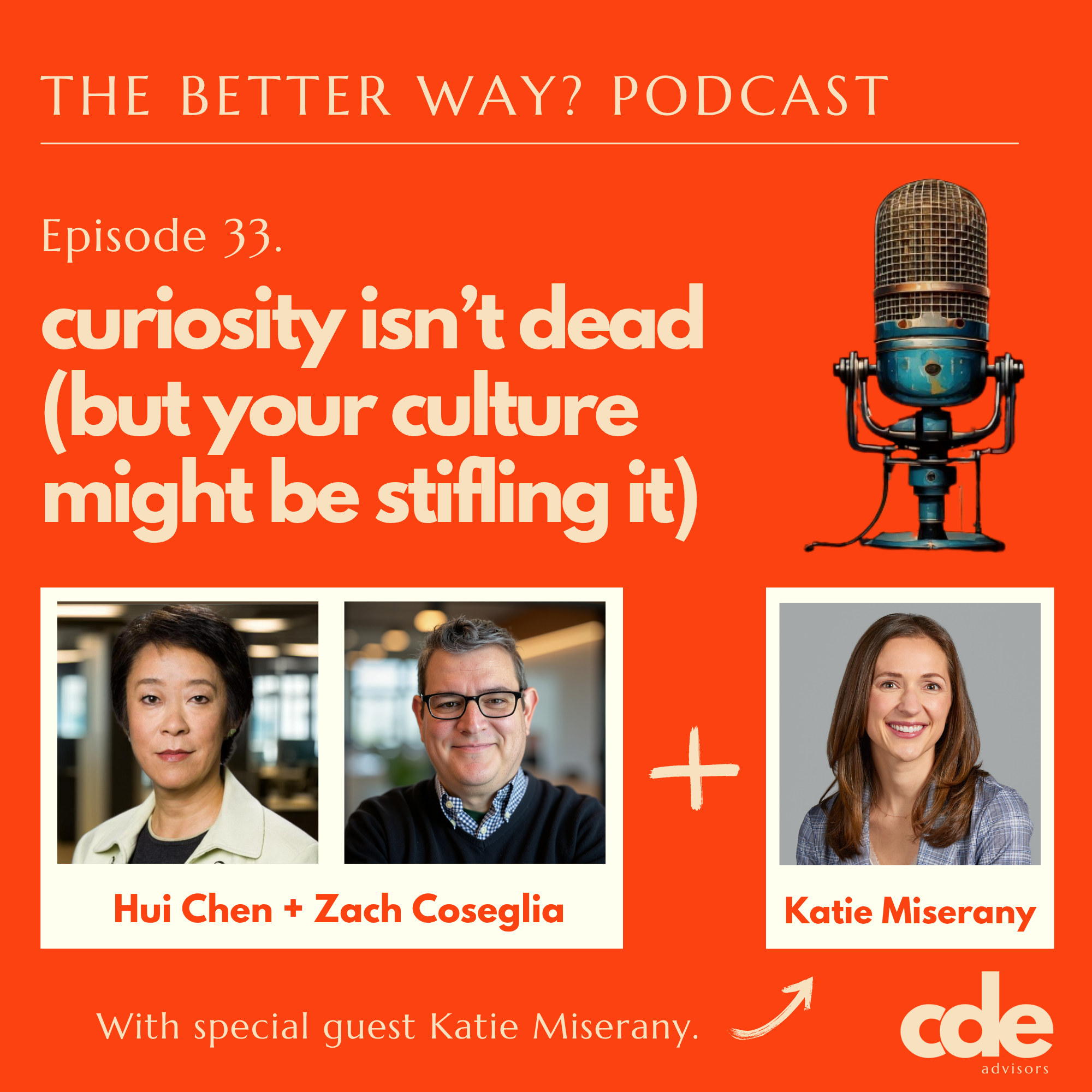
About this episode. Nearly everyone believes they're curious, yet far fewer feel empowered to ask questions, challenge assumptions, or explore new ideas at work. In this episode, Katie Miserany, Chief Communications Officer and Global Head of Marketing at SurveyMonkey, joins Zach and Hui to discuss the company's State of Curiosity 2026 report and what it reveals about the gap between individual curiosity and organizational culture. Together, they examine why employees hesitate to ask questions, challenge assumptions, or slow down long enough to surface better ideas.
Katie also discusses how leaders can avoid mistaking speed for progress, why better inputs matter more than faster outputs, and how organizations can create psychological safety, meaningful brainstorming opportunities, and stronger cross-functional connections. Along the way, we explore AI, surveys, leadership, creative thinking, and what it really takes to build a culture that rewards learning instead of certainty.
Who? Zach Coseglia + Hui Chen, CDE Advisors; Katie Miserany, SurveyMonkey
Full Transcript:
ZACH: Welcome back to The Better Way? Podcast brought to you by CDE advisors. Culture. Data. Ethics. This is a curiosity podcast for those who ask, “There has to be a better way, right? There just has to be.” I'm Zach Coseglia, and I am joined as always by the one and only Hui Chen. Hi, Hui.
HUI: Today, we're really going to focus on that curiosity part of the Curiosity Podcast. And we have with us Katie Miserany, who is the Chief Communications Officer and Global Head of Marketing of SurveyMonkey, where she oversees both communications and marketing, driving the company's global strategy and brand storytelling. She's here to talk to us about a report SurveyMonkey released on the State of Curiosity 2026. Welcome, Katie.
KATIE MISERANY: Thank you. It's great to be here.
ZACH: We're really excited for this discussion and we're so thrilled to have you. Before we get into that report and talk more about curiosity, we're going to ask you the question we ask our guests at the outset of every episode, which is, who are you? Introduce yourself to our listeners. We've heard your sort of formal bio but describe yourself in your own words. Who is Katie?
KATIE MISERANY: I would say I'm a person who tries to make complicated things really simple. And that's important because I'm a working mom. I've got two little kids. Nobody has all the time in the world but especially working parents. And so that's something I just really focus on. I would also say I'm a person who has a compulsive need to have fun at work. And that combination makes SurveyMonkey a really good fit.
ZACH: Amazing. I love that.
HUI: I love that.
ZACH: And it's a great preview. It makes me very excited to do the Better Way Questionnaire with you at the end, because I think there'll be some fun stuff in there. But Hui, where should we start?
HUI: Well, why don't we start as we always do by defining curiosity?
KATIE MISERANY: In our report, so, you know, the State of Curiosity report really came out of a conversation internally on the team. We are in this really lucky position where we can do research on almost anything at almost any time. So, 2 million people take a survey on SurveyMonkey every single day, and we can get the opportunity to ask them other questions. So, we've done surveys on everything from like retirement plans to AI or like secret office behaviors, what do remote workers really do during the day? But we were talking about something that would be a real contribution and something that the market really needed from SurveyMonkey, curiosity really came to the fore. What's interesting about it, though, is like, in an academic circle, curiosity is just like a desire to close an information gap—very cut and dry. But when workplaces talk about curiosity, and this term has been bandied about so much recently, where if you ask business leaders, what are you hiring for in the age of AI, they're like, I just want people who are curious. And what workplaces mean when they talk about curiosity is this instinct to push deeper, to truly understand, to wait and sit and not knowing until a better answer emerges, to question assumptions, to have action tied to their curiosity. So that is one of the first things that we draw out in the report is there's this difference between just trying to close an information gap, which, you know, a Claude, a ChatGPT can help you do that, and real curiosity in the workplace, which is about taking information and making better decisions and evolving people's thinking around you.
ZACH: I love that. I mean, and we're going to talk about AI. I say that reluctantly because I feel like it's hard to go to any space anywhere without talking about it, but we are going to talk about it. But what I love about that description or definition of curiosity is it really underscores the humanity in curiosity. It is an innately human thing to do. And for that reason, really can't be replaced, maybe augmented, maybe enhanced, maybe supported by AI, but really can't be replaced by AI. We're going to dig into the specifics of your research, but let's start by talking about what your research methodology was. What did you do to get us to this report? And then we'll talk about some of the findings.
KATIE MISERANY: Yeah, so as I mentioned, 2 million people take a survey on SurveyMonkey every single day, and we were able to ask a subset of those people. So, we ended up with almost 2,000 respondents on the study, all knowledge workers, and this series of questions that helped inform the study. And then we went out and did some reporting. So, we talked to, you know, professors and management at Duke. We were able to talk to Anne Morris, the legendary Anne Morris, who along with Francis Fry runs the Leadership Consortium. And so, we were able to flesh out some of the findings and really dig into what's going on from there.
ZACH: And what was the headline? What was your main take away from the research?
KATIE MISERANY: I think the stat that jumped out at all of us was that 95% of workers call themselves curious. So, to your earlier point, this is such a human thing, almost universal, and everybody feels like they're curious. But in the study, only 30% of workplaces really strongly rewarded that curiosity. And that felt like a huge gap to us.
HUI: That's so interesting because I have to say, in my experience, I don't feel like 95% of the people that I have worked with in, you know, in any form, I would describe as curious. I would probably put it a significantly lower percentage. So, I do think it's interesting.
ZACH: Well, andHui, and what I thought was interesting about that is, it speaks to a lot of the things that we see when we do surveys, or we do questions of a large stakeholder group: is that delta between how people perceive themselves . . .
HUI: Yeah. That's exactly it, yeah.
ZACH: And how they may actually be. I'm not surprised that 95% of people said that they were curious. I suspect that some meaningful percentage of those people maybe aren't or have a different definition of curiosity than what, Katie, you just shared with us.
KATIE MISERANY: Well, it's interesting because even in…so we divided in the study companies into high-capacity cultures and low curiosity capacity cultures. And even in the high curiosity capacity cultures, people reported being afraid to ask questions. And so, I do wonder, you know, yes, there's always that, you know, it's like, people overinflate, like how many times they eat vegetables or work out when they're answering, because it's like, well, the best version of myself does this all the time. But I do think there's a way in which our workplaces are smothering this instinct or creating a culture in which it's not . . . people perceive that it's not okay to be leaning into their curiosity. So, if they're afraid to ask questions, they feel like it's going to slow the team down, they'll look stupid, something like that, then I think you could see the expression of curiosity being a lot lower than that self-reported number as well.
ZACH: Yeah, that makes a lot of sense.
HUI: Yeah, I actually want to say that perhaps Zach and I sometimes, you know, we remark that we notice an absence of curiosity in workplace. And perhaps that absence is an institutional form rather than individual form. But let's dig into… let's dig into your report a little bit. Actually, not a little bit, a lot. So, let's start with just the concept of curiosity as a skill. Most people tend to think of curiosity as a soft skill, like creativity. But the report calls curiosity an organization’s, “Single greatest competitive advantage.” Why is that?
KATIE MISERANY: Yeah, and we had this definition in the report of curiosity capacity, which I just referred to. It's the practiced ability to stay open, ask sharper questions, and keep learning alongside AI. And I think if you think about where all innovation and all problem solving is born, if you don't have that practiced ability to stay open and ask sharper questions. And then, you know, the AI question aside, that's just this thing that's accelerating all the bad behaviors that we have inside of organizations. How can you ever come up with a fresh idea or a new concept? And so, I think in this age when all workers used to be measured on the output of what they did. So, I produced this document, I made this slide deck. The things that you're creating are kind of the benchmark for how valuable you are to the organization. It's how you're presenting your ideas. It's what you do. Now, Claude can make me a slide deck that on the surface of it seems pretty good, pretty fast. So, where does the value move in the knowledge worker chain. And it’s really about the inputs, more than the outputs. And, as we think about curiosity, it's one of those core moments when you either decide to seek more inputs or you don't, and that's where we think about competitive advantage being formed in this mode. And, again, part of the reason that we wanted to do this study is, as we were talking to our customers or our peers or at conferences, this word was everywhere. I want to hire curious people. I need more curiosity in my organization. And so, I think leaders kind of instinctively know it, but now it's getting more formal or entrenched inside of organizations that are trying to move fast and do something different.
HUI: Is there anything that has surprised Survey Monkey about the link between curiosity, capacity, and organizational performance?
KATIE MISERANY: It's a good question. When we first started out with this study, we had this hypothesis that we were like, we're going to find that curiosity is dead. It's gone down inside of organizations. The AI is blunting this very human instinct. And frankly, what surprised us was that headline that just everybody's like, no, I am curious. But there are things getting in the way of expressing that curiosity. I think that was the biggest surprise to us. We thought we were going to have a different finding there. And it was just so overwhelming how many people were like, I still express this need or this desire inside of myself.
HUI: And what would you say is the difference between low and high curiosity workers? How can you tell from one from the other?
KATIE MISERANY: I'm curious in your experience of people that you've worked with or folks on your team, how have you experienced a really high curiosity person?
ZACH: Well, I… yeah, I think the behaviors that I think about when I think of high curiosity people are people who just first and foremost ask questions, which I think is baked into the thesis and the findings of your report. It's people who have ideas. I feel like people who are curious naturally also have ideas because they're sort of looking at maybe the status quo or they're looking at whatever is in front of them and saying that may be the way it is, but is that necessarily the way it has to be? That's very much baked into the way we think about our podcast, but that Better Way has a question mark at the end. It's not that we have all the better ways, it's that we're on a search for them. Hui, what do you think?
HUI: I agree with everything you've said, but I would also add the willingness or the readiness to confront and question assumptions. I think too many people, too many times, assume things without even realizing that they're making assumptions. They make statements that just, you know, things that we always talk about. People would, you know, we talk to leaders and they'll say, yeah, we have a strong organizational culture. Well, what makes you think that? And then they stumble.
ZACH: Or what they actually say is, I feel that we have a strong organizational culture, or I think we have a strong organizational culture. And those to us are always dead giveaways for an insight that may not actually be supported by data.
HUI: There we go, yes. Yes. Evidence.
ZACH: Evidence, yeah.
KATIE MISERANY: I would agree with all of that. In the report itself, we identified certain behaviors. So, we named them these cool things like the efficiency squeeze. Every company now is just like “we need to be more efficient.” The landscape has changed. It's not just growth at all costs. So, efficiency is a big deal but that can translate in a meeting context to, you know, they ask at the very end, there's two minutes left. Anybody have any questions? You have to be so brave to raise your hand at that moment and be like, have we thought about, do we, are we anticipating, you know, to be the person who's going to slow the team down or, and if questions are perceived in that way, as slowing down in a negative way, then you know, you're going to end up with a low capacity culture.
Another one is what we called the scroll reflex. And we actually went back and forth quite a bit on the name of this one. But we connected to this idea of, if you're scrolling social media, your vibe in that moment is like, boring, boring, oh, interesting, boring, boring. But you're not actively engaging with the content that you're seeing. It's a very passive stance and just like a reflex of accepting what is in front of you. And sometimes maybe you'll get mad and like write a comment or something, but that scroll reflex when paired with AI, can be really dangerous for curiosity. I listened to a podcast where Brene Brown called this being smitten with what's written. So, AI can write it in a way that makes you like, ooh, this sounds great. But are the ideas there? Is it factually accurate? What are the assumptions the AI is making? A lot of people will coach you to like ask it. What assumptions are you making? I want you to make obvious to me when you're guessing or making an assumption. And so that scroll reflex of accepting what the AI pumps back out to you can be really damaging to an organization or a person's curiosity capacity.
And we tried to bring all of these to life, these like low curiosity capacity moments, in a pretty silly activation where we live streamed a 90-minute meeting performed by a group of improv actors who were supposed to be doing the go-to-market for this made-up [product]. So, it was like this completely made-up company with a completely made-up products they needed to take to market. And we gave all the actors a role to play. So, there was the like executive who's really bombastic and his opinion is loud and proud, and he doesn't want anything to be slow. Then there was a person who was just obsessed with AI and every single question. He was like, let me ask ChatGPT. Let me see what Claude thinks. Let me… And then there was a person who was just a naysayer who would just say no to everything without asking probing questions or moving through the motions. And when they first pitched it to me, the team, and they said it was 90 minutes, I was like, does it have to be 90 minutes? And they were like, I know, but when you look at that, aren't you like, oh, I know. And so, it was this way to like make people feel what it's like to be confronted with the efficiency squeeze, with the scroll reflex, with some of these behaviors that are squashing curiosity in the workplace today. And the comments were like, this is so awful and feels so real. Because the conversation was swirling and nobody was making any progress. And there was no… I'm sure when you go into organizations that say things like, I feel like we have a great culture, you're asking probing questions, but you're also coaching those leaders on how to ask good questions in the organizations. And you just couldn't watch this meeting without feeling like, if somebody was just asking the right questions here or questioning those assumptions that we would be making more progress together.
HUI: When you said you have this video of a 90-minute meeting, my head start to hurt because I used to attend, with one of the organizations that I work with, I used to attend a weekly 90-minute meeting with some of the most senior people in this organization. And I honestly just either get completely enraged by everything that's going on. It's all the things you're talking about, the naysayers, the people who are stuck to their position, no matter what other people say, they bring it back to their position. The chief executive who basically wants everyone to agree with him, the people who get up and just tell stories with . . . tell stories not in an insightful way, but in a way that is basically anecdotal to supporting their positions. My health is so much better now that I've decided to stop going to those meetings, but I feel the pain.
KATIE MISERANY: Yeah. I have to send you the like sizzle reel. I won't make you watch the whole 90-minutes of it because it's terrible. But they did such a good job, this troop. They really embodied the spirit of that meeting that we've all been in where you're just like, what is the point of this? Who is it serving? What are we advancing here? You know?
ZACH: Let's talk a little bit more about each of these three kind of pillars of your research. So, you've got the AI middleman, the scroll reflex, and the efficiency squeeze. Let's start with the AI middleman. I want to share with those folks listening a couple of quotes from your research that really resonated with us. One of them was, “AI allows us to impersonate leadership without doing the hard work of actually leading.” And another is “the workers with the most colleagues to call are the ones least likely to call them.” And there you're referring to leaders. So, talk to us a little bit more about what your research uncovered about the use of AI by leadership as compared to individual contributors.
KATIE MISERANY: That quote, the first one was from Anne Morris about impersonating leadership. I don't know about you two, but I have found this to be true, that a lot of executives at the VP and above level have ideas or a point of view. They have enough experience and background to be pretty dangerous when it comes to the use of AI because they're not using it to ask, you know, what does this acronym mean? Or really simple things like that. They're saying like, I think we should move into the healthcare vertical, build me a plan, you know, and like what it comes back with, again, back to Brene Brown and being smitten with what's written, sounds pretty good. It's that impersonating expertise or leadership or some real gravity there. And too often, I think they'll just take it and ship it and be like, look, we should go on the healthcare vertical without the people who are going to make that happen, having deep engagement with that idea and pushing on the ideas. And of course, then doubly dangerous because it comes from an executive. And so, there's a real strong pull to be like, yes, ma'am, yes, sir, I will go and do this now. And it ends up, the study found that that ends up creating a ton of rework, doing it again. We didn't question the assumptions up front. And so, we projected some version of a revenue uplift from this that is not going to materialize. And we've invested all the resources and now it's not going to come, right? Or other kinds of mistakes that happen when you have that misalignment up front. But I did find that, I don't know if it was surprising to you, but I found it troubling that executives are using it much more than people at the lower and middle levels in the organization. Have you seen that in your work as well?
ZACH: Well, it's interesting because I think most leaders don't want to talk about it publicly. So, I feel like it's not something you see unless you, you know, happen to have more than just a traditional professional relationship with someone. I think that it doesn't surprise me that folks may be using it for those purposes, that folks may be using it to question their own ideas or to shape their ideas, but I don't see them talking about it. I don't see them… I don't see them advertising it. And I understand why they wouldn't, too.
HUI: But what I am not… one reason why I'm not surprised is that we have always found that listening is the most underutilized tool in the corporate space. And this to me is another form of not willing to listen. Because when you're seeking, when a leader is seeking input from his or her team, it's not really just because, purely, you know, I want to get your ideas and choose not to use it or use it. It's listening. It's listening to what their ideas are, why they're thinking that way, what are the contexts and the assumptions and all the facts that have given rise to those opinions? That listening exercise is actually where you learn to lead, I think. And by not listening, so now instead of listening to people, you go to an AI platform and listen to AI. That deprives, really, your team's ability or opportunity to be heard. So, you might get some great ideas. You might get ideas that are better than what your team can generate, but you lost all of those things that you could have gotten from actually listening to your people. That's sort of what I'm thinking.
KATIE MISERANY: I think we lose a lot. Yeah, yeah, we lose more in the absence of the person-to-person connection than I think people are realizing quite yet. It's interesting, too, on the quality of ideas. I think we cited in the report that one study, it wasn't our study, but found that when a researcher asked people to come up with unique ideas, if the person was just a person and no access to AI, they came up with a very broad set, a wide range of creative ideas. And the people assigned to work with AI all came up with the same ideas. It's like, I don't think it is there yet where you could actually get more creative ideas without a lot of, again, it's the inputs. So, if you're prompting it to give you better inputs or pushing back or questioning its assumptions and like really getting in there and messing around with it, then you're probably getting a really flat, bland sameness out of it. Even though it sounds great, it's written well, you know?
ZACH: Yeah. Let's talk about the scroll reflex. One of the quotes that stood out to us there was, “workers spend hours a day in social media feeds, engineered to serve up the next thing and keep them scrolling, and the habit follows them to the desk.” Nothing has ever rung more true to me. And yet, I'd never really seen it put that way before. Talk to us a little bit more about how you found this and what we can do to stop that reflex.
KATIE MISERANY: We have that great chart on that page that says 58% of people are like, a colleague is a more reliable way to check than AI is, but 22% still accept AI anyway. And it's like we know better. We know what better looks like, but we're opting to not interrogate it. I think this is kind of one of the biggest remedies that businesses can push on. I will say when we started using AI at SurveyMonkey, we invested in AI inside the product a long time ago because we've got these almost 30 years of survey data. So, we'll help you ask questions better based on the past repository of what we got. So, we've been doing that inside the product for a long time. But when we adopted the tools in-house, the policy was you should be using this because this is the future of the workplace, but you need to use it with transparency. So, you would see people inside the organization saying like, Claude and I produced this. So now we know, okay, we have like a shared point of view of like, Claude has been involved in this or ChatGPT and I made this, Gemini and I made this, and here's what I found and here's what I'm questioning, but it created this great opening to interrogate the doc differently. And sometimes I would even give people feedback where I'm like, that's great. Can you ask Claude to make it shorter? Because the volume of stuff I'm being asked to review now, a single human cannot do in this amount of time. But I do think that opening the door to challenge by saying something like, hey, I ran the projections, I used Claude for this part, here's what I think we should do next. And then I can really focus in on like, with transparency, what was AI generated and what needs maybe further conversation or dialogue.
ZACH: Let's talk about the efficiency squeeze because I feel like it all sort of flows together. And the efficiency squeeze, to me, we've talked about it in different words on this podcast many times before. Tell us more about what your research showed, and then let's talk about what we can do as one part of many organizations to try to push back on it.
KATIE MISERANY: Yeah, the data here was 4 in 10 people stay silent to avoid slowing things down. And almost 3 in 10 say they don't speak up to avoid more work or because meetings move too fast. There's moving too fast, I can't, I don't have a chance to speak up and talk. And I think that's really depressing because you have the right people on the call are in the room and they're not contributing to their fullest. And I think that's what community and belonging and all of those soft topics that we used to talk about were about how do you get people to contribute to their fullest so that you're maximizing the human potential of your workforce. And again, if it used to be about your output and now it's about your input, I think organizations are just a little bit slow to adapt to that right now. In the marketing world, this is about, yes, we could all produce ads probably like 100 times faster than we used to. But I just have to question to what end? Because if my ad looks exactly like your ad, because we're both using the same technology and like sort of different inputs to produce it, then what is the point? Because the ads are out there faster and there's more of them, but they are not actually going to perform better because of the sea of sameness that has emerged in tone and look and feel and where you can just kind of sense something was AI produced and how off-putting that can be when it's being served to you as something that was curated or, you know, created by humans.
I went to this CMO breakfast fairly recently and we were talking about AI slop. And I admitted, I was like, there used to be slop before AI slop. There was slop. And the example I used was my very first job when I was still in college, I was a ghostwriter for a ghostwriter who wrote for executives. And so, I'm 20 writing for a person who's writing for a person, and like, whatever I made must have been slop because I didn't have any perspective. I had no like real helpful nuggets of information to offer the world. I was just doing it because it was my job. The difference was I couldn't do it at the scale it is being produced now. You still needed a writer to be like in there typing away to produce the slop of yore. But now the AI slop is at such a scale, it's unavoidable that brands need to do something to stand out and to really reclaim an identity in this space of the homogenization. One of our themes for our marketing team this year has been to be relentlessly helpful and relentlessly us. And the two sides of that are about like, do not produce something if it does not create value for someone. So, I don't want slop. I want content that's going to help somebody do something, be better at their job, listen better, be a better leader, but it needs to be helpful for us to produce it. And then it has to be relentlessly on brand, just us, only we could do it or say it. And that's where something like that 90-minute live stream improv meeting comes in because it is . . . that is only something we could do because we wrote this report, which is something that the market needed from us. So, it's this like relentlessly helpful, relentlessly us lens that I think is how you start to break through some of this.
ZACH: And kudos to you for hiring an improv troupe and actually creating a real human, you know, video, because most people probably would have . . . if they even had that idea, they would have just had AI create it. And we would have all known and it would have been far less effective. And, you know, you're helping the hard-working improv actors out there who don't get enough love, which I like.
KATIE MISERANY: And they were so good. It was so good in like the worst, most cringy way.
ZACH: Totally. I mean, absolutely. So, I have one more question for you before we move on from the efficiency squeeze. And it is, it's really the thing that kept coming up for me as I was reading this report and thinking about our conversation today, which is, if you've got all these people who think that they're curious and who want to be curious at work, and you have leaders who are saying that one of the characteristics that we look for most is a curious employee. What do you think leaders mean by that? Or what do you think they are misunderstanding about curiosity, if the experience that people are actually having is, as your research showed, not one that necessarily prioritizes curiosity as much as maybe leaders think they prioritize curiosity.
KATIE MISERANY: Yeah, we include in the report this set of behaviors that are characteristic of a high curiosity capacity organization. And so, they're very specific in, you know, what you can do. So, it's like stay open, ask sharper questions, keep learning alongside AI; and there's like specific questions or behaviors that you could tie in there. But I think what it comes down to, because a lot of the… so under ask sharper questions, it's like, who would we need to hear this from to know if it's true? That kind of question is an early question in the project that you need to make the space for to go slow to go fast later on. So, I think it comes back to that idea of inputs versus outputs, where a lot of leaders want to get through the early stages of the hard early stages where you have to ask these questions to really understand where you're going and make sure there's alignment. And so, they go fast in the wrong direction and get to the wrong outputs faster and easier than ever. And then they're disappointed in the results. And it's like, do we have the wrong talent? Do we have the wrong systems? What's going on here? The questions that they're asking at the end, it's like, well, it's the quality of the questions you're asking at the beginning. That are dictating these outcomes.
ZACH: Yeah, love that. Yeah.
HUI: So we're going to dig into those curiosity in action. But before we go there, just on the tail of that question about what should leaders do, I'm curious whether as a result of this research, you as a leader have changed or implemented any practice.
KATIE MISERANY: I have. I've been on an eliminate recurring meetings sprint in my life. You know that reaction to the 90-minute meeting. I had one. I had a 90-minute Monday meeting where we went through the results of the last week and it's now an hour bi-weekly, and we still fill out the doc weekly, but we can have a richer conversation with two weeks’ worth of data. And just even thinking about a lot of the prescriptive actions were like, the workers need more time to brainstorm. They need more time to do creative ideation. And I don't know if others feel the same way, but my calendar was just wall to wall meetings. Any ideation or like work that I was doing was happening after hours in like the second shift. And so, creating more space in the week and trusting that the team is going to get what they need on an ad hoc basis. So, create a short-term meeting cadence or like, hey, can you hop on a quick call? I want to chat through this with you without needing like to be handheld into like we have a quarterly sync, and I save my conversation with you up until the quarterly sync. No, like if I have something now, let's talk about it now and make sure we're moving forward. So, I've definitely re-examined the calendar and what I was asking people to show up for on a regular basis.
HUI: That's great to hear. I mean, I think that's something people can take away right there. Let's go back to curiosity in action. To your definition of curiosity as the practice the ability to stay open, ask sharper questions, and keep learning alongside AI. So, let's start with staying open. You have this call out box in your report, and I'm looking at page 14. It says, the next time your team is coming back from a pause, a reorg, a launch cycle, a return from leave, a post-mortem, a new fiscal year, and I might add, coming back from summer, don't assume the people, problems, or market are the same as when you left. Pick one program, process, or customer segment you've been running on muscle memory and ask the people who live inside it 3 questions. Tell us about those questions.
KATIE MISERANY: So, the first one's, what's changed since we built this? The second one is, what do you need from it now? And 3rd is, what would you stop doing if it were up to you?
HUI: I love those questions. And, you know, I really, truly cannot say enough that people don't make that kind of pause and ask those fundamental questions. We deal with so many organizations that just run everything on muscle memory, from their biggest programmatic components to what they do day-to-day. You have an example in the report about a company that sort of came back from COVID. Feel free to talk about that example or some other examples that may not be in the report as an illustration to this practice.
KATIE MISERANY: Yeah, yeah, we have a couple of our customers featured, and this one is about UI Kai, which is a Japanese American senior community center. So, they closed during the pandemic, and as they were reopening, some teams would have just done what they always did, but as everyone knows, everything is different since the pandemic. There is no business as usual from 2018 to now. And they did a great job asking questions like this. And instead of rushing back to those old habits, they were asking what it would take to bring in, you know, it's a senior center, so they wanted younger seniors or like some of the events were getting flooded with women members, but where were the men? What events could they host to draw those men in? And so, they were able to run a survey to capture the feedback from the community about what was needed now in the community. What could they provide that would be helpful of service to the community now? And so, they kind of rebuilt their operations around that. And it's interesting reflecting on this story, but also something you said earlier, Zach, around executives don't talk about using AI, but we were able to get them to answer this survey, anonymous survey, admitting it. And that's where we get that data that like they're doing it more frequently than the younger people. And surveys are a really great way to get people to admit things, even though sometimes they overinflate things like, yes, I work out every single day. You can also get them to admit to some of these habits or behaviors or thoughts that maybe they're not comfortable sharing more publicly. And when you send out a survey in this mode of like, hey, what's changed for you? What are you missing in your life? What kind of community are you looking to see? Those are kind of private thoughts, and it was just a great way for them to draw that out.
HUI: Actually, let's talk about surveys a little bit. I mean, this is your business. And like you said, they're a really great way to, you know, get some of those private thoughts out. They're also great to finish those unfinished sentences that you talk about, like, here's what we need to find out to know for sure.
KATIE MISERANY: Yeah.
HUI: We hear companies sort of pushing back on their own curiosity by saying things like, you know, but we don't want to do another survey. There's such survey fatigue. We just, you know, another survey is just not what we're going to do. What's your take on that and how do we get past it?
KATIE MISERANY: We see survey fatigue really when people don't do anything with their responses. So especially inside of an organization, if you send out a survey that's like, hey, I'm not getting the curiosity that I was hoping for in our post-mortem, so I'm going to send it as a survey and it's anonymous and you can answer exactly how you think. So, it's like a way to step into mining for conflict or curiosity without people having to be identified with what they're saying. And then you do nothing. They never see it. There's no feedback loop about . . . so why bother? You know, I think that's what we see more and more where like you'll send hundreds of surveys out; or I mean, we don't have hundreds, but we're SurveyMonkey because we send a lot of internal surveys. And it is a best practice to publish the dashboard. We always have that kind of transparency of like, we did the employee engagement polls, here's what people are saying. We did the open enrollment survey, you know, what benefits do you value? What are you looking for next year? And this is how it led to the decisions that we made. Now people are like, well, I really care about X benefit. I'm going to take that survey next year and I'm going to take it seriously because I've seen that the executive team is using it to make decisions. And that's really what it comes down to is, do they believe you're going to take action based on the feedback that they're giving?
HUI: I cannot tell you how much that resonates because we've always said to organizations that if you're going to ask people things, whether it's through a survey or a focus group or other means or just a one-on-one, if you're going to ask people something and not do anything with it, you're better off not asking. Because it's disrespectful. You ask them to put their time and effort into answering your questions, and then you act like you have just completely ignored all that. You may not have, right? But if they can't see it, that's basically what they interpret. So that is just fundamentally disrespectful, and it really generates distrust. So why should I give you this time next time?
KATIE MISERANY: Yeah. And sometimes it's about survey design. So maybe you ask the wrong questions and that's why you can't really use the responses. But we also have, like I said, we've been doing this a long time. So, we have these like proactive, like, did you mean to ask this question? Because this question is going to be better than the question, you're asking to really try to help make sure that the questions people are asking who our customers are going to get them some great results.
HUI: Yes, we definitely see that too. Now, let me, let's go back to your second component of curiosity, which is ask sharper questions about turning, and this is something we referenced earlier, people make so many assumptions. How do we turn some of those assumptions into critical questions?
KATIE MISERANY: Yeah, so the suggested questions here, who would we need to hear this from to know it was true? What will we need to see in the data to confirm it? And how would we know we were wrong? And the example here is the wonderful art supplier, Sakura, makes amazing stationery and pens and all kinds of things. But we were working with the American affiliate, which is Sakura of America, and they were trying to figure out how to make their products resonate with the North American market. And I have been to Tokyo to a Sakura store where it's like 4 floors of pens. And on the top floor, there are pens that are like $750. And the product manager in the Sakura of America store was like, I don't think Americans are going to go for a $750 pen. The example in the story is a $100 pen. But instead of just saying that, she ran a study. And then she could come to the team with some data that's like, I asked the American market, and this is how many people are willing to buy a pen for $100, but this is probably our price point sweet spot. And so how can we architect the offering for the American stores that's going to match the market that we're trying to move into? And so, it's just a really good example of, she wasn't just asking like broad, like, oh, what do Americans want in a pen? Which could have been one direction, but she had a specific thing she was curious about, a hunch, an inkling, and she wanted to know who would I need to hear this from? What would I need to see in the data that would make it true so that I can have confidence in this decision? And that's the study that she went and ran.
HUI: You know, we encourage organizations to do this all the time. And, you know, in our space, in the corporate governance and compliance space, there is longstanding assumptions that are basically never questioned. So, when something bad happens, let's do more policy, let's do more training, let's put in more controls. Rarely have we seen anyone conduct studies to test those assumptions. And the few times they've been tested, critical questions have been raised about the ability of these interventions to actually achieve what they were supposed to achieve. So, I, again, cannot tell you how much this resonates. So, Zach, any thoughts on that?
ZACH: No, I mean, we talk all the time about evidence-based. And Katie, what you just described was a perfect example of someone seeking out evidence to support their hypothesis. And boy, how much better all of the things we do would run if there was more of that.
KATIE MISERANY: Yeah, that curiosity up front, better outputs on the other side. It might feel slow in the beginning, but that's how you move faster.
HUI: All right, the third one is keep learning alongside AI. And here I'm going to also read from your box before you introduce the questions. Before you ask AI to generate something that will shape how your team works, a value, a policy, a process, a message, run 3 checks. What are the three checks?
KATIE MISERANY: Am I asking AI to replace a conversation I should be having or to make sense of one I've already had? Whose input is missing from what I'm about to feed the model? What would I learn if I asked the people closest to the work the same question first?
HUI: Brilliant. And do you have some examples for us?
KATIE MISERANY: Yeah, our example here is an internal one. So SurveyMonkey, we had an exec team off-site, and we wanted to take a look at our values. But instead of being like, here's a slide with the values, what's wrong with them? We started with a conversation about the . . . we asked some key questions. So, it was like, who really is a model employee at SurveyMonkey? What are the behaviors that they do that make them so great to work with? Or if you were going to try to convince your best friend to come and work here, what would you say to them? Someone you deeply care about, like, here's the opportunity, here's what it's like to work at SurveyMonkey. And in that conversation, I took all the notes and everything. And then I kind of synthesized it and came back and said, I think our values need an update because they don't perfectly reflect that conversation that we had about these people who are so incredible to work with or what that experience is like that we're trying to give to our employees, the employee value proposition. But then we didn't want this to be a tops-down exercise. And you don’t want to give the pen to all the employees and be like, “Hey, what do you think the values should be?” So instead, we did a series of surveys. And we started with one to the broader kind of like leader group, so directors and above at the company. And we asked about two different equally valuable ways of operating. So, for instance, this was all from a Harvard Business Review article about dilemmas, using dilemmas to shape your values. And it was super helpful.
ZACH: We know that article well, actually.
HUI: We love that.
ZACH: Yeah, absolutely.
KATIE MISERANY: You like that one? Yeah. Yes, it's so good. We turned it into a survey. So, we had these scenarios and it was like, the famous one in that article, I think, is an executive is departing because they're dealing with substance abuse issues. So should you be transparent about the reason for their departure. So, this is like kind of like radical transparency inside the organization, or are there times when to protect the individuals involved, you refrain from that level of transparency? You could defend either of those traces. So, it's not like the traces were like one good one and one bad one, but like who do we want to be and what choices do we want to make? So, we sent that survey around to the Director Plus group. And then we said, what do you think would be best for SurveyMonkey and what do we do today? And that's where we started to see there were values where we were pulling apart. Like what would be best for SurveyMonkey is not what we do today. And that came through loud and clear. So, then the next round of surveys, was a response to some drafted values that would get us a little bit closer. And then we did a broader survey to the manager population on like the next turn on that. And so, our score inside of our organizational health study that we do annually on the question of like, SurveyMonkey's values match its culture, jumped 23 points in the positive after we did that exercise, which really was just about bringing more people into the camp to help make the decision, but in a very structured way. It wasn't just like, what do you think about our values? We were really mining for more insight than that.
HUI: Love, love that whole approach.
ZACH: Absolutely. And it's a perfect example of what you described as sort of the antidote to survey fatigue. I mean, that's a wonderful story of how the input that you received from people actually turned into action at the end of it.
HUI: So we're almost at the end. We could talk about all of this forever. So, before we go to the better way questionnaire to get to know you better, I'd love for you to just quickly tell our audience a little bit about the key interventions for building curiosity capacity, and then perhaps leave with a final word about what is the one practice organizations should stop doing or start doing immediately.
KATIE MISERANY: Yeah, our suggestions are that you build some brainstorming infrastructure. So that's because more than 3/4 of the workers in the study say they just want more opportunities to brainstorm with their colleagues. And I think remote work, hybrid work has made this more difficult. And so, finding ways to create that in their work week. Second, this has been a topic forever, but how do you create psychological safety for everyone? And like I said, you can start with surveys if your team isn't ready and they're not giving that direct input, but you really need to move to a mode where people are not afraid to be asking questions. How do you model that? How do you make that a regular part of your workplace? And the last one is to make cross-team connections routine. So, I think it was Steve Jobs who talked about at Pixar, like architecting random connections where people are bumping into each other in the office and that would create more creative ideation because of the like disparate groups coming together and rubbing up against each other. I think all of these are great. It's maximizing the potential for this curiosity capacity inside your organization, but if you could only do one, the data would tell you it's about the brainstorming, but I think what would make a good brainstorm is that psychological safety. So as a foundational underpinning, you need to understand what's preventing your team from being able to ask questions and working on that so that you can get into more rigorous, more thoughtful, more expansive brainstorming at the company.
ZACH: Terrific. Let's do the Better Way? Questionnaire. And the first question is actually a choice of one of two to answer. So, if you could wake up tomorrow having gained any one quality or ability, what would it be? Or you can answer, is there a quality about yourself that you're currently working to improve? And if so, what is it?
KATIE MISERANY: I would want to wake up tomorrow with some kind of musical talent. I have none. I would like some.
ZACH: I love that. That was Hui as well. Hui wanted to be an opera singer.
HUI: Yes.
KATIE MISERANY: Same.
ZACH: Okay.
HUI: Which I so clearly am not equipped to do… to be.
KATIE MISERANY: I just want to get through karaoke. Like I would take that. I don't need to go opera, but I have no musical talent.
ZACH: For sure.
HUI: Yep. So, the second question is also a choose one of two. Who is your favorite mentor? Or you can tell us who do you wish you could be mentored by?
KATIE MISERANY: Ina Garten, the Barefoot Contessa. I love her for her recipes and her cooking and everything, but I read her memoir and I actually think she is an incredible leader and boss. And two things she said that really stuck with me is that as a leader, your employees need you to be clear and they need you to be happy. And so, if you are in a bad headspace or whatever, she's like, take a walk, get yourself right, because they are going to feed off of that energy and you need to kind of stay steady. So yes, Ina Garten.
HUI: Interesting. We're going to get along great. Music and the cooking.
ZACH: Definitely. All right. What is the best job, paid or unpaid, that you've ever had?
KATIE MISERANY: My first paid job ever, I was an intern in my dad's office, and this was a very long time ago, but I did very menial tasks. So, I remember sitting on the floor and putting checks in order by number, like thousands and thousands of checks in order by number. And it taught me two things. One that I wanted to go to college and have a big career and not have to do that specific role ever again. But what I remember about that summer is like he would take me to lunch every day and we rode the train together and it was just this like really wonderful memory. So that really stands out to me.
HUI: Oh, that echoes with me because my first internship was in a law office where I was, part of my job was to sort of straighten out the files in the garage, which I called the zoo because it smelled like a zoo. So, next question is, what is your favorite thing to do?
KATIE MISERANY: Take my kids to the beach.
ZACH: Well, that may dovetail with the next question, which is, what is your favorite place? And you can define place however you'd like.
KATIE MISERANY: Favorite place? I mean, I actually think, so in our house, when we read books, my kids have bunk beds and so you can't like crawl in there with them. But we read books in my bed, so we call it the big bed. And I think my favorite memories are just like kids and dogs piled up in there reading a book. So weirdly, I would say it's the big bed at book time.
HUI: Oh, what makes you proud?
KATIE MISERANY: Gosh, I get really proud of my team when we're brave, when we're bold and we're taking risks and we're not playing it safe.
ZACH: I like that. What e-mail sign-off do you use most frequently?
KATIE MISERANY: Thanks, exclamation point.
ZACH: You and me both. And it's funny, I just saw someone did like a LinkedIn video the other day where they said that best regards was like passive aggressive. It was basically you saying, you know, I hate you. Yeah, exactly.
KATIE MISERANY: I asked Claude, we did it all as an executive team, but we said, like, analyze my Slack messages for the last three months and give me some feedback. And my feedback was lovely. Of course, that's not the part I paid attention to, but then it was like, when everything has an exclamation point, nothing is exciting. You need to use these exclamation points differently. And I was like, whatever Claude, I'm in marketing. Emojis, exclamation points, I'm here for it.
ZACH: Yeah. Love it.
HUI: Okay, speaking of marketing, what trend in your field is most overrated?
KATIE MISERANY: It's an easy one, but just this sameness. I think any brand that has fallen in love with how slick you can appear to be and isn't trying to do something different or differentiated is super boring to me.
ZACH: Yeah. All right, last question. What word would you use to describe your day so far?
KATIE MISERANY: Reflective. It’s been a reflective day, yeah.
ZACH: Love that. Love that. That's a very… a curious person would be reflective, I think.
HUI: Wonderful.
KATIE MISERANY: Yeah.
ZACH: Well, thanks, Katie. Thanks so much for joining us. It's been a great discussion. As Hui said, we could keep going and we'd love to have you back.
KATIE MISERANY: Yeah, I would love that. Thank you for having me. It's been a wonderful hour.
HUI: Thank you.
ZACH: And thank you all for tuning in to TheBetter Way? Podcast. For more information about this or anything else that’s happening with CDE Advisors, visit our website at www.CDEAdvisors.com, where you can also check out the Better Way blog. And please like and subscribe to this series on Apply or Spotify. And, finally, if you have thoughts about what we talked about today, the work we do here at CDE, or just have ideas for Better Ways we should explore, please don’t hesitate to reach out—we’d love to hear from you. Thanks again for listenin.